


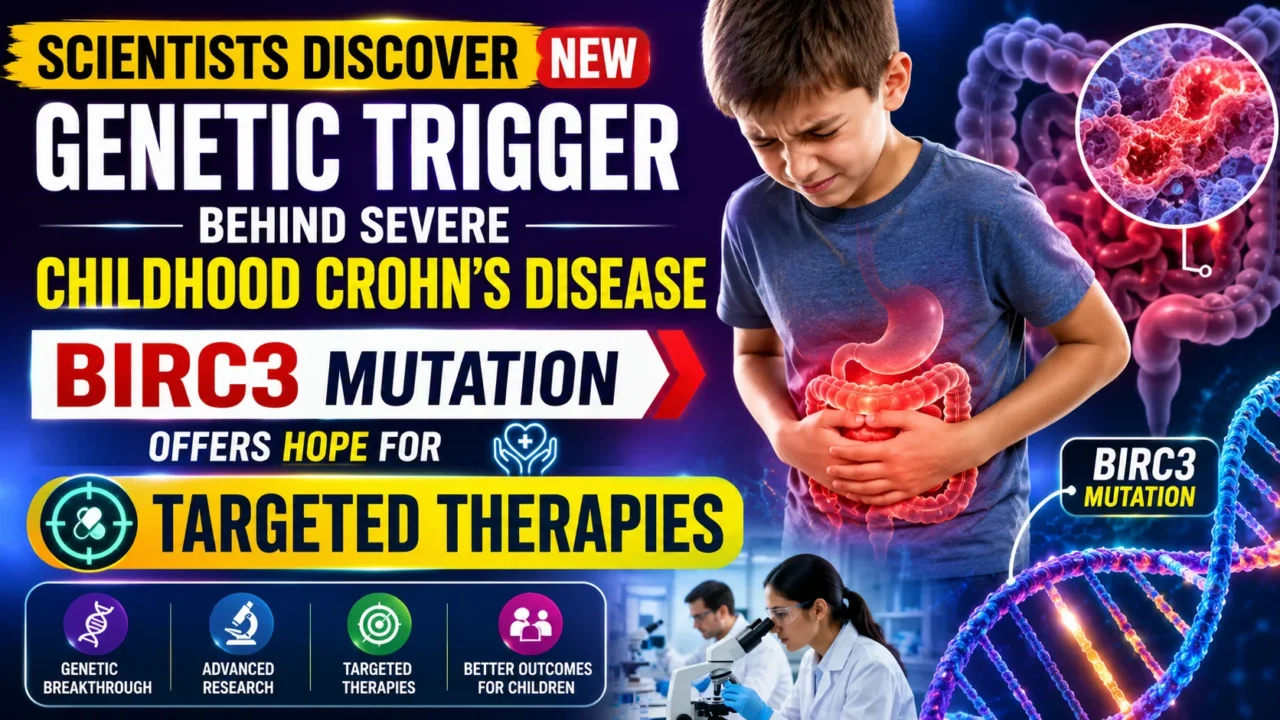

A major international research collaboration has identified a previously unknown genetic cause of severe childhood Crohn’s disease, providing new insights into the development of inflammatory bowel disease (IBD). The groundbreaking study, published in the journal Gastroenterology, reveals that harmful mutations in the BIRC3 gene can trigger a rare but severe form of Crohn’s disease. The discovery could significantly improve early diagnosis and accelerate the development of precision treatments targeting the underlying disease mechanism.
What Is Crohn’s Disease?
Crohn’s disease is a chronic inflammatory bowel disease (IBD) that causes persistent inflammation of the digestive tract. Symptoms often include:
- Persistent diarrhea
- Severe abdominal pain
- Weight loss
- Fatigue
- Blood in stool
- Poor growth in children
Although genetics and environmental factors have long been associated with Crohn’s disease, many cases still lack a clearly defined genetic cause.
International Research Team Behind the Discovery
The study was led by researchers from:
- Ludwig-Maximilians-Universität (LMU) Munich, Germany
- The Hospital for Sick Children (SickKids), Toronto, Canada
The project was conducted under the VEO-IBD Consortium and included scientists from:
- Germany
- Canada
- United States
- China
- Japan
- France
- Spain
- Saudi Arabia
The multinational collaboration enabled researchers to identify extremely rare patients carrying the newly discovered mutation.

BIRC3 Gene Identified as a New Cause of Childhood Crohn’s Disease
Researchers discovered that harmful mutations in the BIRC3 gene cause a rare inherited (monogenic) form of Crohn’s disease.
Key findings include:
- 14 patients from 10 unrelated families carried disease-causing BIRC3 variants.
- The mutations resulted in severe, early-onset intestinal inflammation.
- Advanced genetic, transcriptomic, proteomic, and laboratory analyses confirmed the biological impact of these mutations.
This represents one of the few clearly identified single-gene causes of very early-onset Crohn’s disease.
How Do BIRC3 Mutations Cause Disease?
The study found that the loss of normal BIRC3 function disrupts the RIPK1 signaling pathway, a critical pathway involved in regulating inflammation and cell survival.
As a result:
- Intestinal epithelial cells die excessively.
- The protective lining of the intestine becomes damaged.
- Harmful bacteria and inflammatory molecules enter the intestinal tissue more easily.
- Chronic inflammation develops and persists.
This mechanism explains why affected children develop severe Crohn’s disease at a young age.
Why Is the RIPK1 Pathway Important?
The discovery suggests that the RIPK1 signaling pathway may play a much broader role in inflammatory bowel disease than previously recognized.
Researchers believe that:
- The same pathway may contribute to common forms of Crohn’s disease.
- Drugs targeting RIPK1 could potentially treat both rare genetic cases and more typical Crohn’s disease patients.
- Future therapies may become more personalized based on a patient’s genetic profile.
Potential Impact on Diagnosis and Treatment
The findings could transform the management of childhood inflammatory bowel disease by enabling:
Earlier Genetic Diagnosis
Children with severe, unexplained Crohn’s disease may be screened for BIRC3 mutations, allowing faster and more accurate diagnosis.
Precision Medicine
Instead of treating only symptoms, doctors may eventually target the specific molecular pathway causing inflammation.
New Drug Development
Pharmaceutical companies may focus on developing therapies that regulate the RIPK1 pathway, offering more effective treatment options with fewer side effects.
Importance of International Collaboration
Rare genetic disorders often affect only a small number of patients worldwide, making research difficult.
This study demonstrates how international collaboration allows researchers to:
- Identify rare disease-causing genes.
- Share patient data across countries.
- Validate findings using advanced laboratory techniques.
- Accelerate the discovery of new therapeutic targets.
Without global cooperation, identifying such rare mutations would have been nearly impossible.
Why This Discovery Matters
This research not only uncovers a new genetic cause of severe childhood Crohn’s disease but also provides valuable insight into the biological processes driving intestinal inflammation. By identifying BIRC3 as a critical regulator of the RIPK1 pathway, scientists have opened the door to improved genetic testing, earlier diagnosis, and the development of targeted therapies that may benefit both rare inherited cases and the millions of people living with Crohn’s disease worldwide.
Recommended Products