



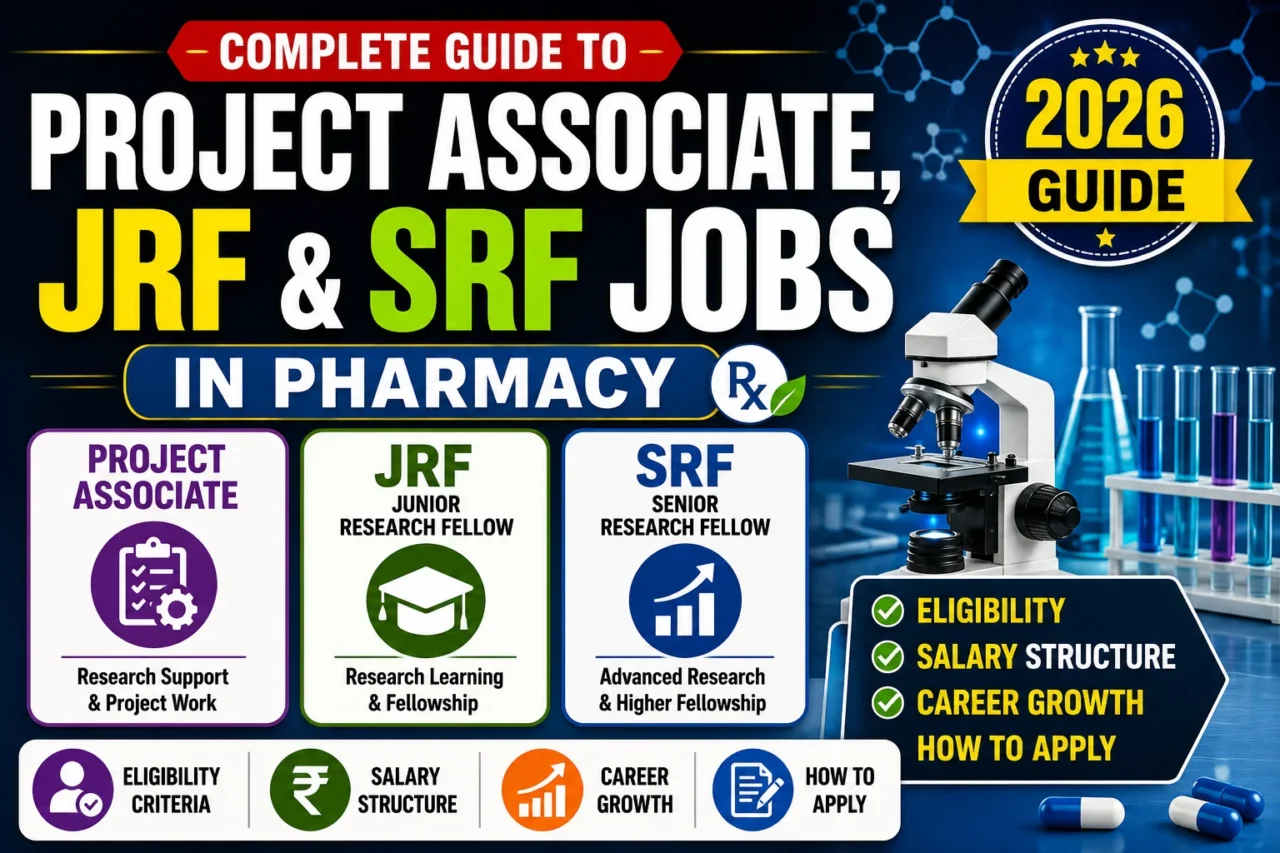

Project Associate vs JRF vs SRF in Pharmacy – Which Research Job is Best?
If you’re a B.Pharm, M.Pharm, Pharm.D, M.S. (Pharm), or Life Sciences graduate, you’ve probably come across job titles like Project Associate, Junior Research Fellow (JRF), and Senior Research Fellow (SRF) in recruitment notifications from CSIR, ICMR, IITs, NIPERs, AIIMS, DRDO, DBT, DST, and various universities.
Many pharmacy graduates are confused about the difference between these research positions, their eligibility, salary, career growth, and which one is better.
This comprehensive guide explains everything you need to know about Project Associate, JRF, and SRF jobs in Pharmacy.
What is a Project Associate?
A Project Associate is a research professional appointed for a specific funded research project. The position is contractual and generally available under projects sponsored by DST, DBT, CSIR, ICMR, SERB, BIRAC, and other funding agencies.
Project Associates assist in:
- Laboratory research
- Drug formulation development
- Pharmaceutical analysis
- Cell culture studies
- Animal experiments
- Clinical research
- Data analysis
- Scientific writing
Eligibility for Project Associate
Generally accepted qualifications include:
- B.Pharm
- M.Pharm
- Pharm.D
- M.S. (Pharm)
- M.Sc. (Relevant Subjects)
- Biotechnology
- Life Sciences
- Chemistry
Some projects require:
- GPAT Qualified
- GATE Qualified
- NET Qualified
Others recruit candidates without any national-level examination.

Salary of Project Associate
| Position | Monthly Salary |
|---|---|
| Project Associate-I | ₹25,000 – ₹37,000 |
| Project Associate-II | ₹28,000 – ₹42,000 |
Salary depends on:
- Funding agency
- Qualification
- Experience
- Whether the candidate is NET/GPAT/GATE qualified
What is a Junior Research Fellow (JRF)?
A Junior Research Fellow (JRF) is a research fellowship position primarily intended for candidates pursuing higher research, including Ph.D. programs.
JRF positions are funded by agencies such as:
- CSIR
- UGC
- ICMR
- DBT
- DST
- SERB
- DRDO
- AIIMS
- NIPER
Eligibility for JRF
Usually requires:
- M.Pharm
- Pharm.D
- M.S. (Pharm)
- M.Sc.
In many institutions, candidates must qualify one of the following:
- GPAT
- CSIR-NET
- UGC-NET
- GATE
However, some institute-funded projects recruit JRFs without GPAT/NET.
JRF Salary
According to current funding norms:
| Fellowship | Monthly Stipend |
| Junior Research Fellow (JRF) | ₹37,000 + HRA |
HRA is provided according to institutional rules.
What is a Senior Research Fellow (SRF)?
A Senior Research Fellow (SRF) is a higher research position generally offered after completing two years as a JRF or to candidates with relevant research experience.
SRFs independently conduct research and often supervise junior researchers.
Eligibility for SRF
Candidates generally require:
- M.Pharm
- Pharm.D
- M.S.
- Relevant research experience (usually 2 years)
Some projects directly recruit experienced candidates as SRF.
SRF Salary
| Fellowship | Monthly Stipend |
| Senior Research Fellow (SRF) | ₹42,000 + HRA |
Project Associate vs JRF vs SRF
| Feature | Project Associate | JRF | SRF |
| Qualification | B.Pharm/M.Pharm | Mostly M.Pharm/Pharm.D | M.Pharm + Experience |
| GPAT/NET | Sometimes Required | Usually Required | Preferred |
| Salary | ₹25k–₹42k | ₹37k + HRA | ₹42k + HRA |
| Research Level | Entry-Level | Ph.D. Level | Advanced Research |
| Ph.D. Opportunity | Sometimes | Excellent | Excellent |
| Experience Required | No | No | Usually 2 Years |
Which Organizations Recruit?
Major recruiters include:
- CSIR Laboratories
- ICMR Institutes
- AIIMS
- IITs
- NIPERs
- DRDO
- DBT Institutes
- DST Projects
- SERB Projects
- BIRAC Projects
- Central Universities
- State Universities
- Government Medical Colleges
Skills Required
Successful candidates generally possess:
- Laboratory techniques
- HPLC
- UV Spectroscopy
- Dissolution Testing
- Cell Culture
- Animal Handling
- Molecular Biology
- Pharmacology
- Scientific Writing
- MS Office
- Statistical Analysis
Career Growth
A typical research career path is:
Project Associate → JRF → SRF → Research Associate (RA) → Scientist → Principal Investigator → Professor / Industry R&D Scientist
Benefits of Research Jobs
- Hands-on laboratory experience
- Opportunity to pursue Ph.D.
- Publications in scientific journals
- Conference presentations
- International collaborations
- Better opportunities in pharmaceutical R&D
- Government-funded fellowships
- Experience in advanced instrumentation
How to Apply?
Keep checking recruitment notifications on:
- CSIR Laboratories
- ICMR
- AIIMS
- NIPER
- IITs
- DRDO
- DBT
- DST
- SERB
- Government Universities
- Institute websites
Most applications are submitted online, followed by a written test and/or interview.
Preparation Tips
- Build a strong foundation in pharmaceutical sciences.
- Revise research methodology and biostatistics.
- Learn analytical instruments like HPLC and UV spectroscopy.
- Practice scientific writing and presentation skills.
- Keep your CV updated with projects, publications, and internships.
- Stay informed about new research opportunities.
Conclusion
Research positions such as Project Associate, Junior Research Fellow (JRF), and Senior Research Fellow (SRF) offer excellent career opportunities for pharmacy graduates interested in research and development. These roles provide valuable laboratory experience, competitive stipends, and a pathway toward doctoral studies and careers in academia, government research institutes, and the pharmaceutical industry. Choosing the right position depends on your qualifications, career goals, and research interests.
Recommended Products