



Introduction
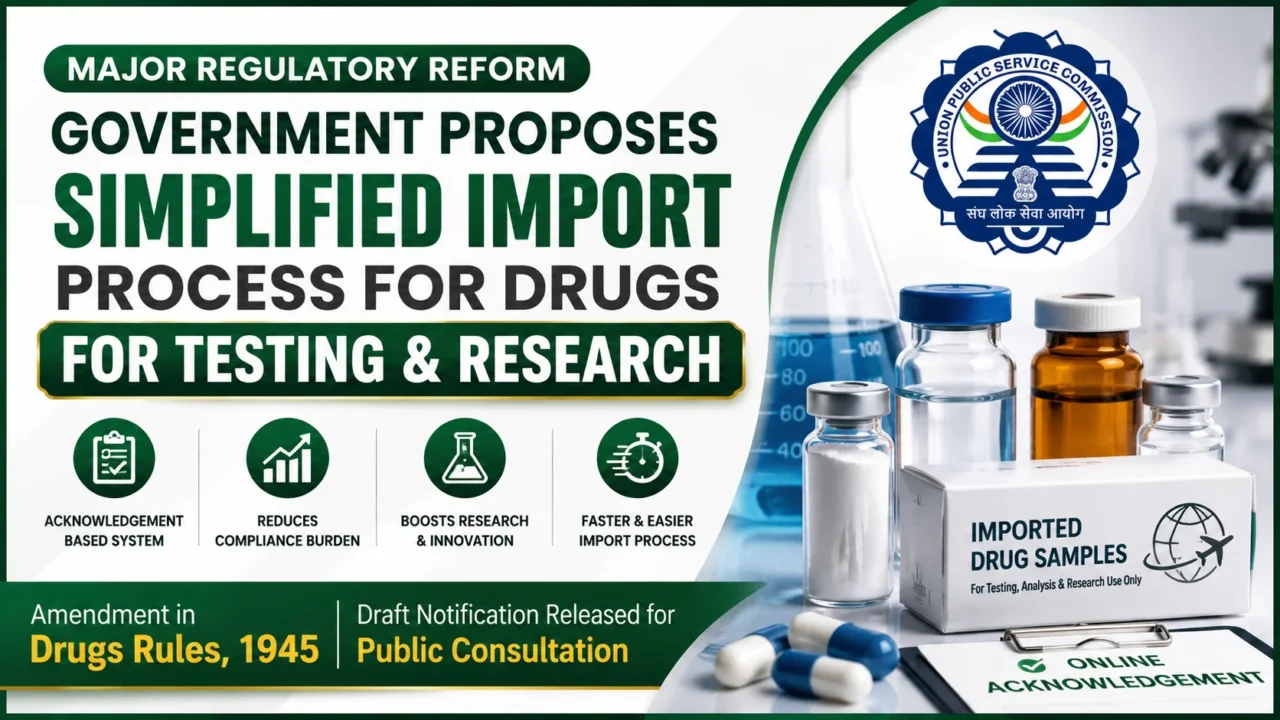
In a significant move to strengthen India’s pharmaceutical research ecosystem and promote ease of doing business, the Ministry of Health and Family Welfare (MoHFW) has proposed important amendments to the Drugs Rules, 1945. The draft notification aims to simplify the import process for small quantities of drugs intended exclusively for examination, testing, analysis, and research purposes.
The proposed reform replaces the existing licensing requirement with a much simpler online acknowledgement-based intimation system, reducing unnecessary regulatory delays while maintaining strict oversight for high-risk drug categories.
What Is Changing?
Currently, organizations importing small quantities of drugs for laboratory examination, testing, or analytical purposes must obtain prior permission through Form 11 under the Drugs Rules, 1945.
Under the proposed amendment:
- Applicants will submit an online prior intimation.
- An acknowledgement will be generated digitally.
- Eligible drug samples can be imported immediately after acknowledgement.
- No separate import licence or approval will be required.
This marks an important shift from a permission-based regulatory framework to a notification-based system for eligible imports.

Which Drug Imports Will Benefit?
The simplified import procedure will apply only to small quantities of drugs imported exclusively for:
- Analytical testing
- Quality evaluation
- Laboratory examination
- Non-clinical research
- Research and Development (R&D)
- Scientific investigations
The amendment is expected to benefit:
- Pharmaceutical companies
- Biotechnology start-ups
- Academic and research institutions
- Contract Research Organizations (CROs)
- Drug testing laboratories
- Quality control laboratories
- Research scientists
Organizations that frequently import reference standards, analytical samples, or research materials are expected to experience significantly faster processing.
Drug Categories That Will Still Require Prior Licence
The Government has decided to continue strict regulatory control over certain sensitive and high-risk drug categories.
These products will still require prior licensing before import:
- Reproductive hormones
- Cytotoxic drugs
- Beta-lactam drugs
- Biologics containing live microorganisms
- Narcotic drugs
- Psychotropic substances
These exclusions ensure that public health and safety remain protected while simplifying procedures for low-risk research materials.
Alignment with Earlier Regulatory Reforms
The proposal builds upon reforms introduced under the New Drugs and Clinical Trials Rules, 2019.
In January 2026, the Government introduced a notification-based system for domestic test licences. The latest amendment extends a similar approach to imported drug samples used for testing and research.
This creates greater regulatory consistency between:
- Domestic research samples
- Imported analytical samples
The move reflects the Government’s broader strategy of modernizing India’s pharmaceutical regulatory framework.
Key Benefits of the Proposed Amendment
The Ministry expects several advantages from the new system, including:
Faster Research
Researchers can begin analytical and non-clinical studies without waiting for lengthy licensing approvals.
Reduced Compliance Burden
The online acknowledgement system eliminates unnecessary paperwork and administrative delays.
Improved Ease of Doing Business
The reform supports India’s growing pharmaceutical and biotechnology industries by simplifying regulatory procedures.
Promotion of Innovation
Quicker access to research materials can accelerate:
- Drug discovery
- Product development
- Quality testing
- Scientific innovation
Digital Regulatory Process
The online acknowledgement mechanism provides a faster, transparent, and more efficient digital workflow for stakeholders.
Impact on India’s Pharmaceutical Industry
India is one of the world’s largest pharmaceutical manufacturing hubs. Research laboratories and pharmaceutical companies regularly import small quantities of reference materials, analytical standards, and investigational drug samples.
The proposed amendment is expected to:
- Reduce project timelines
- Improve operational efficiency
- Encourage pharmaceutical innovation
- Strengthen India’s global competitiveness
- Support biotechnology start-ups
- Enhance research collaborations
By reducing procedural bottlenecks, researchers can focus more on scientific development and less on regulatory formalities.
Public Consultation Process
The amendment has currently been released as a draft notification.
The Ministry of Health and Family Welfare has invited:
- Comments
- Suggestions
- Objections
from stakeholders before finalizing the amendment.
This consultation process allows industry experts, pharmaceutical companies, research institutions, and other stakeholders to provide valuable feedback.
Conclusion
The proposed amendment to the Drugs Rules, 1945 represents another major step toward creating a modern, efficient, and innovation-friendly pharmaceutical regulatory system in India.
By replacing licensing requirements with an online acknowledgement mechanism for eligible research imports, the Government aims to reduce compliance burdens while maintaining strict oversight over high-risk drug categories.
If implemented, the reform will significantly benefit pharmaceutical companies, research organizations, biotechnology start-ups, and academic institutions by enabling faster access to research materials and supporting scientific innovation.
As India continues to strengthen its position as a global pharmaceutical leader, such regulatory reforms are expected to play an important role in promoting research, improving ease of doing business, and accelerating drug development.
Frequently Asked Questions (FAQs)
Q1. What is the proposed amendment to the Drugs Rules, 1945?
The amendment replaces the existing import licence requirement for eligible drug samples used in testing and research with an online acknowledgement-based intimation system.
Q2. Which organizations will benefit?
Pharmaceutical companies, biotechnology firms, CROs, academic institutions, research laboratories, and testing facilities.
Q3. Which drug categories are excluded?
Reproductive hormones, cytotoxic drugs, beta-lactam drugs, biologics containing live microorganisms, narcotic drugs, and psychotropic substances.
Q4. Is the amendment effective now?
No. It is currently a draft notification open for public consultation before final implementation.
Recommended Products