

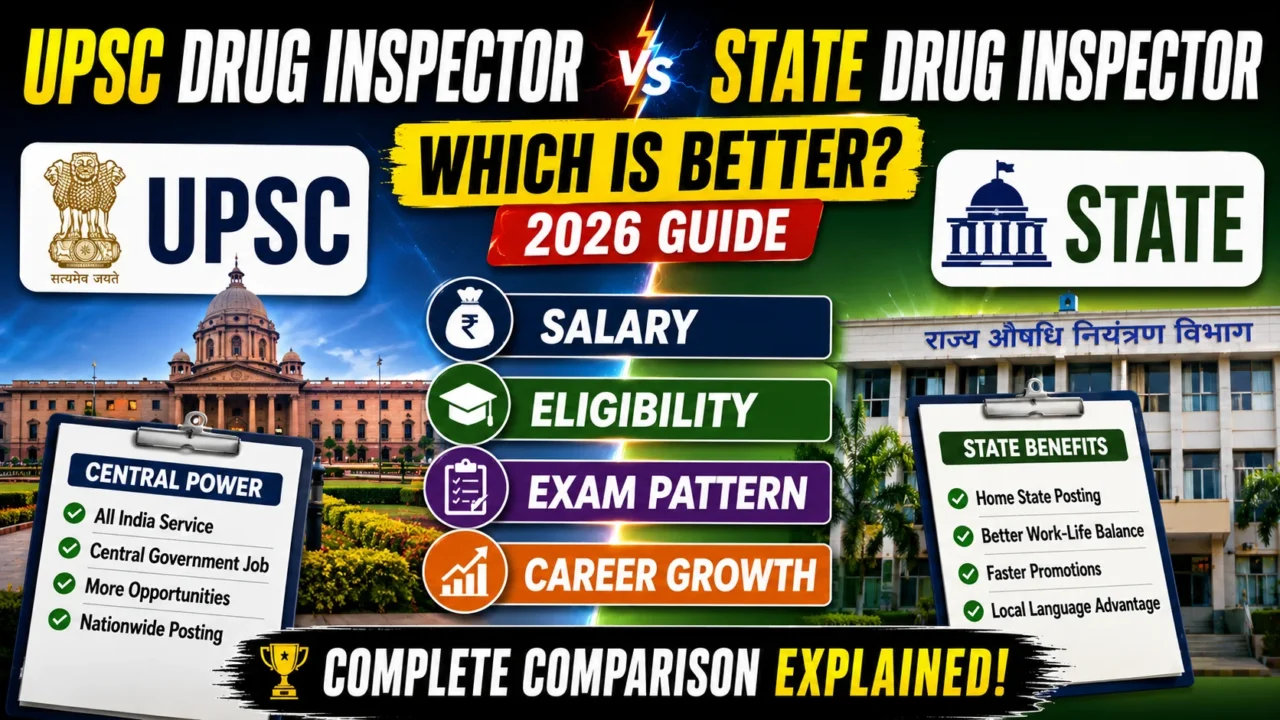

If you’re preparing for a Drug Inspector examination, one of the biggest questions is:
Should you prepare for the UPSC Drug Inspector Exam or the State Drug Inspector Exam?
Both jobs offer excellent career opportunities, job security, government benefits, and the chance to regulate the quality, safety, and efficacy of medicines. However, there are significant differences in recruitment, eligibility, salary, work profile, promotion, and competition.
In this detailed guide, we’ll compare UPSC Drug Inspector vs State Drug Inspector to help you decide which career path is best for you.
What is a Drug Inspector?
A Drug Inspector is a government officer responsible for ensuring that medicines, cosmetics, medical devices, and pharmaceuticals comply with the Drugs and Cosmetics Act, 1940 and related regulations.
Their key responsibilities include:
- Inspecting pharmaceutical manufacturing units
- Inspecting pharmacies and medical stores
- Collecting drug samples for testing
- Investigating complaints regarding drugs
- Preventing the sale of spurious and substandard medicines
- Ensuring compliance with Good Manufacturing Practices (GMP)
UPSC Drug Inspector
The Union Public Service Commission (UPSC) recruits Drug Inspectors for various Central Government departments, including:
- Central Drugs Standard Control Organization (CDSCO)
- Ministry of Health & Family Welfare
- Central Government laboratories
- Other central regulatory organizations
These officers usually work under the Central Government and may be posted anywhere in India.

State Drug Inspector
State Drug Inspectors are recruited by State Public Service Commissions (PSC), State Staff Selection Boards, or State Health Departments.
Examples include:
- UPPSC
- MPSC
- MPPSC
- BPSC
- TNPSC
- GPSC
- RPSC
- HPSC
- OSSC
- UKPSC
They mainly regulate drug manufacturing, sales, and distribution within their respective states.
UPSC Drug Inspector vs State Drug Inspector
| Feature | UPSC Drug Inspector | State Drug Inspector |
|---|---|---|
| Recruiting Authority | UPSC | State PSC/Recruitment Board |
| Government | Central Government | State Government |
| Posting | Anywhere in India | Within the State |
| Competition | Very High | Moderate to High |
| Vacancy Frequency | Less Frequent | More Frequent |
| Transfer | Nationwide | Mostly State-level |
| Promotion Scope | Excellent | Good |
| Salary | Higher | Good |
| Job Security | Excellent | Excellent |
Eligibility Criteria
UPSC Drug Inspector
Candidates should possess:
- Degree in Pharmacy
- OR Pharmaceutical Sciences
- OR Medicine with specialization in Clinical Pharmacology or Microbiology
Experience requirements may vary depending on the notification.

State Drug Inspector
Most states require:
- B.Pharm
- M.Pharm
- Pharmaceutical Sciences
- Pharm.D
- Medicine with specialization
Some states also require pharmaceutical manufacturing experience.
Always check the official notification because eligibility varies from state to state.
Age Limit
UPSC
Generally:
- 30–35 years
- Age relaxation as per Government of India rules
State Drug Inspector
Usually:
- 21–40 years
Age relaxation differs across states.
Salary Comparison
UPSC Drug Inspector Salary
Generally under Level-8, Level-9 or Level-10 (7th CPC)
Approximate monthly salary:
₹60,000 – ₹1,10,000+
Including:
- DA
- HRA
- TA
- Medical benefits
- Pension (as applicable)
State Drug Inspector Salary
Depends on the state.
Generally ranges between:
₹50,000 – ₹90,000+ per month
Some states provide salaries comparable to Central Government posts.
Exam Pattern Comparison
UPSC Drug Inspector
The examination generally includes:
Paper-I
- General Studies
- Current Affairs
- Reasoning
- Constitution
- General Science
Paper-II
- Pharmacy Subjects
- Pharmaceutical Chemistry
- Pharmacology
- Pharmaceutics
- Pharmacognosy
- Drug Laws
- Pharmaceutical Analysis
- Microbiology
Some recruitments may also include interviews.
State Drug Inspector Exam
Most state examinations focus heavily on pharmacy subjects.
Common topics include:
- Pharmaceutics
- Pharmacology
- Pharmaceutical Chemistry
- Pharmacognosy
- Drug Laws
- Hospital Pharmacy
- Clinical Pharmacy
- Pharmaceutical Analysis
- Microbiology
- Biochemistry
Several states also include:
- General Knowledge
- English
- Reasoning
- State GK
Difficulty Level
UPSC Drug Inspector
Difficulty: ⭐⭐⭐⭐⭐
Reasons:
- National-level competition
- Limited vacancies
- High cutoff
- Large number of applicants
State Drug Inspector
Difficulty: ⭐⭐⭐⭐☆
Reasons:
- State-level competition
- Fewer applicants than UPSC
- Varies by state
Promotion Opportunities
UPSC
Typical career progression:
- Drug Inspector
- Senior Drug Inspector
- Assistant Drugs Controller
- Deputy Drugs Controller
- Joint Drugs Controller
- Deputy Drug Controller General
- Senior Regulatory Positions
State Drug Inspector
Promotion hierarchy generally includes:
- Drug Inspector
- Senior Drug Inspector
- Assistant Drugs Controller
- Deputy Drugs Controller
- State Drugs Controller
Promotion speed depends on vacancies and state policies.
Work Profile Comparison
UPSC Drug Inspector
Responsibilities include:
- Inspection of pharmaceutical companies
- Regulatory enforcement
- National drug surveillance
- Clinical trial inspections
- GMP audits
- Central investigations
State Drug Inspector
Responsibilities include:
- Inspection of pharmacies
- Drug sample collection
- Licensing inspections
- Monitoring manufacturing units
- Court cases under Drug Laws
- Public health enforcement
Which Exam is Easier?
Generally,
State Drug Inspector examinations are considered slightly easier because:
- Competition is limited to one state.
- Vacancies are announced more frequently.
- Syllabus is relatively focused.
UPSC Drug Inspector examinations are more competitive due to nationwide applicants and fewer vacancies.
Which One Should You Choose?
Choose UPSC Drug Inspector if you:
- Want a Central Government job.
- Prefer nationwide career opportunities.
- Aim for higher promotions and broader regulatory roles.
- Are comfortable with intense competition.
Choose State Drug Inspector if you:
- Prefer working in your home state.
- Want more frequent recruitment opportunities.
- Are preparing for multiple state PSC examinations.
- Prefer state-level postings with good work-life balance.
Preparation Tips
- Build strong fundamentals in all pharmacy subjects.
- Master the Drugs and Cosmetics Act, 1940 and related rules.
- Solve previous year Drug Inspector question papers.
- Practice daily MCQs.
- Stay updated on CDSCO guidelines and pharmaceutical current affairs.
- Revise GMP, GLP, GDP, and GCP concepts regularly.
- Attempt mock tests to improve speed and accuracy.
Conclusion
Both UPSC Drug Inspector and State Drug Inspector are prestigious government positions that offer excellent salaries, job security, and opportunities to contribute to public health by ensuring the quality and safety of medicines. If your goal is a nationwide regulatory career with broader responsibilities, UPSC Drug Inspector is the better choice. If you prefer stability, state-level postings, and more frequent recruitment opportunities, becoming a State Drug Inspector can be equally rewarding.
The ideal strategy for pharmacy graduates is to prepare the common pharmacy syllabus thoroughly and apply for both UPSC and State Drug Inspector recruitments, maximizing their chances of securing a government job.
Recommended Products