

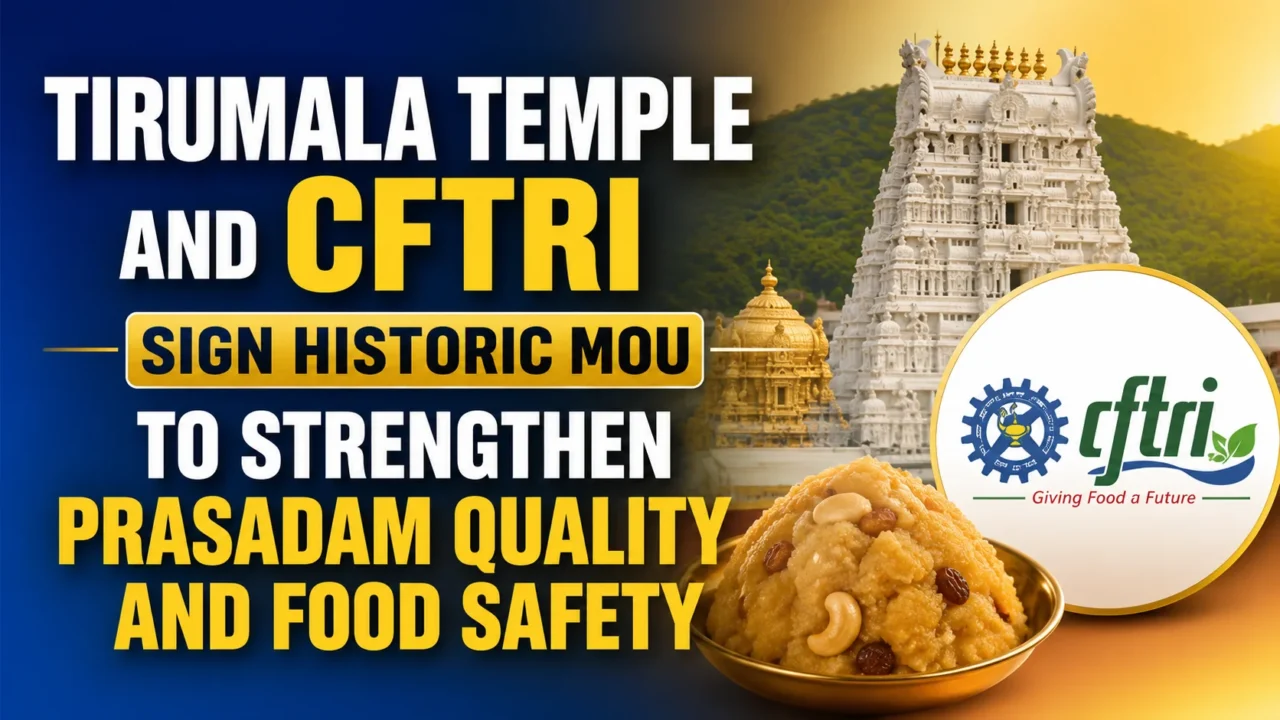

In a landmark initiative aimed at enhancing food safety and quality standards, the Tirumala Tirupati Devasthanams (TTD) has signed a Memorandum of Understanding (MoU) with the Central Food Technological Research Institute (CFTRI), Mysuru. This collaboration marks the first such partnership in India’s temple sector, focusing on ensuring the highest standards in the preparation and distribution of temple prasadam.

A New Era for Food Safety in Temples
The agreement was officially signed on June 15, 2026, and represents a significant step toward integrating scientific food management practices into temple operations. Through this partnership, CFTRI will provide technical expertise in food testing, quality control, and staff training to strengthen the overall food safety ecosystem at Tirumala Temple.
Millions of devotees visit Tirumala every year and receive prasadam as a sacred offering. Ensuring its safety, quality, and consistency is therefore a matter of great importance. The collaboration aims to establish robust quality assurance mechanisms throughout the entire food supply chain.
Key Areas of Collaboration
Under the MoU, CFTRI will assist TTD in several critical areas, including:
1. Food Quality Testing
Regular scientific testing of raw materials and finished prasadam products to ensure compliance with food safety standards.
2. Quality Control Systems
Implementation of advanced quality control measures during procurement, preparation, storage, and distribution processes.
3. Staff Training
Training programs for food handlers and kitchen staff on hygiene, sanitation, food safety protocols, and best manufacturing practices.
4. Scientific Food Management
Introduction of evidence-based methods and modern food technology solutions to improve efficiency and maintain product quality.
Why This Partnership Matters
Food safety has become a major priority for institutions handling large-scale food preparation. Tirumala Temple prepares and distributes prasadam to thousands of devotees daily. Even minor lapses in food handling can have significant consequences.
By partnering with CFTRI, one of India’s premier food research institutes, TTD aims to:
- Enhance public confidence in prasadam quality.
- Reduce food contamination risks.
- Improve operational efficiency.
- Ensure adherence to national food safety standards.
- Create a model that other religious institutions can follow.
CFTRI’s Role in Food Safety
CFTRI, operating under the Council of Scientific and Industrial Research (CSIR), is renowned for its expertise in food science, technology, quality assurance, and food safety research. The institute has played a crucial role in developing food processing technologies and supporting industries across India.
Its involvement will bring scientific rigor and internationally recognized food safety practices to one of the country’s most visited religious institutions.
A Model for Other Religious Institutions
Experts believe this initiative could serve as a benchmark for temples, gurudwaras, mosques, churches, and other religious organizations that manage large-scale food preparation and distribution programs.
The successful implementation of food safety systems at Tirumala may encourage similar collaborations across the country, ultimately benefiting millions of devotees and ensuring safer food practices nationwide.
Conclusion
The MoU between Tirumala Tirupati Devasthanams and CFTRI is a pioneering step toward improving food safety and quality management in religious institutions. By combining spiritual traditions with scientific expertise, the partnership aims to ensure that prasadam remains safe, hygienic, and of the highest quality for all devotees.
As food safety continues to gain importance globally, initiatives like this demonstrate how science and tradition can work together to protect public health while preserving cultural and religious practices.
Recommended Products