

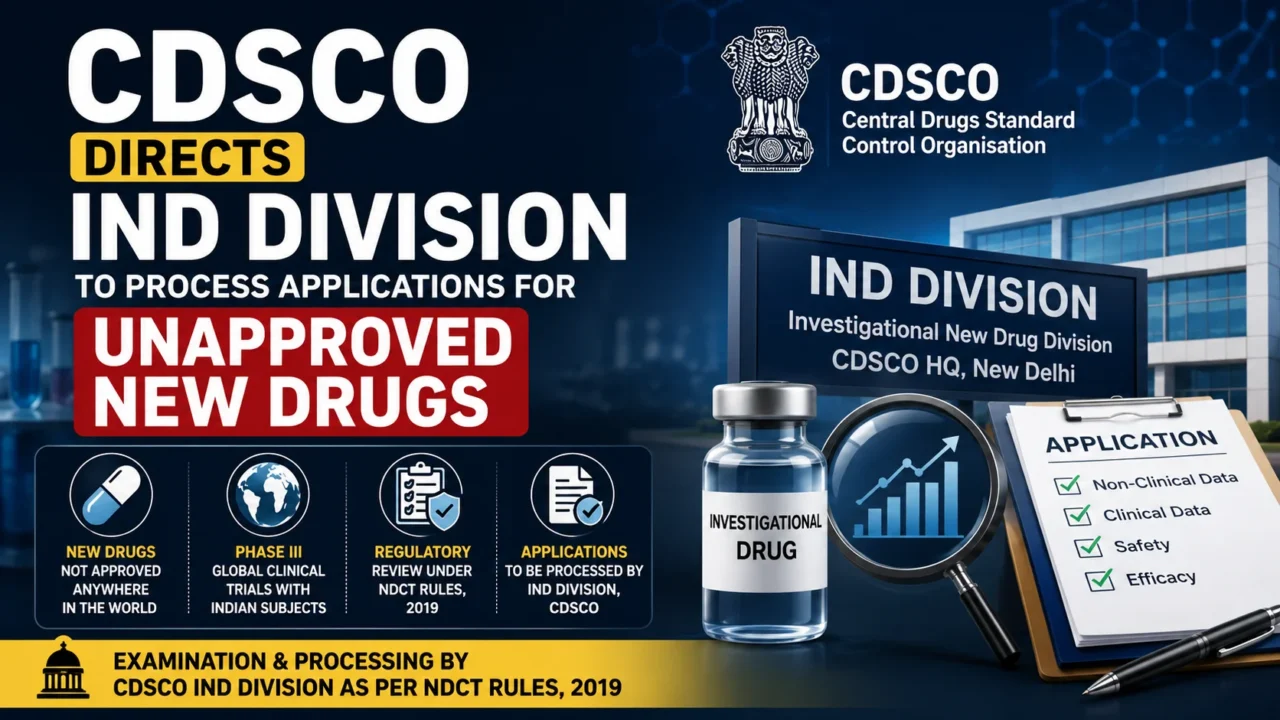

The CDSCO IND Division will examine and process applications concerning certain new drugs that have not been approved for marketing anywhere in the world, including cases where Phase III Global Clinical Trials (GCTs) are ongoing or have been completed with the participation of Indian subjects.
The clarification follows consideration of the matter by an internal technical committee within the Central Drugs Standard Control Organisation (CDSCO). The committee concluded that such applications require comprehensive evaluation of the available non-clinical and clinical data under the New Drugs and Clinical Trials Rules, 2019 (NDCT Rules, 2019).
Applicants falling within this category have accordingly been directed to submit their applications to the Investigational New Drug (IND) Division, CDSCO Headquarters, New Delhi.
Quick Summary
CDSCO has clarified that applications involving new drugs not approved anywhere in the world, including products associated with Phase III Global Clinical Trials involving Indian subjects, will be examined by the IND Division. Such applications are subject to evaluation of relevant clinical and non-clinical data under the NDCT Rules, 2019 and applicable regulatory requirements.

CDSCO IND Division: Key Details
| Particular | Details |
|---|---|
| Regulatory authority | CDSCO |
| Division | Investigational New Drug (IND) Division |
| Relevant framework | New Drugs and Clinical Trials Rules, 2019 |
| Drug category | Globally unapproved investigational new drugs |
| Clinical-trial stage mentioned | Phase III Global Clinical Trials |
| Indian participation | Indian subjects may have participated |
| Regulatory action | Application examination and processing |
| Submission point | IND Division, CDSCO Headquarters, New Delhi |
CDSCO states that an Investigational New Drug is a new chemical or biological entity or substance that has not been approved for marketing as a drug in any country. The IND Division handles relevant applications under the NDCT Rules, 2019.
What Has CDSCO Clarified?
The clarification relates to applications seeking permission to import and market new drugs in India when those drugs have not received marketing approval anywhere in the world.
The matter was examined by an internal technical committee of CDSCO. Following deliberations, the committee concluded that such applications require a comprehensive review of the available:
- Non-clinical data
- Clinical data
- Safety information
- Efficacy information
- Other regulatory documents required under the applicable framework
As a result, such applications are to be examined and processed by the IND Division in accordance with the NDCT Rules, 2019.
What Is an Investigational New Drug?
An Investigational New Drug (IND) is defined under the NDCT framework as a new chemical or biological entity or substance that has not been approved for marketing as a drug in any country.
In simple terms, if a drug has not received marketing approval anywhere globally, it remains an investigational product from a regulatory perspective.
IND vs Approved New Drug
| Drug Status | Meaning |
|---|---|
| Investigational New Drug | Not approved for marketing in any country |
| Approved drug | Has received marketing authorization |
| Drug under foreign regulatory review | May still be investigational if no country has granted marketing approval |
| Drug in Phase III trial | May still be investigational until marketing authorization is granted |
The key factor is therefore marketing approval status, not simply whether a clinical trial has reached Phase III.
Why Is the IND Division Responsible?
The Investigational New Drug Division of CDSCO plays a specific role in the regulatory process for investigational new drugs.
According to CDSCO, the IND Division processes applications related to clinical trials and the import or manufacture of investigational new drugs under the NDCT Rules, 2019. Relevant applications are submitted through the SUGAM Portal along with the required documents and fees.
The division also handles proposals that require consideration by the Subject Expert Committee (SEC) for Investigational New Drugs.
CDSCO’s published 2026 records show that the IND SEC continues to review clinical-trial protocols, non-clinical data, clinical data and protocol amendments for investigational products.

What Happens When a Drug Has No Global Marketing Approval?
When a new drug has not been approved for marketing in any country, the application cannot be treated simply as an application for an already approved medicine.
The regulatory pathway requires assessment of the investigational product and the evidence supporting its proposed use.
The process can broadly be understood as:
Investigational drug → Regulatory submission → Scientific review → Clinical/non-clinical assessment → Regulatory decision
The exact requirements depend on the nature of the application and the applicable provisions of the NDCT Rules, 2019.
What About Phase III Global Clinical Trials?
A Phase III Global Clinical Trial may involve participants from several countries, including India.
However, completion or continuation of a Phase III GCT does not automatically mean that the drug has received marketing approval.
Clinical trials generate evidence about a medicine’s safety and efficacy. Marketing authorization is a separate regulatory decision.
Therefore:
Participation in a Phase III GCT does not automatically equal marketing approval in India.
This distinction is particularly important when the drug remains unapproved globally.
Can Indian Subjects Participate in a Trial Before Global Approval?
Yes, participation in a clinical trial does not itself establish marketing authorization.
A medicine can be investigated in clinical trials while regulatory authorities continue to evaluate its safety and efficacy data.
The present clarification is relevant to situations where Indian subjects have participated in Phase III Global Clinical Trials but the investigational drug has not received marketing approval anywhere in the world.
The subsequent application still needs to follow the applicable Indian regulatory pathway.
Does Foreign Regulatory Review Mean the Drug Is Approved?
No.
A drug may be under review by the US FDA, EMA or another foreign regulatory authority without having received marketing authorization.
If no country has granted marketing approval, the product remains within the definition of an Investigational New Drug under the NDCT framework.
Therefore, an application in India must still undergo the applicable CDSCO regulatory process.
What Data May Be Evaluated?
The exact documentation required depends on the application. However, regulatory assessment of investigational drugs can involve both non-clinical and clinical evidence.
Non-Clinical Data
Depending on the product and development stage, this may include:
- Pharmacology
- Pharmacokinetics
- Toxicology
- Safety pharmacology
- Reproductive and developmental studies, where applicable
- Other required preclinical investigations
Clinical Data
Relevant clinical information may include:
- Phase I clinical data
- Phase II clinical data
- Phase III clinical data
- Safety data
- Efficacy data
- Adverse-event information
- Clinical study reports
Applicants must follow the applicable regulatory requirements rather than assuming that completion of a particular clinical-trial phase is sufficient for approval.
What Are the New Drugs and Clinical Trials Rules, 2019?
The New Drugs and Clinical Trials Rules, 2019, commonly called the NDCT Rules, 2019, provide an important regulatory framework for new drugs and clinical trials in India.
The Rules cover areas including:
- New drug applications
- Clinical trials
- Investigational new drugs
- Clinical-trial permissions
- Import and manufacture of new drugs
- Ethics committee requirements
- Regulatory review
CDSCO’s official information confirms that the IND Division operates under the NDCT Rules, 2019.
Where Should These Applications Be Submitted?
For the category covered by this clarification, applicants have been directed to submit applications to:
Investigational New Drug (IND) Division
CDSCO Headquarters
New Delhi
CDSCO’s IND Division states that relevant applications are processed through the SUGAM Portal with the prescribed documentation and fees under the NDCT Rules, 2019.
IND Division vs New Drugs Division
Understanding the difference between these regulatory functions is important for regulatory-affairs professionals and pharmacy students.
| IND Division | New Drugs Regulatory Function |
|---|---|
| Focuses on investigational new drugs | Deals with new-drug regulatory applications within its defined scope |
| Relevant when the product has not been approved for marketing in any country | Includes regulatory assessment of new-drug applications according to applicable provisions |
| Handles relevant clinical-trial and IND submissions | Handles new-drug approval-related regulatory matters |
| Works under NDCT Rules, 2019 | Works under applicable drug-regulatory provisions |
The exact regulatory pathway depends on the product’s status and the type of application being submitted.
Does This Mean the Drug Is Approved for Marketing?
No.
This clarification concerns which CDSCO division should examine and process the application.
It should not be interpreted as automatic approval to import, manufacture or market an investigational drug.
The application remains subject to the applicable regulatory evaluation and permissions under the NDCT Rules, 2019.
Why Is This Clarification Important for the Pharma Industry?
The clarification provides greater regulatory direction for pharmaceutical companies and clinical research organisations working on globally developed investigational medicines.
It helps stakeholders understand that:
- Global Phase III participation does not equal marketing approval.
- Foreign regulatory review does not automatically establish approval in India.
- Global approval status is important when determining the regulatory pathway.
- Investigational products require appropriate scientific and regulatory assessment.
- Applications in the specified category should be routed through the IND Division.
This can help companies identify the appropriate regulatory pathway before preparing and submitting an application.
What Does This Mean for Clinical Research Organisations?
For CROs and clinical research professionals, the clarification highlights the importance of maintaining a clear regulatory record of:
- Clinical-trial status
- Global regulatory status
- Indian trial participation
- Non-clinical evidence
- Clinical evidence
- Safety information
- Regulatory submissions
The regulatory status of the investigational product should be clearly established before determining the appropriate application route.
Why Is This Important for Pharmacy Students?
This update is highly relevant for B.Pharm, D.Pharm, M.Pharm, Pharm.D and pharmacy competitive-exam aspirants.
It connects important concepts from:
Regulatory Affairs
- CDSCO
- NDCT Rules, 2019
- Investigational New Drugs
- Marketing authorization
- Regulatory submissions
Clinical Research
- Phase I, II and III trials
- Global Clinical Trials
- Clinical-trial protocols
- Clinical data
- Safety and efficacy evaluation
Pharmacology
- Drug development
- Non-clinical studies
- Pharmacokinetics
- Pharmacodynamics
- Toxicology
Competitive Exam Preparation
This topic can be useful for questions related to:
- CDSCO
- Drug regulatory authorities
- Clinical trial phases
- NDCT Rules, 2019
- Investigational New Drugs
- Pharmaceutical jurisprudence
- Regulatory affairs
Important Exam Point
An Investigational New Drug is a new chemical or biological entity or substance that has not been approved for marketing as a drug in any country.
Important Regulatory Takeaways
| Question | Answer |
|---|---|
| Which authority? | CDSCO |
| Which division? | IND Division |
| Which drug category? | Globally unapproved investigational new drugs |
| Clinical stage mentioned? | Phase III GCT |
| Can Indian subjects participate? | Yes, participation does not equal marketing approval |
| Does foreign regulatory review mean approval? | No |
| Applicable framework? | NDCT Rules, 2019 |
| Where should applications be submitted? | IND Division, CDSCO Headquarters, New Delhi |
| Is this an automatic marketing approval? | No |
Frequently Asked Questions
1. What has CDSCO clarified about unapproved new drugs?
CDSCO has clarified that applications concerning new drugs that have not been approved for marketing anywhere in the world, including those associated with Phase III Global Clinical Trials involving Indian subjects, are to be examined and processed by the IND Division under the applicable regulatory framework.
2. What is an Investigational New Drug in India?
Under the NDCT framework, an Investigational New Drug is a new chemical or biological entity or substance that has not been approved for marketing as a drug in any country.
3. Which CDSCO division handles Investigational New Drugs?
The Investigational New Drug Division handles relevant regulatory applications for investigational new drugs and associated clinical-trial submissions under the NDCT Rules, 2019.
4. Does Phase III Global Clinical Trial participation mean that a drug is approved in India?
No. Participation of Indian subjects in a Phase III Global Clinical Trial does not by itself grant marketing authorization in India.
5. What if a drug is under review by a foreign regulator?
Foreign regulatory review does not automatically mean that the drug has been approved. If no country has granted marketing approval, the product may remain an Investigational New Drug under the NDCT definition.
6. Where should applications covered by this clarification be submitted?
Applicants have been directed to submit the relevant applications to the IND Division, CDSCO Headquarters, New Delhi.
7. Which rules govern Investigational New Drugs in India?
The principal framework is the New Drugs and Clinical Trials Rules, 2019 (NDCT Rules, 2019).
8. Does this CDSCO clarification mean that the drug is approved for marketing?
No. The clarification identifies the regulatory division responsible for examining and processing the relevant application. It does not itself constitute marketing authorization.
Important Links
- CDSCO Investigational New Drugs Division: Official information about the IND Division, its functions and regulatory process.
- CDSCO IND Committee: Official SEC recommendations for Investigational New Drugs.
- NDCT Rules, 2019: Use the official CDSCO New Drugs and Clinical Trials Rules resources for the applicable regulatory framework.
Suggested Internal Links for GDC Classes
For better internal SEO and topical authority, add these internal links where relevant:
- Clinical Trial Phases Explained → GDC Classes clinical research article
- CDSCO and Drug Approval Process in India → GDC Classes regulatory-affairs article
- Pharmacovigilance Notes for Pharmacy Students → GDC Classes pharmacovigilance notes
- Regulatory Affairs Notes for B.Pharm and M.Pharm → GDC Classes study material
- Drug Inspector Preparation → GDC Classes Drug Inspector preparation page
- Latest CDSCO Updates → GDC Classes pharma-news category
- GPAT Pharmaceutical Jurisprudence Preparation → GDC Classes GPAT preparation page
Use descriptive anchor text such as “CDSCO drug approval process” rather than generic anchors like “Click Here.”
Conclusion
The latest CDSCO IND Division clarification provides a defined regulatory route for applications involving new drugs that have not received marketing approval anywhere in the world, including cases associated with Phase III Global Clinical Trials involving Indian subjects.
Such applications are to be examined and processed by the Investigational New Drug Division of CDSCO under the applicable provisions of the New Drugs and Clinical Trials Rules, 2019.
The clarification also reinforces an important regulatory distinction: participation in a global clinical trial or review by a foreign regulatory authority does not automatically mean that a medicine has received marketing authorization in India or anywhere else.
For pharmaceutical companies and CROs, determining the global approval status of a product is therefore an important part of selecting the appropriate regulatory pathway.
For pharmacy students, the update provides a practical example of how Investigational New Drugs, clinical trials, CDSCO, NDCT Rules and marketing authorization are connected within India’s pharmaceutical regulatory system.
Key Takeaway: Applications involving globally unapproved new drugs associated with Phase III Global Clinical Trials involving Indian subjects are to be routed through the CDSCO IND Division for examination under the applicable NDCT Rules, 2019 requirements.
Recommended Products