



Quick Summary
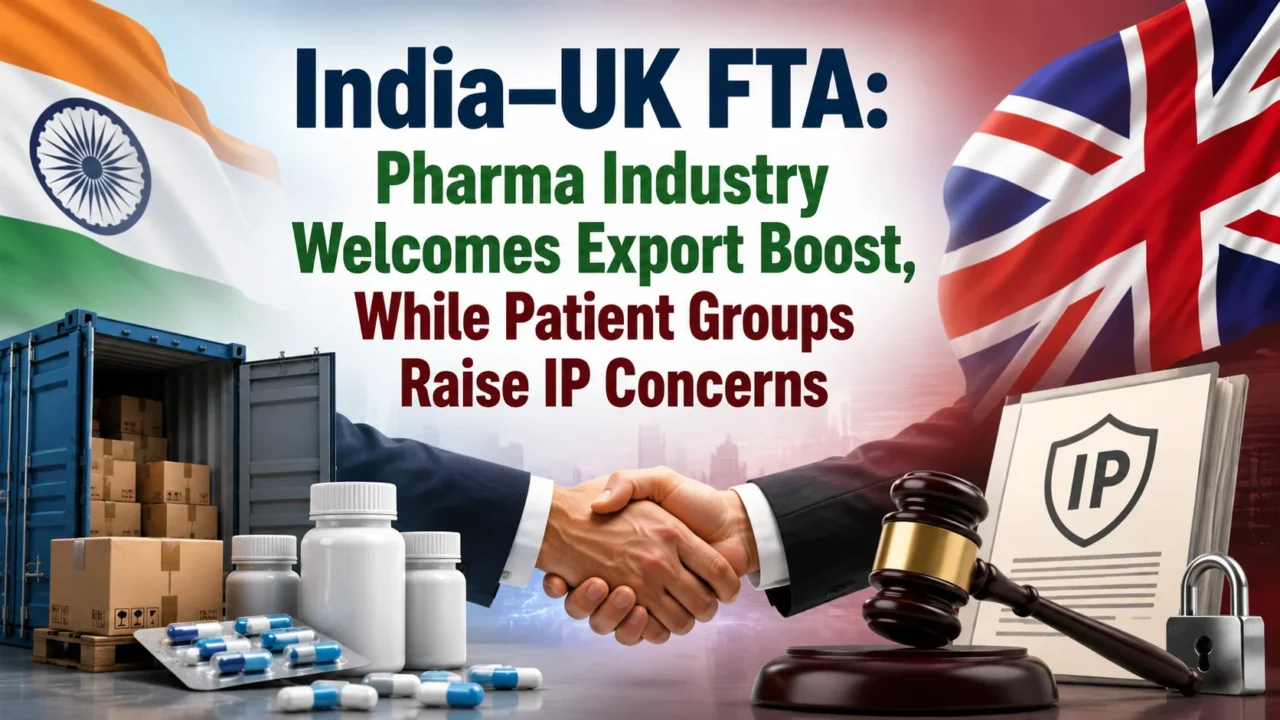
The India–UK Free Trade Agreement (FTA) is expected to strengthen India’s pharmaceutical exports by reducing trade barriers and encouraging contract manufacturing partnerships. While the pharma industry welcomes the opportunities, patient advocacy groups have raised concerns that certain intellectual property (IP) provisions could affect access to affordable generic medicines. The agreement aims to balance economic growth with public health interests.
India–UK FTA Pharma: Overview
The India–UK FTA Pharma agreement marks an important development for India’s pharmaceutical industry. Industry experts believe the agreement will improve export competitiveness, attract new investments, and expand manufacturing partnerships with global pharmaceutical companies.
At the same time, patient organizations have expressed concerns regarding certain intellectual property (IP) provisions, stating that they must not compromise India’s long-standing role in providing affordable generic medicines.
The agreement is expected to play a significant role in shaping the future of India’s pharmaceutical trade while maintaining a balance between innovation and public health.
Highlights of India–UK FTA for the Pharmaceutical Industry
| Particular | Details |
|---|---|
| Agreement | India–UK Free Trade Agreement (FTA) |
| Sector | Pharmaceutical Industry |
| Major Benefit | Improved export competitiveness |
| Trade Impact | Reduction in import duties on pharmaceutical products |
| Manufacturing | Growth in contract manufacturing opportunities |
| Concern Raised | Intellectual Property (IP) provisions |
| Stakeholders | Indian pharma companies, patient advocacy groups, policymakers |
How Will the India–UK FTA Benefit the Pharmaceutical Industry?
The pharmaceutical industry has largely welcomed the agreement due to several expected advantages.

Improved Export Competitiveness
Lower trade barriers can help Indian pharmaceutical companies expand exports to the United Kingdom and strengthen their presence in global markets.
Reduced Import Duties
The elimination of import duties on pharmaceutical products is expected to lower trade costs and improve market access.
Stronger Global Supply Chain
The agreement may strengthen India’s position as one of the world’s leading pharmaceutical manufacturing hubs.
Increased International Collaboration
Global pharmaceutical companies are likely to explore more partnerships with Indian manufacturers for research, development, and manufacturing.
Contract Manufacturing Expected to Grow
One of the biggest opportunities created by the agreement is the expansion of contract manufacturing.
India already offers several competitive advantages:
- Cost-effective manufacturing
- Highly skilled pharmaceutical workforce
- WHO-GMP compliant manufacturing facilities
- Strong regulatory expertise
- Large-scale production capacity
These strengths make India an attractive destination for international pharmaceutical companies looking to outsource manufacturing operations.
Why Are Patient Groups Concerned?
Although the pharmaceutical industry has welcomed the agreement, several patient advocacy organizations have expressed concerns about intellectual property provisions.
According to these groups, increased reliance on voluntary licensing could weaken India’s existing IP safeguards if not implemented carefully.
They believe that affordable access to essential medicines must remain a priority, especially for patients who depend on low-cost generic medicines.
What is Voluntary Licensing?
Voluntary licensing is an arrangement where the patent holder gives permission to another company to manufacture and market a patented medicine under mutually agreed terms.
Advantages
- Encourages collaboration
- Expands medicine availability
- Supports technology transfer
- Can improve supply in selected markets
Concerns
- May reduce wider generic competition
- Could affect long-term affordability if overly restrictive
- Requires balanced implementation
Balancing Innovation and Public Health
The India–UK FTA highlights the need to balance two equally important objectives.
| Innovation | Public Health |
|---|---|
| Encourage pharmaceutical research | Ensure affordable medicines |
| Attract global investments | Protect access to generic medicines |
| Promote innovation | Safeguard patient interests |
| Expand international partnerships | Maintain India’s public health commitments |
Both industry leaders and policymakers will closely monitor the implementation of the agreement to ensure that economic growth does not come at the cost of healthcare accessibility.
What Does This Mean for India’s Pharma Industry?
If implemented effectively, the agreement could:
- Increase pharmaceutical exports
- Create new manufacturing partnerships
- Generate employment opportunities
- Attract foreign investment
- Strengthen India’s position in global healthcare manufacturing
However, careful implementation of intellectual property provisions will remain essential to preserve affordable access to medicines.
Key Takeaways
| Positive Impact | Areas to Watch |
|---|---|
| Better export opportunities | IP implementation |
| Growth in contract manufacturing | Access to generic medicines |
| Increased foreign investment | Public health safeguards |
| Stronger global partnerships | Voluntary licensing framework |
Conclusion
The India–UK FTA Pharma agreement offers significant opportunities for India’s pharmaceutical industry by improving export competitiveness and expanding contract manufacturing partnerships. At the same time, concerns regarding intellectual property provisions highlight the importance of balancing innovation with affordable access to medicines.
As implementation progresses, policymakers, industry leaders, and healthcare stakeholders will need to ensure that economic growth supports both pharmaceutical innovation and public health.

Frequently Asked Questions (FAQs)
1. What is the India–UK FTA?
The India–UK Free Trade Agreement is a bilateral trade agreement aimed at improving trade and investment between India and the United Kingdom across multiple sectors, including pharmaceuticals.
2. How will the FTA benefit Indian pharmaceutical companies?
The agreement is expected to improve export competitiveness, reduce trade barriers, and encourage more international manufacturing partnerships.
3. What is contract manufacturing?
Contract manufacturing refers to pharmaceutical companies outsourcing the production of medicines to specialized manufacturers, often to reduce costs and improve efficiency.
4. Why are patient groups concerned?
Patient advocacy organizations believe certain intellectual property provisions could impact the availability of affordable generic medicines if not implemented carefully.
5. What is voluntary licensing?
Voluntary licensing allows a patent holder to authorize another company to manufacture and sell a patented medicine under agreed terms.
6. Will affordable medicines be affected?
The final impact will depend on how the agreement’s intellectual property provisions are implemented. Patient groups have urged policymakers to protect access to affordable medicines.
7. Does the FTA immediately change India’s pharmaceutical regulations?
No. The agreement provides a framework for trade cooperation, while implementation will follow applicable legal and regulatory processes.
8. Why is the India–UK FTA important for the pharmaceutical sector?
It has the potential to increase exports, attract investment, strengthen contract manufacturing, and improve India’s position in the global pharmaceutical supply chain.
Recommended Products