


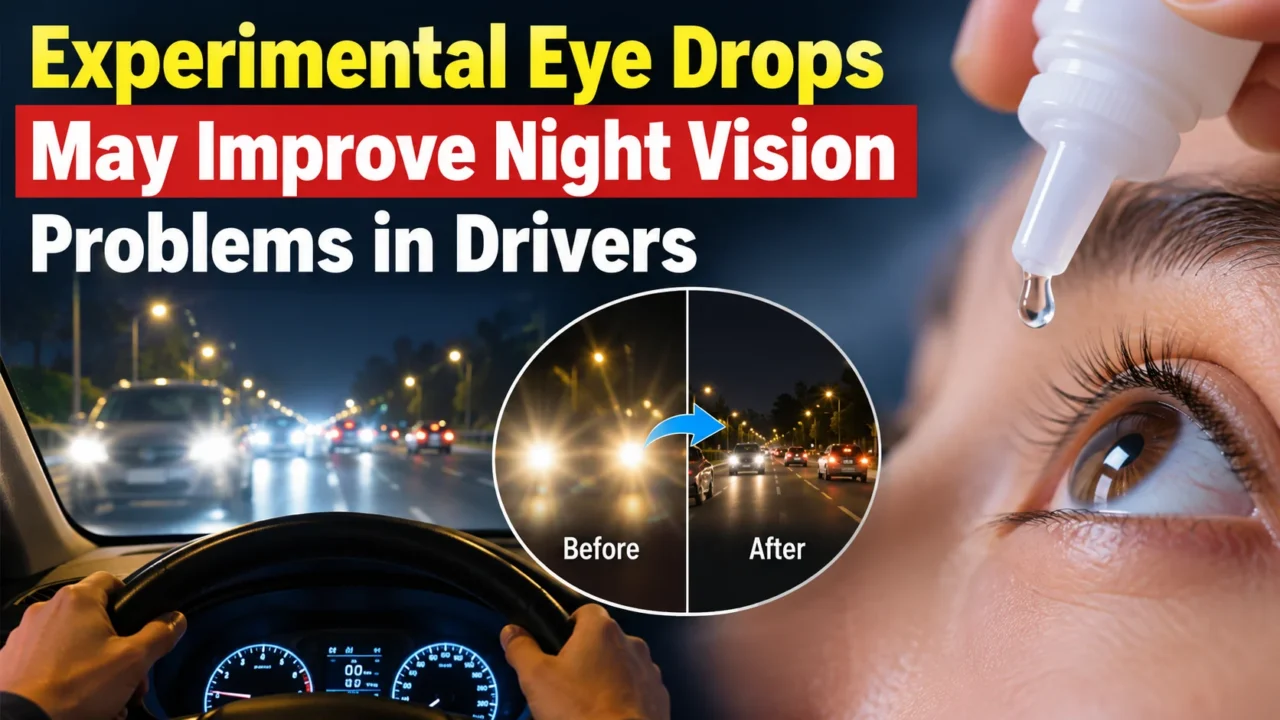

Experimental eye drops for night vision containing 0.75% phentolamine ophthalmic solution are being investigated for people who experience difficulty seeing in dim or dark conditions, glare, halos, and starbursts. Early clinical trial research is evaluating whether the treatment can improve visual performance in low-light environments.
Night-time driving can be difficult for people with poor low-light vision. Headlights, streetlights, glare, halos, and starburst patterns may make it harder to see road signs, vehicles, pedestrians, and other objects clearly.
Researchers are studying whether phentolamine eye drops could offer a potential treatment approach for these night-vision problems.
Quick Summary
An experimental 0.75% phentolamine ophthalmic solution is being studied for night-vision problems such as impaired vision in dim or dark conditions, glare, halos, and starbursts. In one trial, 145 patients received either Opus eye drops or placebo for eight or 15 days. Further clinical research is needed to establish safety and effectiveness.

Overview of the Experimental Eye Drops
The investigational treatment contains 0.75% phentolamine ophthalmic solution and is being evaluated for specific visual problems that can occur in low-light conditions.
The first clinical trial included 145 patients with impaired visual acuity in dim or dark environments and symptoms including glare, halos, and starbursts.
Key Trial Details
| Trial Parameter | Details |
|---|---|
| Investigational treatment | Opus eye drops |
| Active ingredient | Phentolamine ophthalmic solution |
| Strength | 0.75% |
| Participants | 145 patients |
| Main problem studied | Impaired vision in dim or dark conditions |
| Symptoms | Glare, halos and starbursts |
| Comparator | Placebo |
| Treatment frequency | Once daily |
| Treatment duration | 8 or 15 days |
What Is Phentolamine?
Phentolamine is an alpha-adrenergic receptor antagonist that can affect the muscles involved in controlling the pupil.
The ophthalmic formulation is being investigated for its potential effect on pupil size and visual performance. Researchers are studying whether this mechanism may help improve the quality of vision in certain low-light conditions.
However, the fact that a drug affects pupil function does not by itself establish that it will improve night-time driving or other visual activities. Clinical trial results are needed to determine its actual benefits and risks.
What Night-Vision Problems Are Being Studied?
The clinical investigation focuses on people experiencing visual difficulties in dim or dark environments.
Important symptoms include:
- Difficulty seeing clearly in low-light conditions
- Glare around headlights and other bright lights
- Halos around light sources
- Starburst patterns around lights
- Reduced visual clarity during night-time activities
These symptoms may be particularly troublesome while driving after dark.
How Was the Clinical Trial Conducted?
In the first reported clinical trial, researchers enrolled 145 patients with impaired visual acuity in dim or dark conditions and symptoms such as glare, halos, and starbursts.
Participants received either the investigational Opus eye drops containing 0.75% phentolamine ophthalmic solution or a placebo.
The treatment was administered once daily for either eight days or 15 days.
Trial Design at a Glance
| Feature | Information |
|---|---|
| Participants | 145 |
| Treatment | 0.75% phentolamine ophthalmic solution |
| Control | Placebo |
| Administration | Once daily |
| Duration | 8 or 15 days |
| Visual conditions studied | Dim or dark environments |
| Symptoms assessed | Glare, halos, starbursts and impaired visual acuity |
A placebo-controlled design helps researchers compare outcomes between people receiving the investigational treatment and those receiving an inactive comparator.
Why Can Night-Time Vision Be Difficult?
Vision in darkness is different from vision in bright conditions. The eye needs to adapt to reduced light, while bright sources such as vehicle headlights can create additional visual disturbances.
For some people, headlights may appear surrounded by glare or halos, while starburst patterns can make light sources appear scattered.
Such disturbances can make it more difficult to identify objects and potential hazards on the road.
However, night-vision problems can have different causes. They may be associated with refractive errors, eye conditions, previous eye procedures, medications, or other factors. A comprehensive eye examination is therefore important.
Can These Eye Drops Improve Night Vision?
The experimental treatment is being investigated for its potential to improve certain night-vision problems.
At present, the available information does not establish that 0.75% phentolamine eye drops are a proven treatment for night-vision problems. Further clinical evaluation is required to determine their effectiveness, safety, appropriate patient population, and potential clinical use.
Therefore, people experiencing night-vision difficulties should not self-medicate with an investigational product.
Potential Importance for Night-Time Drivers
Night-time visual disturbances can affect activities that require clear vision in low-light environments, including driving.
Problems with glare, halos, and starbursts may make bright lights appear distorted and can potentially interfere with visual comfort and clarity.
If future studies demonstrate meaningful improvements in appropriate patients, treatments targeting these problems could become an area of interest in ophthalmology.
For now, people who have difficulty driving at night should discuss their symptoms with an eye-care professional.

Safety and Medical Considerations
The eye drops discussed in this article are part of clinical research and should not be considered a routine treatment based solely on preliminary findings.
People experiencing persistent:
- Night blindness or difficulty seeing in darkness
- Glare from headlights
- Halos around lights
- Starbursts
- Sudden changes in vision
- Difficulty driving safely at night
should seek professional eye-care advice.
Do not use an investigational medicine unless it has been prescribed or provided under appropriate medical supervision.
Why Is Further Research Needed?
Clinical trials are necessary to determine whether a treatment provides benefits that outweigh its potential risks.
Further research can help establish:
- How much the treatment improves night-time visual performance.
- Which patients are most likely to benefit.
- How long any improvement lasts.
- What adverse effects may occur.
- Whether the treatment is suitable for regular clinical use.
The results of additional clinical studies will be important before drawing firm conclusions about the role of phentolamine eye drops in managing night-vision problems.
Important Facts at a Glance
| Question | Answer |
|---|---|
| What is being studied? | Experimental eye drops for certain night-vision problems |
| What is the active ingredient? | Phentolamine |
| What strength was studied? | 0.75% |
| How many patients were in the first trial? | 145 |
| What symptoms were studied? | Glare, halos, starbursts and impaired low-light visual acuity |
| Was there a placebo group? | Yes |
| How long was treatment given? | 8 or 15 days |
| Is it a proven treatment? | Further clinical research is required |
| Should people self-use it? | No; medical supervision is required |
What Does This Mean for Pharmacy Students?
The development of ophthalmic formulations containing phentolamine is relevant to pharmacy students because it demonstrates how an established pharmacological mechanism can be investigated for a different clinical application.
For B.Pharm, D.Pharm, M.Pharm and pharmacy exam aspirants, this topic can also be useful for understanding:
- Alpha-adrenergic receptor antagonists
- Ophthalmic drug delivery
- Clinical trial design
- Placebo-controlled studies
- Drug development and repurposing
- Pharmacology of pupil function
FAQs About Experimental Eye Drops for Night Vision
1. What are the experimental eye drops for night vision?
The investigational eye drops contain 0.75% phentolamine ophthalmic solution and are being studied for certain low-light visual problems, including glare, halos, starbursts, and impaired visual acuity.
2. How many patients participated in the first clinical trial?
The first clinical trial included 145 patients with impaired visual acuity in dim or dark conditions and symptoms such as glare, halos, and starbursts.
3. What is the active ingredient in the eye drops?
The active ingredient is phentolamine, an alpha-adrenergic receptor antagonist.
4. How long were the eye drops used in the trial?
Participants received the investigational treatment once daily for either eight days or 15 days.
5. Were the eye drops compared with a placebo?
Yes. Participants received either the investigational Opus eye drops containing 0.75% phentolamine ophthalmic solution or a placebo.
6. Can these eye drops currently be used to treat night-vision problems?
The treatment is experimental, and the available information does not establish it as a proven routine treatment. Patients should consult an eye-care professional about night-vision problems.
7. What symptoms were researchers investigating?
The study involved people with impaired vision in dim or dark environments and symptoms including glare, halos, and starbursts.
8. Why is this research important?
If future clinical studies demonstrate that the treatment is effective and safe, it could potentially provide another approach for selected patients experiencing certain night-vision problems.
Related Topics for Pharmacy Students
You may also find these topics useful:
- Alpha-Adrenergic Receptor Antagonists
- Ophthalmic Drug Delivery Systems
- Clinical Trials in Drug Development
- Pharmacology of the Eye
- Drug Repurposing and Novel Drug Development
- Pharmacology Current Affairs
Conclusion
Experimental 0.75% phentolamine ophthalmic solution is being investigated as a potential approach for certain night-vision problems, including impaired vision in dim or dark conditions, glare, halos, and starbursts.
In the first clinical trial, 145 patients received either Opus eye drops containing the investigational treatment or placebo once daily for eight or 15 days.
Although the research is promising enough to warrant further investigation, the treatment should not yet be considered a proven solution for night-vision problems. Additional clinical evidence is needed to establish its effectiveness, safety, and appropriate use.
For people experiencing persistent glare, halos, starbursts, or difficulty seeing while driving at night, consultation with an eye-care professional remains the appropriate next step.
Recommended Products