


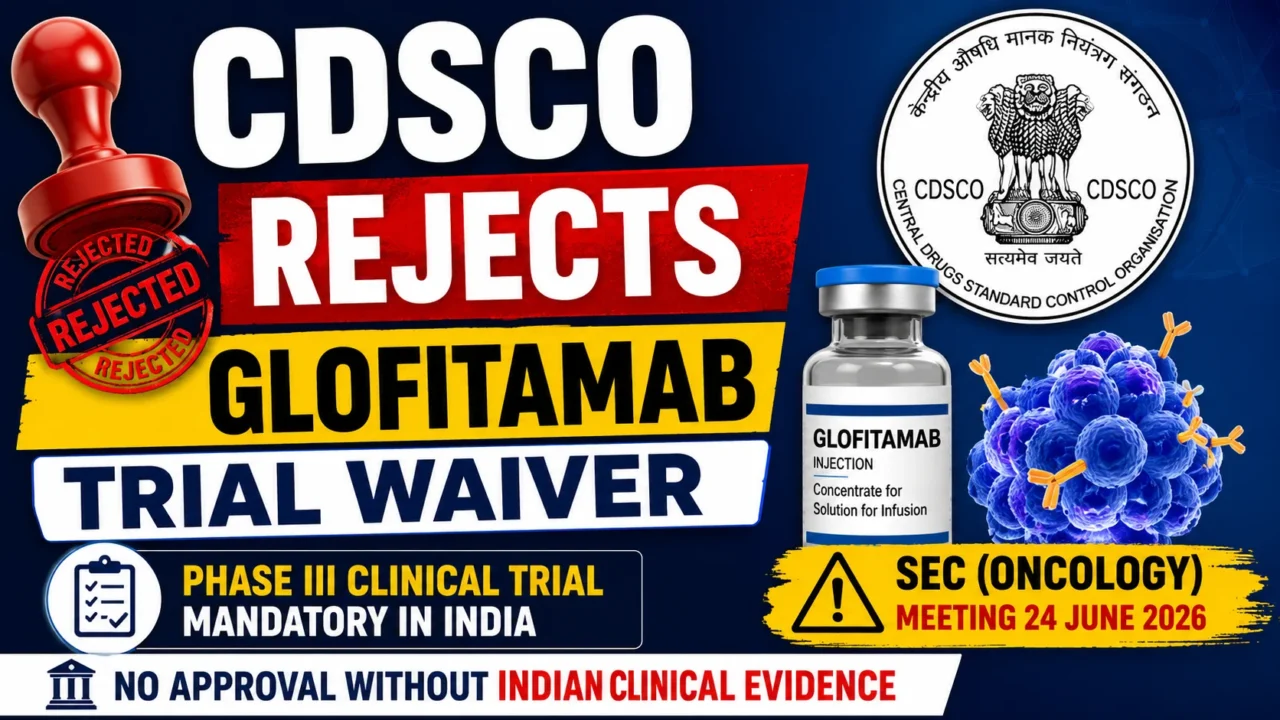

The CDSCO Glofitamab Trial Waiver has become a major regulatory update in India’s pharmaceutical and oncology sector. The Subject Expert Committee (SEC) on Oncology has rejected Roche Products (India) Private Limited’s request to waive local Phase III and Phase IV clinical trials for Glofitamab.
Instead, the committee has directed Roche to conduct a Phase III clinical trial in India before the drug can be considered for marketing approval.
The recommendation was made during the 17th SEC (Oncology) Meeting held on 24 June 2026 at the CDSCO Headquarters in New Delhi.
This decision highlights CDSCO’s continued focus on ensuring India-specific clinical evidence before approving innovative oncology medicines.

Quick Summary
The Oncology Subject Expert Committee (SEC) has rejected Roche India’s request to waive local clinical trials for Glofitamab. Despite approvals in multiple international markets, CDSCO has recommended that Roche conduct a Phase III clinical trial in India before the drug can receive marketing approval, emphasizing the importance of India-specific clinical evidence.
Overview
| Particular | Details |
|---|---|
| Drug | Glofitamab |
| Company | Roche Products (India) Pvt. Ltd. |
| Regulatory Authority | CDSCO |
| Committee | Subject Expert Committee (SEC) – Oncology |
| Meeting | 17th SEC Meeting |
| Meeting Date | 24 June 2026 |
| Decision | Trial Waiver Rejected |
| Next Requirement | Phase III Clinical Trial in India |
What is Glofitamab?
Glofitamab is a bispecific monoclonal antibody developed by Roche for the treatment of certain aggressive B-cell lymphomas.
It targets:
- CD20 present on B-cells
- CD3 present on T-cells
This dual-target mechanism helps activate the patient’s immune system to destroy lymphoma cells.
Roche’s Proposal to CDSCO
Roche applied for permission to import and market Glofitamab Concentrate for Solution for Infusion in India.
Available Strengths
- 2.5 mg/2.5 mL Single-Dose Vial
- 10 mg/10 mL Single-Dose Vial
- Strength: 1 mg/mL
The company also requested a waiver of local Phase III and Phase IV clinical trials.

Proposed Indications
Roche requested approval for the following indications.
1. Combination Therapy
Glofitamab + Gemcitabine + Oxaliplatin
For adult patients with:
- Relapsed or Refractory Diffuse Large B-cell Lymphoma (DLBCL NOS)
- Patients not eligible for Autologous Stem Cell Transplant (ASCT)
2. Monotherapy
Glofitamab alone for adult patients with:
- Relapsed or Refractory DLBCL
- Primary Mediastinal Large B-cell Lymphoma (PMBCL)
After failure of two or more previous systemic therapies.
Why Did CDSCO Reject the Trial Waiver?
During scientific evaluation, the Subject Expert Committee made several important observations.
Global Approvals Exist
The committee acknowledged that Glofitamab has already been approved in several countries, including:
- United States
- United Kingdom
- European Union
- Japan
- Australia
- Canada
These approvals were based on global clinical trial data.
India Was Not Part of Global Clinical Trials
One of the major concerns raised by the committee was that India did not participate in the global clinical studies submitted by Roche.
As a result, there was insufficient evidence regarding the drug’s safety and efficacy in the Indian population.
No Significant Therapeutic Advantage Demonstrated
The committee also observed that Roche had not demonstrated that Glofitamab provides a significant therapeutic advantage over currently available treatment options in India.
Therefore, the request for waiving local clinical trials was not considered justified.
CDSCO’s Final Recommendation
After detailed discussions, the Subject Expert Committee recommended:
- Reject the waiver for Phase III clinical trial.
- Reject the waiver for Phase IV clinical trial.
- Roche should submit a Phase III clinical trial protocol.
- Conduct Phase III clinical trials in India covering both proposed indications.
Only after successful completion of the Indian clinical trial can the application proceed further.
Why is This Decision Important?
This recommendation reflects CDSCO’s regulatory approach toward new oncology drugs.
Key objectives include:
- Patient safety
- India-specific efficacy data
- Scientific regulatory evaluation
- Evidence-based drug approval
- Better healthcare outcomes for Indian patients
What Happens Next?
Roche is expected to:
Step 1
Prepare a detailed Phase III clinical trial protocol.
Step 2
Submit the protocol to CDSCO.
Step 3
Receive permission to conduct the clinical trial.
Step 4
Generate India-specific clinical evidence.
Step 5
Reapply for marketing authorization after successful completion of the study.
Key Highlights
| Particular | Information |
|---|---|
| Drug | Glofitamab |
| Company | Roche |
| Disease | DLBCL & PMBCL |
| Clinical Trial Waiver | Rejected |
| Phase III Trial | Mandatory |
| Phase IV Trial Waiver | Rejected |
| India Included in Global Trial | No |
| Marketing Approval | Pending |
Why Should Pharmacy Students and Pharma Professionals Know This?
Understanding CDSCO’s regulatory decisions is important because:
- Helps GPAT and NIPER aspirants learn Indian drug approval processes.
- Useful for Drug Inspector and Regulatory Affairs exam preparation.
- Provides insights into CDSCO’s decision-making process.
- Enhances knowledge of oncology drug approvals.
- Relevant for careers in Clinical Research and Regulatory Affairs.
Frequently Asked Questions (FAQs)
1. Why did CDSCO reject Roche’s trial waiver request?
Because India was not included in the global clinical trials, and the company did not establish a significant therapeutic advantage over existing treatments.
2. What is Glofitamab used for?
Glofitamab is used to treat relapsed or refractory Diffuse Large B-cell Lymphoma (DLBCL) and Primary Mediastinal Large B-cell Lymphoma (PMBCL).
3. Is Glofitamab approved outside India?
Yes. It has received approvals in the United States, United Kingdom, European Union, Japan, Australia, and Canada.
4. What did the Subject Expert Committee recommend?
The committee recommended conducting a Phase III clinical trial in India before marketing approval.
5. Has CDSCO permanently rejected Glofitamab?
No. CDSCO has only rejected the request for a waiver of local clinical trials. The company can proceed after completing the required Phase III study in India.
6. Why are India-specific clinical trials important?
They help evaluate the safety and effectiveness of medicines in the Indian population before regulatory approval.
7. What diseases is Glofitamab intended to treat?
The proposed indications include:
- Relapsed/Refractory DLBCL
- Primary Mediastinal Large B-cell Lymphoma (PMBCL)
8. When was this decision taken?
The recommendation was made during the 17th SEC (Oncology) Meeting held on 24 June 2026.
Important Links
| Resource | Details |
|---|---|
| Regulatory Authority | CDSCO |
| Company | Roche Products (India) Pvt. Ltd. |
| Meeting | 17th SEC (Oncology) |
| Official Minutes | Available on the CDSCO website when published |
Conclusion
The CDSCO Glofitamab Trial Waiver decision reflects India’s commitment to evidence-based drug regulation. Although Glofitamab has already received approvals in several major global markets, the absence of Indian clinical trial data and the lack of proven therapeutic superiority over existing treatment options prompted the Oncology Subject Expert Committee to reject Roche’s request for a clinical trial waiver.
Roche must now conduct a Phase III clinical trial in India and submit India-specific safety and efficacy data before the drug can be considered for marketing approval. This decision reinforces CDSCO’s emphasis on patient safety, scientific evaluation, and robust clinical evidence in the approval of new oncology therapies.
Recommended Products