


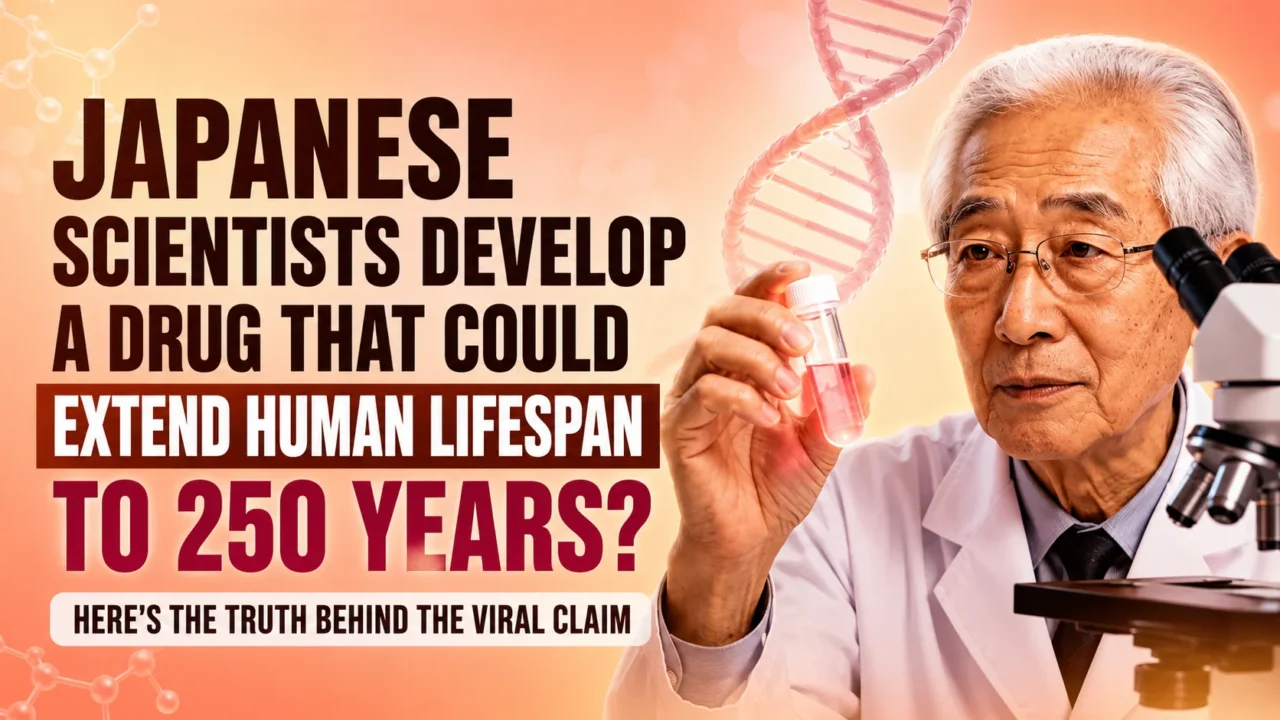

Have you recently seen viral posts claiming that Japanese scientists have developed a drug capable of extending human lifespan to 250 years?
The news has spread rapidly across social media, with many users believing that aging can now be stopped or even reversed. But is there any scientific evidence supporting this extraordinary claim?
In this article, we examine the available scientific research, separate facts from misinformation, and explain what scientists actually know about anti-aging medicine.

Quick Summary
A viral claim suggests Japanese scientists have developed a drug that can extend human lifespan to 250 years. However, there is currently no scientific evidence supporting this claim. Researchers are making significant progress in anti-aging research, including senolytic drugs, DNA repair, and longevity pathways, but no approved medicine can dramatically extend human lifespan.
Overview
| Particular | Details |
|---|---|
| Topic | Viral Claim Fact Check |
| Claim | Drug can extend lifespan to 250 years |
| Scientific Status | Not Proven |
| Current Research | Senolytics, DNA Repair, NAD+, Longevity Genes |
| Human Clinical Evidence | No evidence of 250-year lifespan |
| Approved Anti-aging Drug | None |
What Is the Viral Claim?
According to widely shared social media posts, Japanese researchers have developed a revolutionary anti-aging medicine that can:
- Eliminate aging (senescent) cells
- Repair damaged DNA
- Slow or reverse aging
- Extend human lifespan to 250 years
- Make aging a treatable condition
Although these claims sound exciting, they are not supported by current scientific evidence.
What Does Current Scientific Research Actually Say?
Scientists worldwide—including researchers in Japan—are actively studying the biological mechanisms responsible for aging.
Current research focuses on several key areas:
- Cellular senescence
- DNA repair mechanisms
- Stem cell regeneration
- Mitochondrial health
- Epigenetic modifications
- Caloric restriction pathways
- Longevity-associated genes
Many laboratory studies have shown encouraging results in mice and other experimental models. However, translating these findings into safe and effective human therapies remains a major scientific challenge.
Understanding Senescent Cells (Zombie Cells)
One of the most promising fields of aging research involves senescent cells, commonly called zombie cells.
These cells:
- Stop dividing permanently
- Accumulate naturally with age
- Release inflammatory molecules
- Damage nearby healthy tissues
Scientists believe removing these cells may:
- Improve tissue repair
- Reduce chronic inflammation
- Delay age-related diseases
- Improve overall healthspan
However, eliminating senescent cells does not mean humans can live for centuries.
What Are Senolytic Drugs?
Senolytic drugs are experimental medicines designed to selectively eliminate senescent cells.
Several compounds currently under investigation include:
| Experimental Senolytic | Current Status |
|---|---|
| Dasatinib | Clinical research |
| Quercetin | Experimental studies |
| Fisetin | Clinical investigation |
| Navitoclax | Experimental research |
Early studies suggest these drugs may improve certain age-related conditions, but none have been proven to significantly increase human lifespan, let alone to 250 years.
Can Humans Really Live for 250 Years?
The Short Answer: No.
At present, there is no verified scientific evidence showing that any medicine can extend human lifespan to 250 years.
Researchers have not demonstrated:
- A drug that doubles or triples human lifespan
- A medicine that permanently stops aging
- Clinical proof that humans can live for 250 years
The viral claim remains speculative and should not be considered an established scientific fact.
What Role Does DNA Repair Play in Aging?
As humans grow older:
- DNA accumulates damage
- Cells repair DNA less efficiently
- Genetic mutations increase
- Cellular function gradually declines
Researchers are investigating therapies that may improve DNA repair through:
- NAD⁺ metabolism
- Sirtuin activation
- PARP enzymes
- Gene-editing technologies
These approaches are promising but remain under active research.
Can Vitamin B3 (Nicotinamide Riboside) Extend Lifespan?
Nicotinamide Riboside (NR), a form of Vitamin B3, has gained attention for its potential role in healthy aging.
Studies suggest NR may:
- Increase NAD⁺ levels
- Support mitochondrial function
- Improve cellular energy production
However:
- Human studies remain limited
- Reported benefits are modest
- There is no evidence that NR dramatically extends human lifespan

Why Anti-Aging Research Matters
Even if humans never reach 250 years, anti-aging research has the potential to improve quality of life.
Scientists aim to:
- Delay Alzheimer’s disease
- Reduce Parkinson’s disease progression
- Prevent cardiovascular diseases
- Preserve muscle strength
- Protect brain function
- Extend healthy lifespan (healthspan)
The primary goal is not simply to live longer, but to live healthier.
Major Challenges in Anti-Aging Medicine
Researchers still face several obstacles before anti-aging therapies become widely available.
These include:
- Long-term safety testing
- Large-scale human clinical trials
- Regulatory approval
- Genetic variability among individuals
- Ethical concerns
- High treatment costs
Developing an approved anti-aging medicine could take many years.
Viral Claim vs Scientific Reality
| Viral Claim | Scientific Evidence |
|---|---|
| Drug extends lifespan to 250 years | ❌ No evidence |
| Aging can be completely stopped | ❌ Not proven |
| Senolytic drugs exist | ✅ Yes (experimental) |
| DNA repair research is advancing | ✅ Yes |
| Human anti-aging medicine approved | ❌ No |
Should You Trust Viral Health Claims?
Health-related viral posts often exaggerate scientific discoveries.
Before believing extraordinary claims:
- Verify whether the research is published in peer-reviewed journals.
- Check official announcements from universities or research institutions.
- Avoid relying solely on social media videos or posts.
- Read expert analyses from trusted scientific organizations.
Critical thinking and evidence-based information are essential when evaluating health news.
Internal Linking Suggestions (GDC Classes)
To improve user engagement and SEO, consider linking this article to related content on GDC Classes, such as:
- Latest Pharmacy News
- Pharmacology Notes
- Drug Inspector Preparation
- GPAT Study Materials
- Pharmaceutical Research Updates
- Biotechnology & Genetics Articles
External Linking Suggestions
For additional reading, link to reputable sources such as:
- World Health Organization (WHO)
- National Institutes of Health (NIH)
- Nature
- Cell
- PubMed
Only link to official or peer-reviewed scientific sources when referencing research.
Conclusion
The claim that Japanese scientists have developed a drug capable of extending human lifespan to 250 years is not supported by current scientific evidence.
Researchers in Japan and around the world are making remarkable progress in understanding aging through studies on senescent cells, DNA repair, longevity genes, and metabolic pathways. These discoveries may eventually help people live healthier lives for longer, but no approved medicine currently exists that can extend human lifespan anywhere near 250 years.
As with all extraordinary scientific claims, it is important to rely on peer-reviewed research and trusted medical sources rather than viral social media posts.
Frequently Asked Questions (FAQs)
1. Have Japanese scientists developed a drug that can make humans live for 250 years?
No. There is currently no scientifically validated drug capable of extending human lifespan to 250 years.
2. What are senescent cells?
Senescent cells are aging cells that stop dividing but remain in the body, contributing to inflammation and age-related diseases.
3. What are senolytic drugs?
Senolytic drugs are experimental medicines designed to selectively remove senescent (“zombie”) cells from the body.
4. Is there any approved anti-aging medicine available today?
No. No medicine has been officially approved to stop or reverse human aging.
5. Can Vitamin B3 (Nicotinamide Riboside) increase lifespan?
Current evidence suggests Nicotinamide Riboside may support cellular health, but it has not been proven to dramatically extend human lifespan.
6. Why is anti-aging research important?
Anti-aging research aims to delay age-related diseases, improve overall health, and increase the number of years people live in good health (healthspan).
7. Can DNA repair therapies reverse aging?
DNA repair therapies are an active area of research, but there is currently no evidence that they can completely reverse aging in humans.
8. How can I verify viral scientific claims?
Always check peer-reviewed journals, official university announcements, trusted medical organizations, and reputable scientific publications before accepting extraordinary claims.
Recommended Products