


Introduction
Sun Pharma Advanced Research Company Ltd (SPARC), one of India’s prominent pharmaceutical research and innovation companies, has recently witnessed a downgrade in its quality grade. The downgrade has attracted investor attention, particularly at a time when the stock has experienced significant volatility despite delivering strong year-to-date returns.
While SPARC continues to showcase impressive revenue growth and a strong return on equity, several underlying financial indicators have raised concerns regarding operational efficiency, capital utilization, and long-term sustainability. This analysis examines the key factors behind the downgrade and what it means for investors.
Market Performance Snapshot
SPARC’s stock performance has been mixed across different time horizons.
Share Price Performance
| Metric | Value |
|---|---|
| Current Share Price | ₹196.40 |
| Previous Close | ₹211.90 |
| 52-Week High | ₹248.65 |
| 1-Week Return | -15.78% |
| Sensex 1-Week Return | -2.90% |
| YTD Return | 46.08% |
| Sensex YTD Return | -12.85% |
| 5-Year Return | -10.71% |
| 10-Year Return | -30.28% |
The sharp one-week decline indicates increased market caution following the quality downgrade, despite the stock outperforming the broader market on a year-to-date basis.
Strong Revenue Growth Remains a Key Strength
One of SPARC’s most impressive achievements has been its exceptional revenue expansion over recent years.
Growth Metrics
| Financial Indicator | 5-Year Growth |
|---|---|
| Sales Growth | 398.73% |
| EBIT Growth | 141.48% |
The company’s nearly 400% sales growth reflects its ability to scale research activities and capitalize on opportunities within the pharmaceutical innovation ecosystem.
Similarly, EBIT growth of over 141% demonstrates improvement in operational earnings and business expansion. However, the quality downgrade suggests that strong growth alone is insufficient when other financial metrics continue to deteriorate.

Return Ratios Present a Mixed Picture
Return on Equity (ROE)
SPARC continues to maintain a remarkably strong average Return on Equity (ROE).
| Metric | Value |
|---|---|
| Average ROE | 58.47% |
A ROE of nearly 58.5% indicates efficient utilization of shareholder funds and remains significantly above industry averages. This is a positive sign for equity investors.
Return on Capital Employed (ROCE)
However, a major concern emerges when analyzing ROCE.
| Metric | Value |
|---|---|
| Average ROCE | -178.66% |
A deeply negative ROCE indicates that the company’s overall capital base is not generating sufficient operating returns. This suggests inefficiencies in asset utilization and raises concerns about long-term capital allocation strategies.
Debt Position: Strong Balance Sheet but Operational Challenges
From a leverage perspective, SPARC appears financially stable.
Debt Indicators
| Metric | Value |
|---|---|
| Net Debt to Equity | 0.42 |
| Net Debt Position | Negative (Net Cash) |
A net cash position reduces financial risk and provides flexibility for future investments and R&D initiatives.
However, another critical metric raises red flags.
Interest Coverage
| Metric | Value |
|---|---|
| EBIT to Interest Coverage | -78.63 |
Negative interest coverage implies that operating earnings have not consistently covered interest obligations. This could be due to operating losses, non-cash expenses, or irregular earnings patterns. Investors should monitor this metric closely.
Capital Utilization Efficiency
Capital efficiency remains one of SPARC’s weakest areas.
| Metric | Value |
|---|---|
| Sales to Capital Employed Ratio | 0.77 |
This means that every ₹1 invested in capital generates only ₹0.77 in revenue. Ideally, investors prefer this ratio to exceed 1, indicating better utilization of assets and investments.
Combined with the negative ROCE, this suggests the company faces challenges converting capital investments into sustainable profitability.
Corporate Governance and Ownership Structure
Despite operational concerns, SPARC demonstrates several governance strengths.
Shareholding Indicators
| Indicator | Status |
|---|---|
| Promoter Share Pledge | 0% |
| Institutional Holding | 2.57% |
| Tax Ratio | Negative |
The absence of pledged promoter shares is a positive sign and reduces governance risks. However, relatively low institutional ownership may indicate limited confidence among large investors.
Industry Comparison
SPARC’s downgrade has impacted its position relative to peers within the Pharmaceuticals & Biotechnology sector.
Quality Rating Comparison
| Company | Quality Rating |
|---|---|
| Gland Pharma | Good |
| Ajanta Pharma | Good |
| AstraZeneca Pharma | Good |
| SPARC | Average |
| Piramal Pharma | Average |
| Wockhardt | Below Average |
This ranking indicates that SPARC currently trails several leading pharmaceutical companies in terms of overall financial quality and operational performance.
Why Was the Quality Grade Downgraded?
The downgrade appears to be driven primarily by the following concerns:
Key Negative Factors
- Deeply negative ROCE (-178.66%)
- Negative EBIT-to-interest coverage ratio
- Suboptimal capital utilization
- Limited institutional participation
- Inconsistent profitability trends
Key Positive Factors
- Exceptional sales growth
- Strong EBIT growth
- High ROE
- Low leverage
- Zero pledged shares
While growth metrics remain attractive, quality assessments place greater emphasis on sustainability, profitability, and efficient capital allocation.
Impact on Investors
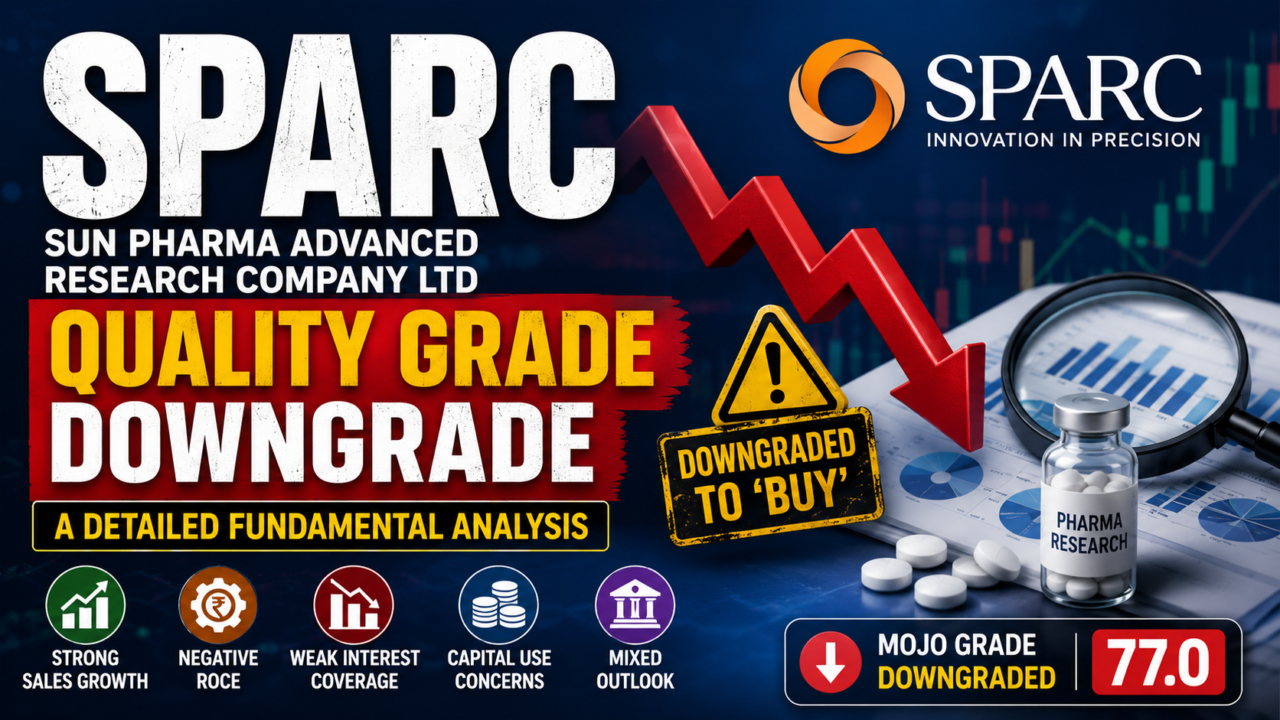
The company’s Mojo Grade has been downgraded from Strong Buy to Buy, with a current Mojo Score of 77.0.
Investor Considerations
For Conservative Investors
- Wait for improvement in ROCE and profitability metrics.
- Monitor upcoming quarterly earnings.
- Assess management’s capital allocation strategy.
For Aggressive Investors
- Strong sales growth may present long-term opportunities.
- Current price correction could offer an attractive entry point.
- Future value depends heavily on operational turnaround.
Future Outlook
SPARC remains a unique player in India’s pharmaceutical research landscape. The company possesses strong growth potential driven by innovation and R&D capabilities. However, management must address concerns surrounding capital efficiency and profitability consistency.
The next few quarters will be crucial in determining whether SPARC can convert its revenue growth into sustainable shareholder value.
Key areas investors should monitor include:
- Improvement in ROCE
- Positive interest coverage
- Enhanced capital productivity
- Institutional investor participation
- Pipeline commercialization progress
Conclusion
Sun Pharma Advanced Research Company Ltd’s quality grade downgrade reflects a complex financial picture. On one hand, the company boasts exceptional revenue growth, robust EBIT expansion, and strong returns on equity. On the other hand, negative ROCE, weak interest coverage, and operational inefficiencies have weakened its overall quality profile.
While SPARC still maintains considerable growth potential, investors should approach the stock with a balanced perspective. The company’s ability to improve capital efficiency and deliver consistent profitability will ultimately determine whether it can regain a higher quality rating and strengthen investor confidence in the years ahead.
Recommended Products