


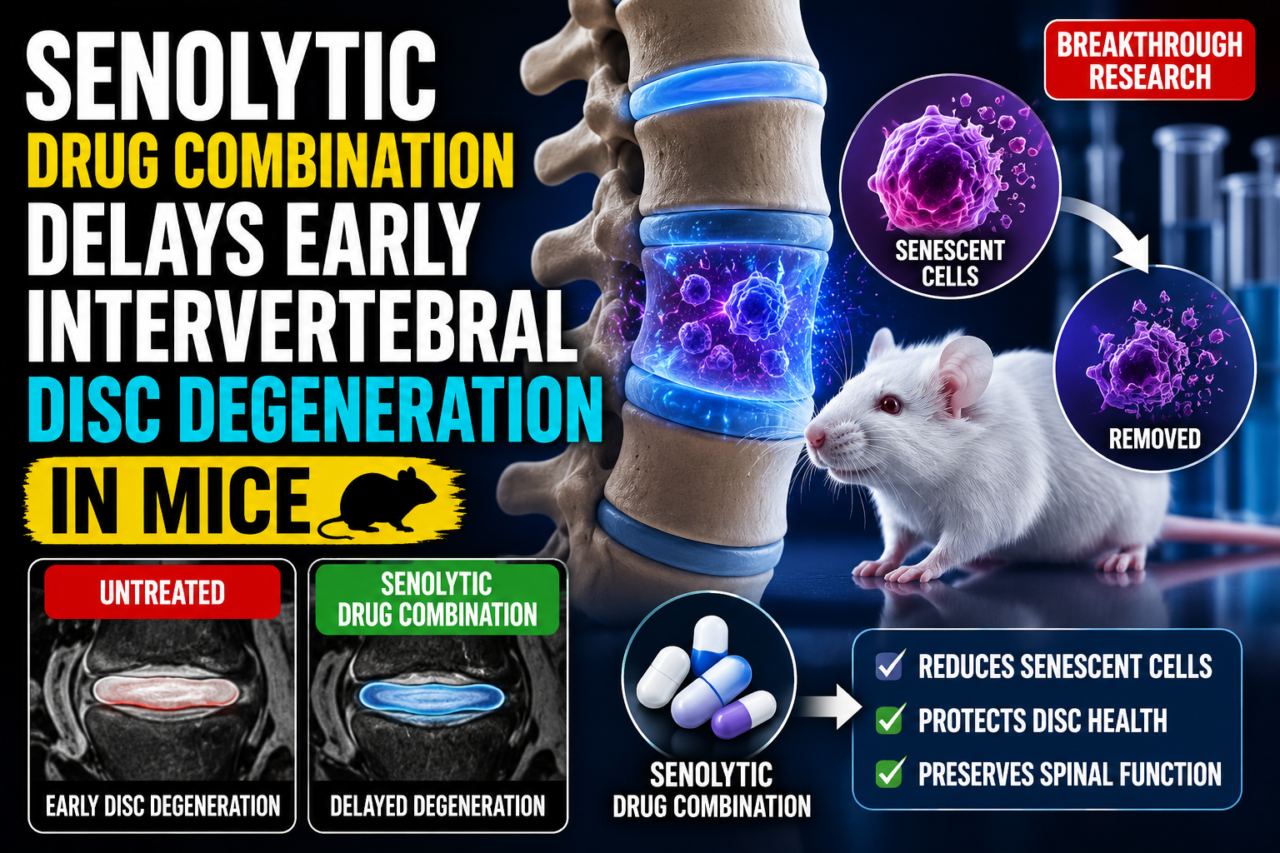

A new study published in Bone Research has revealed a promising breakthrough in the fight against chronic back and neck pain. Researchers from Thomas Jefferson University, USA, discovered that a senolytic drug combination known as dasatinib and quercetin (DQ) can significantly delay early intervertebral disc degeneration in mice.
The findings could pave the way for future therapies that target the root cause of spinal disc degeneration instead of simply managing symptoms.
What Is Intervertebral Disc Degeneration?
Intervertebral discs are soft, cushion-like structures located between the bones of the spine. These discs absorb shock and help maintain flexibility in the neck and back.
Over time, discs can begin to degenerate due to aging, inflammation, injury, or genetic factors. This condition, known as intervertebral disc degeneration (IVDD), is one of the leading causes of:
- Chronic lower back pain
- Neck pain
- Reduced spinal mobility
- Disability in older adults
Current treatments mainly focus on symptom relief through painkillers, physiotherapy, or surgery. However, there are very few therapies that actually slow or prevent degeneration itself.
The Role of Cellular Senescence in Disc Degeneration
Scientists increasingly believe that cellular senescence plays a major role in accelerating spinal disc damage.
Cellular senescence occurs when cells lose their ability to divide and function properly. These aging cells release harmful inflammatory molecules that damage surrounding tissues and promote degeneration.
In spinal discs, the accumulation of senescent cells can:
- Increase inflammation
- Break down disc tissue
- Reduce tissue repair capacity
- Accelerate disease progression
Because of this, researchers are exploring “senolytic” therapies — treatments designed to selectively eliminate senescent cells.
What Did the Researchers Study?
The research team was led by Professor Makarand V. Risbud from the Department of Orthopaedic Surgery at Sidney Kimmel Medical College, Thomas Jefferson University.
The scientists used SM/J mice, a special mouse model genetically prone to early-onset intervertebral disc degeneration.
The study compared two senolytic treatment approaches:
1. Navitoclax
A drug that targets BCL-2 family survival proteins involved in protecting senescent cells.
2. Dasatinib + Quercetin (DQ)
A widely studied senolytic drug combination known for removing senescent cells and reducing inflammation.
The goal was to determine whether these therapies could delay or slow early spinal disc degeneration.
Key Findings of the Study
The results showed that the DQ combination therapy produced significant protective effects against early disc degeneration.
Researchers observed:
- Reduced accumulation of senescent cells
- Lower inflammation levels
- Improved disc structure preservation
- Delayed progression of disc degeneration
The DQ treatment appeared to outperform navitoclax in several important markers related to tissue protection and inflammation control.
These findings suggest that targeting cellular aging processes could become a new strategy for treating degenerative spinal diseases.
Why This Discovery Matters
Millions of people worldwide suffer from chronic back pain caused by degenerative disc disease. Existing treatments mainly aim to relieve pain temporarily rather than stopping tissue deterioration.
This study is important because it focuses on the biological mechanisms driving degeneration itself.
If future human studies confirm these results, senolytic therapies could potentially:
- Slow spinal aging
- Delay chronic back pain development
- Reduce the need for surgery
- Improve long-term spinal health
Potential Future of Senolytic Therapies
Senolytic medicine is an emerging field in aging and regenerative research. Scientists are investigating these therapies for several age-related conditions including:
- Osteoarthritis
- Neurodegenerative diseases
- Cardiovascular disease
- Fibrosis
- Degenerative spine disorders
The success of DQ therapy in this study strengthens interest in developing anti-aging treatments that target senescent cells directly.
Challenges Before Human Use
Although the findings are highly promising, more research is needed before these therapies can be used clinically in humans.
Important next steps include:
- Human clinical trials
- Long-term safety evaluation
- Determining optimal dosage
- Understanding side effects
- Evaluating effectiveness across different age groups
Animal studies provide valuable insight, but human biology is far more complex.

Published in Bone Research
The study was published on April 14, 2026, in Volume 14 of the prestigious scientific journal Bone Research.
The publication adds important evidence supporting the role of cellular senescence in musculoskeletal degeneration and highlights the therapeutic potential of senolytic drugs.
Recommended Products