

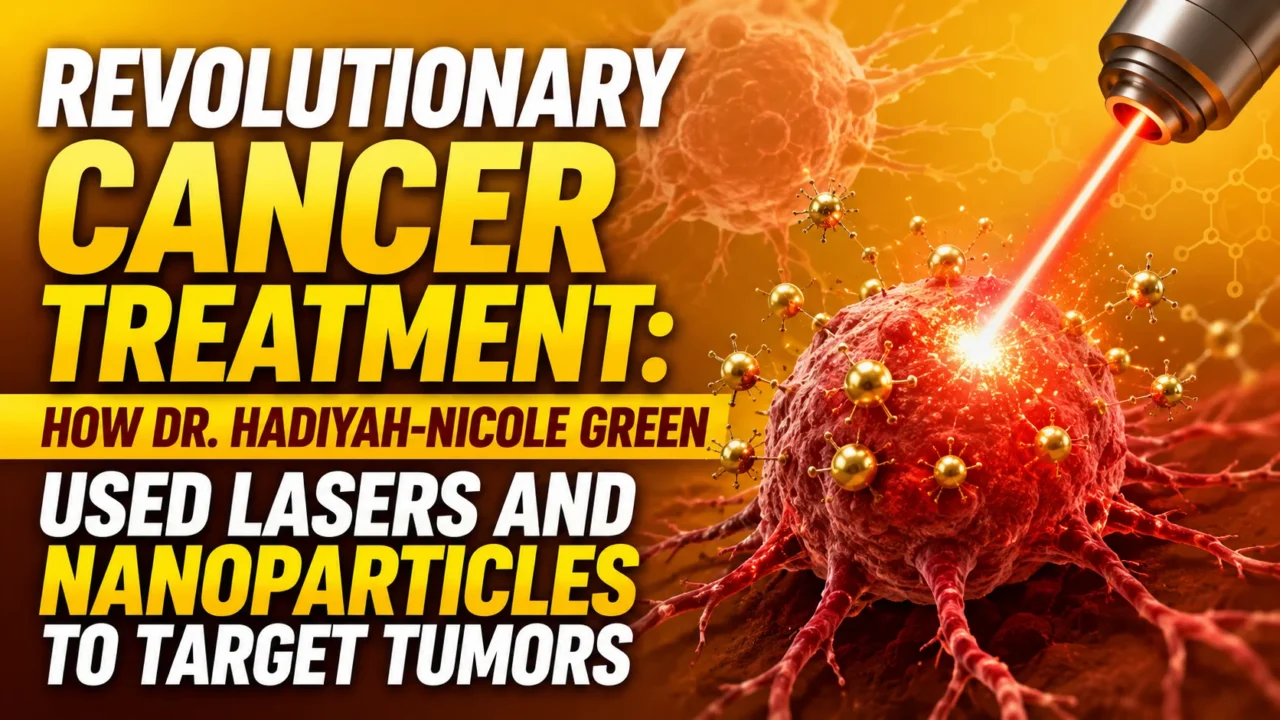

Cancer treatment has long relied on surgery, chemotherapy, and radiation therapy. While these treatments have saved countless lives, they often come with significant side effects and can impact healthy tissues. However, a groundbreaking innovation developed by Dr. Hadiyah-Nicole Green is attracting global attention for its potential to transform cancer care.
By combining laser technology and specially designed nanoparticles, Dr. Green and her research team have developed a promising approach that aims to destroy cancer cells while minimizing damage to surrounding healthy tissue.

Who Is Dr. Hadiyah-Nicole Green?
Dr. Hadiyah-Nicole Green is an American physicist, scientist, and cancer researcher known for her pioneering work in nanotechnology-based cancer treatments.
She has dedicated her career to finding safer and more effective ways to treat cancer, particularly focusing on methods that can selectively target tumor cells without exposing the entire body to toxic treatments.
Her innovative research has earned recognition worldwide and has sparked hope for future cancer therapies.
The Science Behind the Innovation
The treatment developed by Dr. Green combines two powerful technologies:
1. Nanoparticles
Nanoparticles are extremely tiny particles measured in nanometers. These particles can be engineered to interact with specific cells inside the body.
In Dr. Green’s research, specially designed nanoparticles are introduced into tumor tissue.
2. Laser Activation
Once the nanoparticles accumulate in the tumor, a laser is applied externally.
The nanoparticles absorb the laser energy and convert it into heat, creating a highly localized therapeutic effect that destroys cancer cells.
This process is often referred to as laser-activated nanoparticle therapy.
How Does the Treatment Work?
The procedure generally follows several steps:
Step 1: Nanoparticle Delivery
Researchers inject specialized nanoparticles into or near the tumor.
Step 2: Targeted Accumulation
The particles remain concentrated in cancerous tissue.
Step 3: Laser Exposure
A low-energy laser is directed toward the tumor site.
Step 4: Heat Generation
The nanoparticles absorb laser energy and generate heat.
Step 5: Tumor Destruction
The heat damages and destroys cancer cells while minimizing harm to nearby healthy tissues.
Why Is This Approach Different?
Traditional cancer treatments often affect both cancerous and healthy cells.
Chemotherapy
- Travels throughout the body
- Can cause nausea, hair loss, fatigue, and immune suppression
Radiation Therapy
- May damage nearby healthy tissues
- Can produce long-term side effects
Laser-Nanoparticle Therapy
- Targets tumors directly
- Requires lower treatment intensity
- May reduce side effects
- Focuses treatment only where needed
Potential Benefits
Highly Targeted Treatment
The therapy aims to attack only cancerous tissue.
Reduced Side Effects
Healthy cells experience less exposure compared to traditional therapies.
Non-Invasive Approach
The treatment does not require major surgery.
Faster Recovery
Patients may potentially experience shorter recovery times.
Broad Applications
Researchers believe the technology could eventually be adapted for multiple cancer types.
What Do Current Studies Show?
Early laboratory and preclinical studies have demonstrated encouraging results.
Researchers observed significant tumor reduction after laser activation of nanoparticles in experimental settings.
However, it is important to understand that:
- More clinical research is still needed.
- Large-scale human trials are necessary.
- Long-term safety and effectiveness must be confirmed.
Scientific experts emphasize that while the findings are promising, the treatment is still undergoing continued development and evaluation.
Challenges Ahead
Despite its potential, several challenges remain:
Clinical Validation
The therapy must be tested extensively in human clinical trials.
Regulatory Approval
Health authorities must verify safety and effectiveness before widespread use.
Manufacturing and Cost
Producing specialized nanoparticles at scale can be expensive.
Accessibility
Researchers hope future advancements will make the technology available globally.
The Future of Cancer Treatment
Nanotechnology is rapidly becoming one of the most exciting areas in modern medicine.
Scientists worldwide are exploring:
- Targeted drug delivery
- Nanoparticle-based imaging
- Precision cancer therapies
- Personalized treatment approaches
Dr. Green’s work represents a significant step toward a future where cancer treatments become more precise, less toxic, and more effective.
Conclusion
Dr. Hadiyah-Nicole Green’s laser-activated nanoparticle therapy offers an innovative approach to cancer treatment by combining advanced nanotechnology with targeted laser energy. The goal is to destroy tumors while minimizing damage to healthy tissues, potentially reducing many of the side effects associated with conventional cancer therapies.
Although further research and clinical testing are required before widespread adoption, this groundbreaking work highlights the enormous potential of nanomedicine in the fight against cancer.
As science continues to advance, treatments like these could help redefine how cancer is treated in the years ahead.
Recommended Products