


For decades, biology has followed a fundamental principle known as the Central Dogma — the flow of genetic information from DNA → RNA → Protein. DNA stores instructions, RNA carries those instructions, and proteins perform most biological functions inside living organisms.
But now, scientists have introduced a groundbreaking concept that appears to work in the opposite direction.
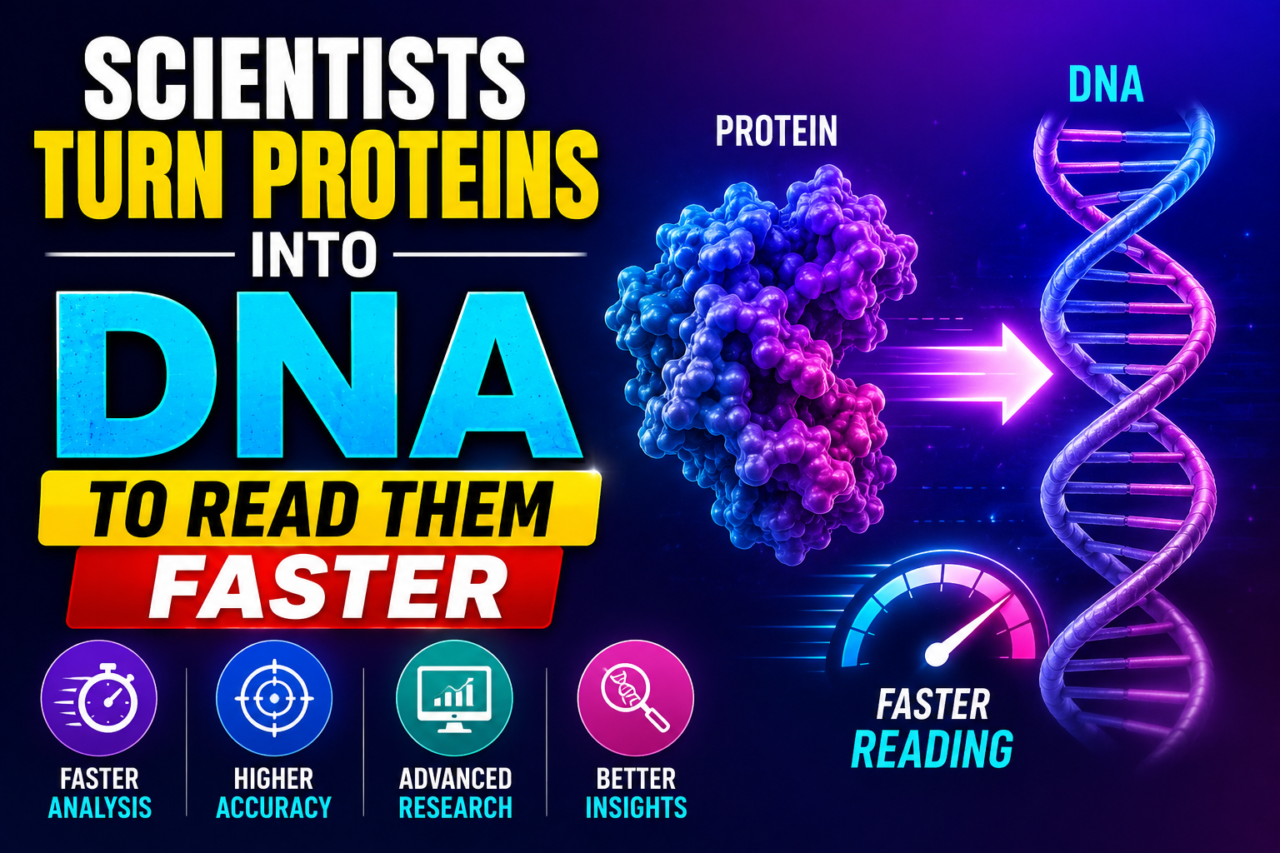
Researchers have developed a new reverse translation method that can convert proteins into DNA-like information, allowing proteins to be analyzed using powerful DNA sequencing technologies. This innovation could dramatically accelerate protein sequencing and transform fields like medicine, biotechnology, drug discovery, and disease diagnostics.
Why Proteins Matter So Much
Proteins are often called the “working molecules” of life. They:
- Build tissues and muscles
- Carry oxygen in blood
- Fight infections
- Control chemical reactions
- Regulate body functions
Every disease, from cancer to Alzheimer’s, involves proteins in some way. That’s why understanding proteins is one of the biggest goals in modern biology.
However, studying proteins has always been more difficult than studying DNA.
The Problem With Traditional Protein Sequencing
DNA sequencing technology has advanced rapidly over the last two decades. Scientists can now sequence entire genomes quickly and cheaply.
Protein sequencing, however, remains slower and more complex because:
- Proteins are chemically diverse
- They fold into complicated shapes
- Tiny changes are difficult to detect
- Existing methods require expensive instruments
Traditional protein analysis methods like mass spectrometry are powerful but still have limitations in speed, scalability, and sensitivity.
Scientists wanted a way to study proteins with the same efficiency as DNA.
Now, they may have found it.
What Is the New Discovery?
Researchers created a method that effectively converts protein information into DNA-compatible signals.
In simple terms:
- A protein molecule is analyzed at the single-molecule level
- Its amino acid sequence is translated into DNA-readable data
- Existing DNA sequencing machines then read the information rapidly
This process is sometimes described as “reverse translation” because information is moving from proteins back toward DNA-readable form.
It does not mean proteins naturally become DNA inside the body. Instead, scientists engineered a technology that allows protein data to be processed through DNA sequencing systems.
Why This Is Such a Big Deal
This breakthrough could change molecular biology in several major ways.
1. Faster Protein Sequencing
DNA sequencers are already highly optimized and widely available. By adapting proteins for DNA sequencing platforms, researchers can analyze proteins much faster than before.
2. Single-Molecule Precision
The technique works at the single-molecule level, meaning scientists can study individual proteins instead of large mixed samples.
This increases accuracy and sensitivity.
3. Better Disease Detection
Many diseases produce tiny protein changes long before symptoms appear.
Faster protein sequencing could help doctors detect:
- Cancer earlier
- Neurodegenerative diseases
- Viral infections
- Rare genetic disorders
4. Drug Development
Pharmaceutical companies rely heavily on protein analysis.
This technology may accelerate:
- Drug discovery
- Vaccine development
- Personalized medicine
- Biomarker identification
5. Understanding Human Biology
Proteins constantly change depending on environment, stress, diet, and disease.
This method may help scientists understand biological processes in unprecedented detail.
Does This Reverse the Central Dogma?
Not exactly.
The classic Central Dogma still remains scientifically valid:
DNA → RNA → Protein
However, this discovery shows that researchers can artificially recover protein information and convert it into a DNA-readable format for analysis.
So rather than “breaking” biology, the technology expands the tools scientists use to study life.
It represents a major technological innovation rather than a complete rewrite of molecular biology.
Potential Future Applications
Experts believe this breakthrough could lead to:
- Portable protein sequencing devices
- Real-time disease monitoring
- Faster blood testing
- Precision cancer diagnostics
- Advanced biotech manufacturing
- AI-powered molecular analysis
In the future, protein sequencing may become as common and accessible as DNA sequencing is today.
Challenges Still Remain
Although promising, the technology is still in early stages.
Researchers must improve:
- Accuracy
- Cost efficiency
- Scalability
- Clinical validation
- Commercial accessibility
Large-scale adoption may take several years, but the scientific community is already calling this a major milestone.
Final Thoughts
The ability to convert protein information into DNA-readable sequences could become one of the most important innovations in modern biotechnology.
By combining the complexity of proteins with the speed of DNA sequencing, scientists may unlock a completely new era of molecular medicine.
What once seemed impossible — reading proteins as easily as DNA — is now moving closer to reality.
The future of biology may not only depend on understanding genes, but also on decoding proteins faster, deeper, and more accurately than ever before.
Keywords:
Protein sequencing, reverse translation, DNA sequencing, central dogma, molecular biology, biotechnology, genomics, proteomics, single-molecule sequencing, medical research, protein to DNA technology
Recommended Products