


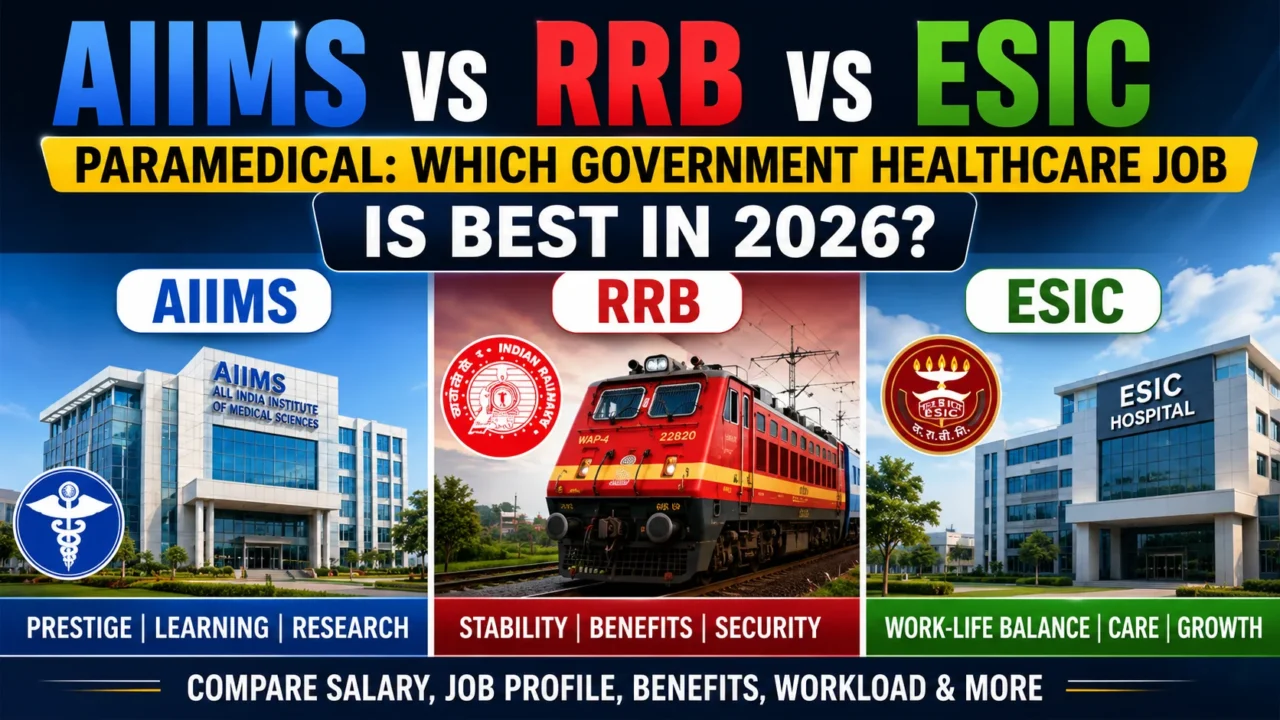

Government paramedical jobs continue to be among the most preferred career options for healthcare professionals in India. Among the top recruiters, AIIMS, RRB (Railways), and ESIC offer attractive salaries, job security, allowances, and long-term career growth. However, each organization has distinct advantages that suit different career goals.
This article provides a detailed comparison of AIIMS, RRB, and ESIC paramedical jobs to help candidates make an informed decision in 2026.
Understanding the Organizations
AIIMS
The All India Institute of Medical Sciences (AIIMS) is India’s premier healthcare institution. It is known for excellence in patient care, medical education, and research. Working at AIIMS provides exposure to advanced medical technologies, specialized departments, and some of the country’s most experienced healthcare professionals.
RRB (Railways)
The Railway Recruitment Board recruits paramedical staff for Indian Railways hospitals and healthcare units. Railway healthcare services support a large workforce and their families, making it one of the most stable government healthcare sectors.
ESIC
The Employees’ State Insurance Corporation (ESIC) provides healthcare services to insured employees and their dependents through hospitals and dispensaries across India. ESIC is known for its structured work environment and balanced workload.
Salary Comparison
| Organization | Approximate Monthly Salary |
|---|---|
| AIIMS | ₹55,000 – ₹90,000+ |
| RRB | ₹45,000 – ₹80,000+ |
| ESIC | ₹50,000 – ₹85,000+ |
Salary varies based on post, pay level, experience, city category, and applicable allowances. AIIMS generally offers better earning potential due to specialized healthcare roles, while ESIC and RRB also provide competitive compensation packages.
Work Environment and Workload
AIIMS
AIIMS hospitals handle a large patient load and complex medical cases. Employees gain significant practical experience and exposure to advanced healthcare practices.
Workload: High
RRB
Railway hospitals typically offer a structured work environment with moderate patient flow and well-defined responsibilities.
Workload: Moderate
ESIC
ESIC hospitals often provide fixed duty schedules and a balanced work environment.
Workload: Moderate

Career Growth Opportunities
AIIMS
AIIMS offers strong opportunities for:
- Research and development
- Higher education
- Academic careers
- Specialized healthcare roles
- Clinical excellence
RRB
Railway healthcare services provide:
- Departmental promotions
- Administrative positions
- Long-term government career progression
- Stable professional growth
ESIC
ESIC offers:
- Promotion opportunities
- Clinical experience
- Hospital administration roles
- Consistent career advancement
Learning and Professional Exposure
| Factor | AIIMS | RRB | ESIC |
|---|---|---|---|
| Clinical Exposure | Excellent | Good | Good |
| Research Opportunities | Excellent | Limited | Moderate |
| Advanced Technology Exposure | Excellent | Good | Good |
| Academic Opportunities | Excellent | Limited | Limited |
AIIMS clearly leads in terms of learning opportunities, research exposure, and specialization.
Job Security
All three organizations provide excellent job security as central government institutions.
| Organization | Job Security |
|---|---|
| AIIMS | Very High |
| RRB | Very High |
| ESIC | Very High |
Government healthcare jobs remain among the safest and most stable career options in India.
Employee Benefits and Allowances
AIIMS
- Dearness Allowance (DA)
- House Rent Allowance (HRA)
- Transport Allowance (TA)
- Medical benefits
- Leave benefits
RRB
- Dearness Allowance (DA)
- House Rent Allowance (HRA)
- Transport Allowance (TA)
- Railway travel facilities
- Medical benefits
- Retirement benefits
ESIC
- Dearness Allowance (DA)
- House Rent Allowance (HRA)
- Transport Allowance (TA)
- Medical facilities
- Leave benefits
RRB generally provides additional railway-related benefits that many candidates find attractive.
Advantages and Challenges
AIIMS
Advantages
- Highest professional prestige
- Advanced clinical exposure
- Excellent research opportunities
- Better specialization prospects
- Strong academic environment
Challenges
- High competition
- Heavy workload
- Limited vacancies
RRB
Advantages
- Strong employee benefits
- Excellent job security
- Stable work environment
- Departmental growth opportunities
Challenges
- Transfer possibilities
- Remote postings in some zones
ESIC
Advantages
- Better work-life balance
- Urban posting opportunities
- Fixed working hours in many locations
- Comfortable working environment
Challenges
- Limited research opportunities
- Lower exposure to super-specialty healthcare compared to AIIMS
Which Organization Should You Choose?
Choose AIIMS If:
- You are interested in research and academics.
- You want exposure to advanced healthcare practices.
- You aim to become a specialist in your field.
- You are comfortable working in a demanding environment.
Choose RRB If:
- You want a secure government career.
- You value railway benefits and facilities.
- You are comfortable with transfer policies.
- You prefer a structured organizational setup.
Choose ESIC If:
- Work-life balance is important to you.
- You prefer urban healthcare settings.
- You want predictable working hours.
- You seek a balanced professional and personal life.
Final Verdict
There is no universal winner among AIIMS, RRB, and ESIC because each organization serves different career objectives.
AIIMS is the best choice for candidates seeking prestige, research opportunities, advanced clinical exposure, and academic growth.
RRB is ideal for those looking for long-term stability, strong employee benefits, and a structured government career.
ESIC is the preferred option for professionals who prioritize work-life balance, urban postings, and a comfortable working environment.
The best decision depends on your personal career goals, preferred work environment, and long-term aspirations. Before applying, evaluate what matters most to you—learning opportunities, salary growth, job stability, or lifestyle balance—and choose accordingly.
Recommended Products