


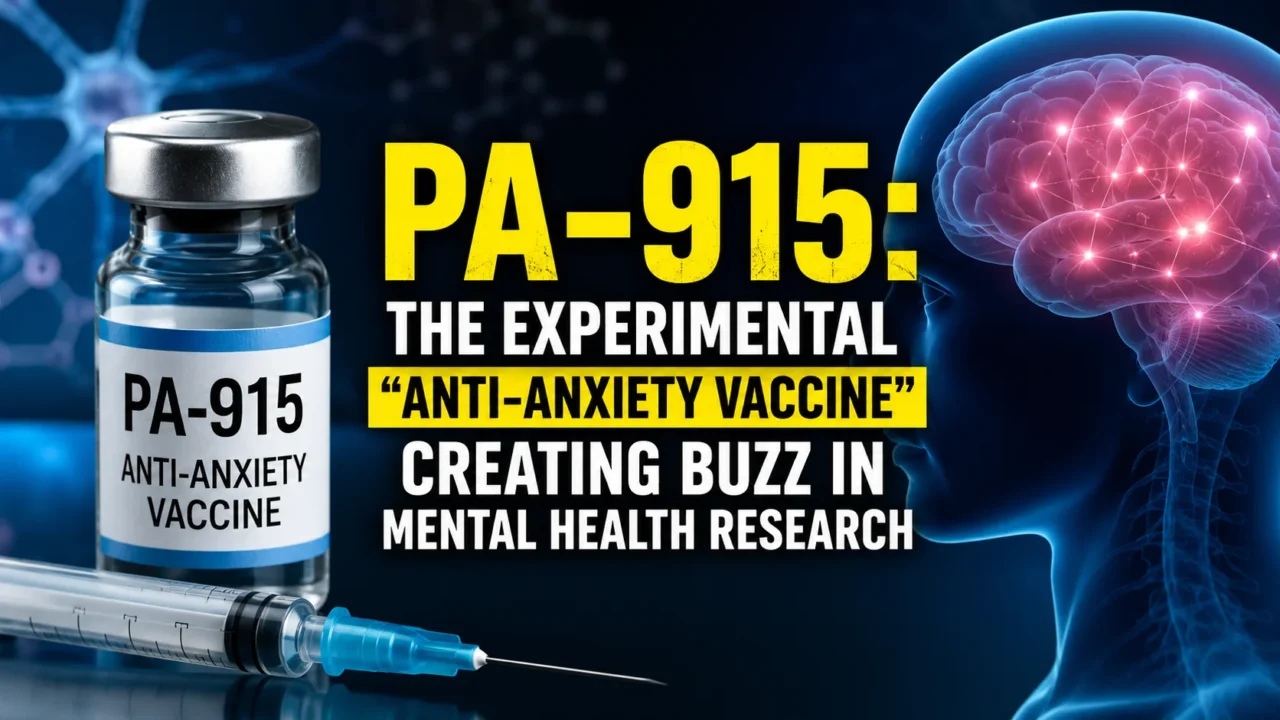

Mental health disorders such as anxiety and depression affect millions of people worldwide. While current treatments like antidepressants, anti-anxiety medications, and psychotherapy help many individuals, researchers are constantly exploring new approaches that may provide longer-lasting relief. One experimental compound that has recently attracted attention is PA-915, sometimes referred to on social media as a potential “anti-anxiety vaccine.”
However, it is important to understand that PA-915 is not currently an approved vaccine and remains in the research stage.

What is PA-915?
PA-915 is an experimental compound being studied for its potential anti-anxiety and antidepressant-like effects. Early preclinical studies suggest that a single administration may produce long-lasting effects on stress-related behaviors in animal models.
Researchers are investigating whether PA-915 can influence brain pathways involved in stress regulation and emotional processing.
How Does PA-915 Work?
PA-915 is believed to act on the PAC1 receptor (Pituitary Adenylate Cyclase-Activating Polypeptide Receptor 1), an important component of the body’s stress-response system.
The PAC1 receptor is involved in regulating the:
- Hypothalamic-Pituitary-Adrenal (HPA) Axis
- Stress hormone (cortisol) release
- Emotional and anxiety-related responses
By targeting this pathway, PA-915 may help reduce excessive stress signaling associated with anxiety and depression.
Why Is It Being Called an “Anti-Anxiety Vaccine”?
The term “anti-anxiety vaccine” has gained popularity because some early studies suggest that a single dose of PA-915 may produce effects lasting several weeks.
However, unlike traditional vaccines that train the immune system to prevent infectious diseases, PA-915 does not function as a conventional vaccine. It is better described as an experimental neuropsychiatric therapeutic agent.
Therefore, the phrase “anti-anxiety vaccine” should be viewed as a simplified media description rather than a scientific classification.
Findings from Early Research
Preclinical studies have reported that PA-915 may:
- Reduce anxiety-like behaviors
- Produce antidepressant-like effects
- Show longer-lasting activity than some conventional treatments
- Modulate stress-related brain pathways
These findings are promising but have primarily been observed in animal studies.
Potential Advantages
If future human studies confirm its effectiveness, PA-915 could offer several benefits:
1. Long-Lasting Effects
A single administration may provide relief for an extended period.
2. Improved Treatment Adherence
Patients may not need to take daily medication.
3. Novel Mechanism of Action
PA-915 targets stress pathways differently from many existing antidepressants.
4. Potential for Treatment-Resistant Cases
New therapeutic options may help patients who do not respond well to current medications.
Current Limitations
Despite the excitement, several important limitations remain:
- Human clinical trials are still needed.
- Long-term safety has not been established.
- Optimal dosing remains unknown.
- Regulatory approval is far from certain.
- Results seen in animals do not always translate to humans.
Expert Perspective
Mental health researchers emphasize that while PA-915 is an interesting scientific development, it should not be considered a cure for anxiety or depression at this stage. More research is required before healthcare professionals can determine its effectiveness and safety in humans.
Conclusion
PA-915 represents an innovative approach to treating anxiety and depression by targeting the brain’s stress-response system. Early studies suggest it may provide long-lasting anti-anxiety and antidepressant-like effects, generating excitement among researchers.
However, PA-915 remains an experimental compound, and there is currently no approved “anti-anxiety vaccine” available for public use. Future clinical trials will determine whether this promising research can eventually become a safe and effective treatment option for patients struggling with anxiety and depression.
Recommended Products