

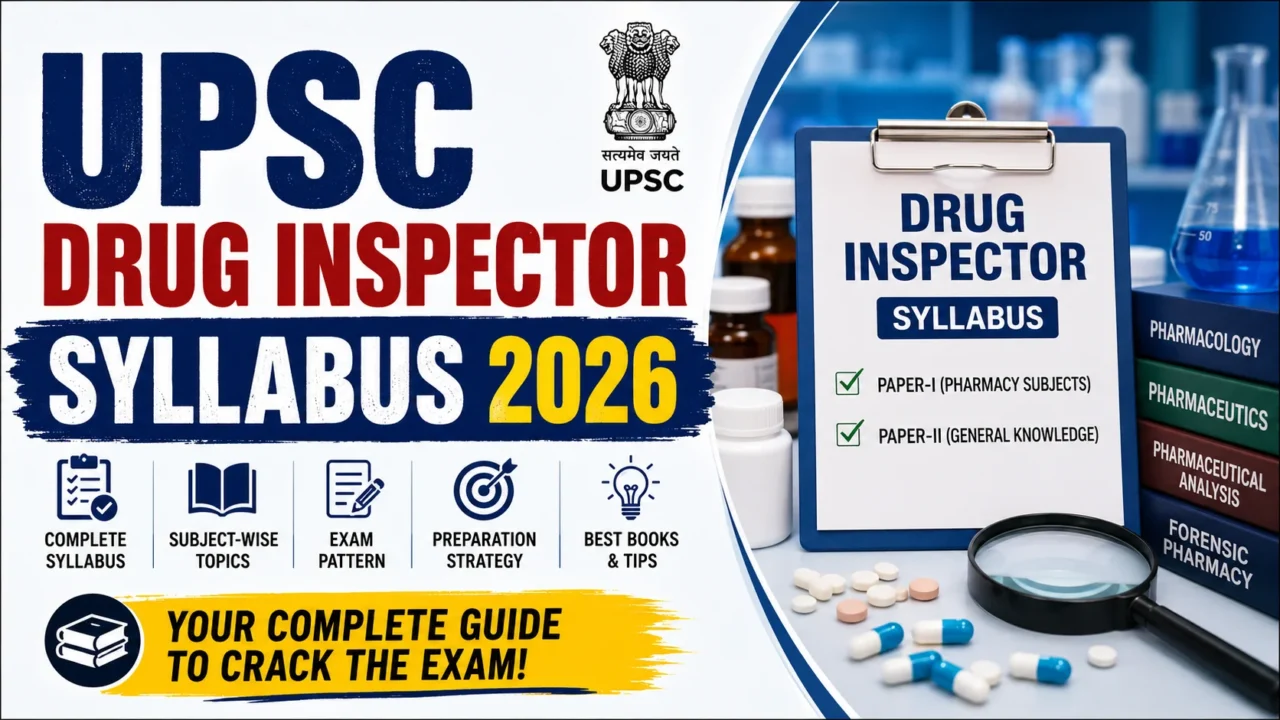

The Union Public Service Commission (UPSC) Drug Inspector examination is one of the most prestigious opportunities for pharmacy graduates aspiring to work in the pharmaceutical regulatory sector. A Drug Inspector plays a vital role in ensuring the quality, safety, and efficacy of medicines available in the Indian market.
If you are preparing for the upcoming UPSC Drug Inspector Recruitment 2026, understanding the complete syllabus is the first and most important step. This article provides a detailed overview of the syllabus, subject-wise topics, and preparation strategy to help you score well in the examination.
UPSC Drug Inspector Exam Pattern
The UPSC Drug Inspector examination consists of two papers, both conducted on the same day.
Paper-I
This paper mainly evaluates the candidate’s pharmaceutical knowledge and professional competency.
Paper-II
This paper assesses General Knowledge, Current Affairs, Constitution, Economy, Geography, History, and related subjects.
UPSC Drug Inspector Paper-I Syllabus
1. Forensic Pharmacy
This section focuses on pharmaceutical legislation and ethics.
Important Acts
- Drugs and Cosmetics Act, 1940
- Pharmacy Act, 1948
- Drugs and Magic Remedies Act, 1954
- Medical and Toilet Preparations Act, 1955
- Prevention of Cruelty to Animals Act
- Drug Price Control Order (DPCO)
- Medical Termination of Pregnancy Act
- Poisons Act
- Dangerous Drugs Act
- Trademark Registration Act
- Pharmaceutical Ethics
2. Manufacturing Pharmacy
Candidates should prepare the manufacturing process, formulation, quality control, and evaluation of pharmaceutical dosage forms.
Important Topics
- Tablets
- Tablet Coating
- Capsules
- Blood Fluids and Electrolytes
- Parenteral Preparations
- Emulsions
- Suspensions
- Ointments
- Creams
- Ophthalmic Preparations
- Surgical Dressings
- Vaccines
- Biological Preparations
- Biopharmaceutics
3. Pharmaceutical Analysis
Questions are generally asked from analytical methods and quality control.
Important Topics
- Limit Test
- Bioassay
- Sterility Test
- Pyrogen Test
- Karl Fischer Titration
- Alcohol Determination
- Microbiological Assay
- Colorimeter
- Fluorimeter
- Nephelometer
- Turbidimeter
4. Medicinal Chemistry
Candidates should know the structure, storage, and therapeutic uses of important drug classes.
Important Drug Categories
- Steroids
- Antihistamines
- Sedatives
- Hypnotics
- Psychotherapeutic Agents
- Analgesics
- Cardiovascular Drugs
5. Pharmacognosy
This section covers natural drugs, their source, chemical constituents, adulteration, and medicinal uses.
Important Crude Drugs
- Rauwolfia
- Belladonna
- Cinchona
- Senna
- Aloe
- Digitalis
- Opium
- Cinnamon
- Tulsi
- Brahmi
- Bael
- Ephedra
- Ipecac
- Nux Vomica
- Kurchi
6. Pharmacology & Toxicology
One of the highest-scoring sections in the exam.
Important Topics
- Drug Receptors
- Mechanism of Action
- Drug Antagonism
- Pharmacokinetics
- Routes of Drug Administration
- Bioavailability
- Drug Dependence
- Drug Addiction
- Drug Abuse
- Drug Toxicity
- Adverse Drug Reactions
- Drug Allergy
- Biostatistics
7. Hospital & Clinical Pharmacy
Important Topics
- Prescription Handling
- Drug Incompatibility
- Drug Storage Conditions
- Clinical Pharmacy
8. Anatomy, Physiology & Health Education
Candidates should have basic knowledge of:
- Blood
- Digestive System
- Respiratory System
- Urinary System
- Reproductive System
- Eye
- Ear
- Nutrition
- First Aid
- Population Control
- AIDS Control
UPSC Drug Inspector Paper-II Syllabus
Paper-II evaluates a candidate’s awareness of current national and international affairs along with general aptitude.
Important Topics
- Indian Constitution
- Indian History
- Geography
- Economy
- Banking and Finance
- Budget
- Five-Year Plans
- Current Affairs
- Scientific Research
- Sports
- Culture
- Countries and Capitals
- Science and Discoveries
- General Politics
- India and Neighboring Countries
Best Preparation Strategy
1. Complete Pharmacy Subjects First
Focus on:
- Pharmaceutics
- Pharmaceutical Analysis
- Pharmacology
- Pharmacognosy
- Medicinal Chemistry
- Forensic Pharmacy
These subjects carry maximum weightage in Paper-I.
2. Master Pharmaceutical Laws
Pay special attention to:
- Drugs and Cosmetics Act
- Pharmacy Act
- Drug Price Control Order (DPCO)
- Good Manufacturing Practices (GMP)
- Schedule M
- Schedule H
- Schedule X
These topics are frequently asked in the examination.
3. Solve Previous Year Question Papers
Practice previous UPSC and State Drug Inspector papers regularly to understand:
- Exam pattern
- Frequently asked topics
- Difficulty level
- Time management
4. Strengthen General Knowledge
Spend at least one hour daily on:
- Current Affairs
- Indian Constitution
- Economy
- Geography
- Science
- Government Schemes
5. Revise Regularly
Prepare concise notes and revise them multiple times. Focus on:
- Pharmaceutical Acts
- Drug Schedules
- Drug Classifications
- Quality Control Tests
- Important Formulae
- Standard Pharmaceutical Definitions
Recommended Books
- Forensic Pharmacy – B.M. Mithal
- Pharmaceutics – Lachman
- Pharmaceutical Analysis – Chatwal & Anand
- Pharmacology – K.D. Tripathi
- Pharmacognosy – C.K. Kokate
- Medicinal Chemistry – Wilson & Gisvold
- Lucent’s General Knowledge
- Monthly Current Affairs Magazine
Conclusion
The UPSC Drug Inspector examination is an excellent career opportunity for pharmacy graduates seeking a prestigious government position in drug regulation and public health. The syllabus is comprehensive, covering core pharmacy subjects, pharmaceutical laws, hospital pharmacy, pharmacology, medicinal chemistry, pharmaceutical analysis, pharmacognosy, anatomy, physiology, and general knowledge.
Success in this examination depends on conceptual clarity, consistent revision, regular practice of previous-year question papers, and staying updated with current affairs. A well-planned preparation strategy, combined with discipline and smart study techniques, can significantly improve your chances of securing a high score.
Start your preparation early, focus on strengthening your fundamentals, revise regularly, and practice mock tests to maximize your performance in the UPSC Drug Inspector examination. Best of luck with your preparation!
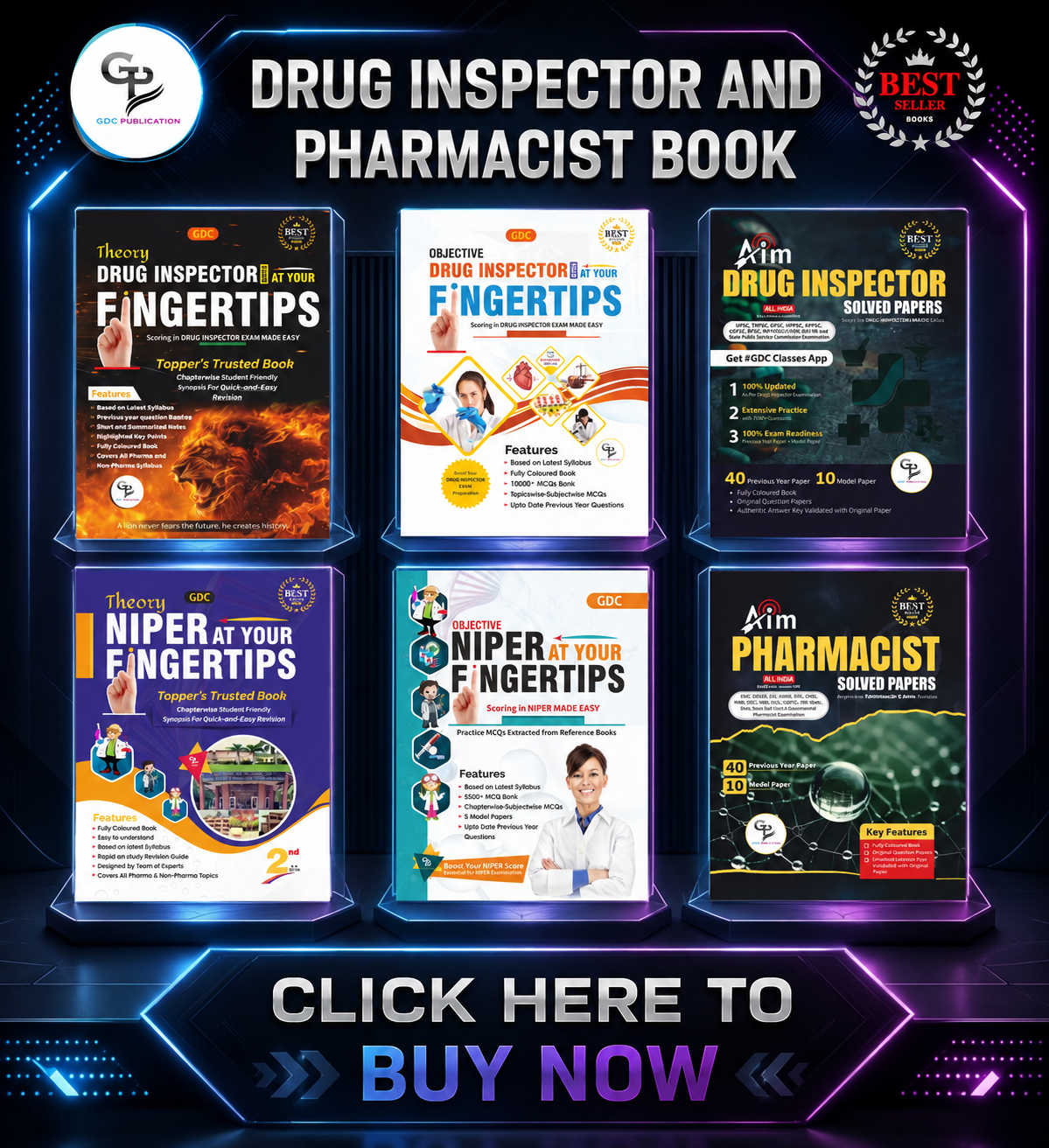
Recommended Products