


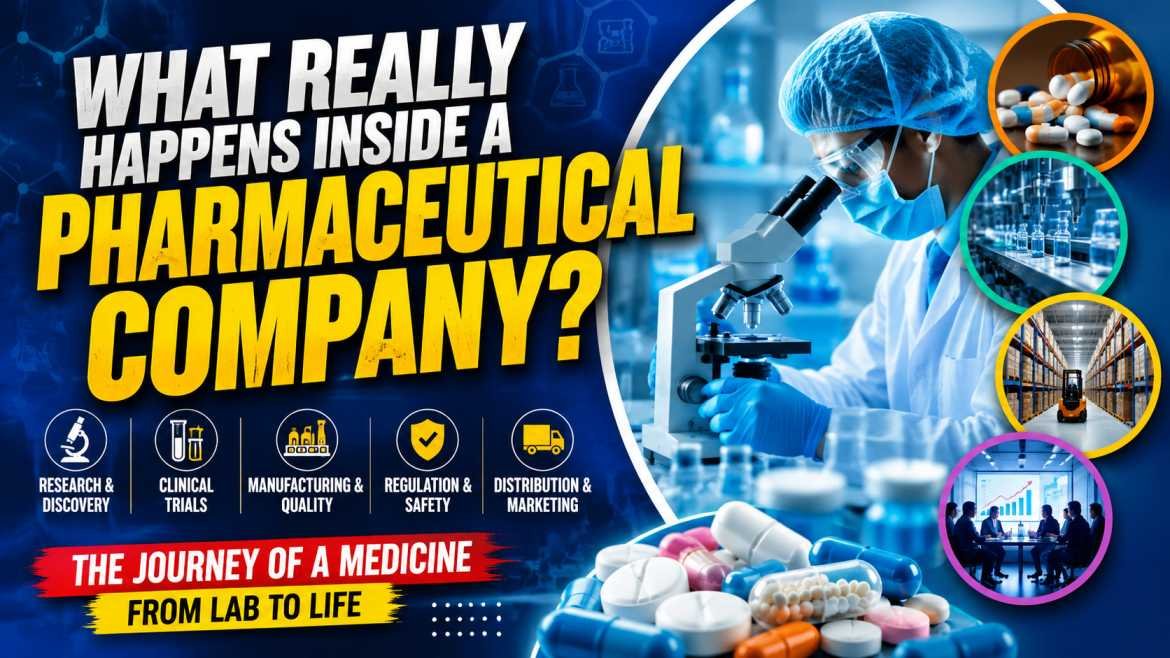

When most people think about pharmaceutical companies, they imagine scientists in white lab coats mixing chemicals in giant laboratories. While research is certainly a major part of the industry, the reality is far more complex. A pharmaceutical company is a massive ecosystem involving science, technology, regulations, manufacturing, marketing, logistics, and patient safety — all working together to bring medicines from an idea to a pharmacy shelf.
Here’s a closer look at what really happens inside a pharmaceutical company.
1. Research & Drug Discovery: Where Everything Begins
Every medicine starts with a problem that needs solving — a disease, infection, disorder, or unmet medical need.
Scientists in the Research & Development (R&D) department spend years:
- Studying diseases
- Identifying biological targets
- Testing thousands of chemical compounds
- Running laboratory experiments
- Developing potential drug molecules
In many cases, out of 10,000 tested compounds, only one may eventually become an approved medicine.
This stage can take several years and requires huge investments in equipment, expertise, and technology.

2. Preclinical Testing: Ensuring Safety Before Human Trials
Before a drug reaches humans, it must go through preclinical studies.
Researchers test the medicine in laboratories and controlled environments to evaluate:
- Toxicity
- Side effects
- Dosage range
- Stability
- Effectiveness
The goal is simple: determine whether the drug is safe enough for human testing.
If the results are promising, the company applies for regulatory approval to begin clinical trials.
3. Clinical Trials: Testing on Humans
Clinical trials are among the most critical and expensive stages in pharmaceutical development.
These trials usually happen in three phases:
Phase 1
Small group of healthy volunteers
Focus: Safety and dosage
Phase 2
Patients with the disease
Focus: Effectiveness and side effects
Phase 3
Large patient populations
Focus: Confirmation of effectiveness and monitoring adverse reactions
Some drugs spend nearly a decade in clinical trials before receiving approval.
During this stage, pharmaceutical companies work closely with:
- Doctors
- Hospitals
- Research organizations
- Regulatory authorities
4. Regulatory Affairs: The Gatekeepers of Compliance
Pharmaceutical companies cannot simply manufacture and sell medicines freely. Every product must comply with strict government regulations.
The Regulatory Affairs department handles:
- Drug approval documentation
- Compliance with national and international laws
- Communication with health authorities
- Labeling approvals
- Safety reporting
Authorities such as the World Health Organization and national drug regulators ensure medicines are safe, effective, and manufactured properly.
Without regulatory approval, no medicine can legally enter the market.
5. Manufacturing: Turning Science into Real Products
Once approved, the medicine moves to manufacturing facilities.
This is where pharmaceutical companies produce medicines in large quantities while maintaining strict quality standards.
Manufacturing includes:
- Mixing ingredients
- Tablet compression
- Capsule filling
- Sterile injections
- Packaging
- Labeling
Even tiny contamination can make medicines unsafe, which is why pharmaceutical factories follow extremely strict cleanliness and safety protocols.
Many plants operate under Good Manufacturing Practices (GMP).
6. Quality Control & Quality Assurance
Before medicines leave the factory, they undergo rigorous quality checks.
Quality Control (QC) teams test products for:
- Purity
- Strength
- Dissolution
- Stability
- Microbial contamination
Meanwhile, Quality Assurance (QA) ensures every process follows proper procedures and documentation standards.
In pharma, documentation is almost as important as manufacturing itself.
A single error can lead to:
- Product recalls
- Legal action
- Financial losses
- Patient safety risks
7. Supply Chain & Distribution
Making medicines is only half the job. Getting them safely to hospitals and pharmacies is another huge challenge.
Pharmaceutical supply chains involve:
- Warehousing
- Cold storage
- Transportation
- Inventory management
- Export/import coordination
Some medicines require temperature-controlled logistics, especially vaccines and biologics.
Even a small temperature variation can damage sensitive medicines.
8. Marketing & Medical Representatives
One of the most visible parts of the pharma industry is pharmaceutical marketing.
Medical representatives visit doctors and healthcare professionals to:
- Explain medicines
- Share clinical data
- Discuss treatment benefits
- Provide product updates
Pharmaceutical marketing is highly regulated because companies must avoid misleading claims.
Modern pharma companies also use:
- Digital marketing
- Medical webinars
- Scientific conferences
- Online physician education
9. Pharmacovigilance: Monitoring After Launch
A medicine’s journey does not end after approval.
Pharmaceutical companies continuously monitor drugs for side effects through a process called pharmacovigilance.
This involves:
- Collecting patient safety reports
- Investigating adverse reactions
- Updating warning labels
- Reporting to regulatory authorities
In rare cases, medicines may even be withdrawn from the market if serious risks are discovered later.
10. The Business Side of Pharma
Behind the science, pharmaceutical companies are also businesses.
Departments like:
- Finance
- Human resources
- Legal
- Procurement
- IT
- Strategy
- Sales
play a major role in daily operations.
Drug development costs billions of dollars, making financial planning and business strategy extremely important.
Challenges Pharmaceutical Companies Face
The pharmaceutical industry faces constant pressure from:
- High research costs
- Patent expirations
- Generic competition
- Regulatory changes
- Public trust issues
- Drug pricing debates
- Supply chain disruptions
Despite these challenges, pharmaceutical companies remain one of the most important pillars of modern healthcare.
The Human Impact
At the center of every pharmaceutical company is one mission: improving human health.
Whether it’s a life-saving cancer therapy, a simple antibiotic, or a vaccine that prevents global outbreaks, pharmaceutical companies influence millions of lives every day.
While the industry is not without criticism, its role in extending life expectancy and fighting disease is undeniable.
Final Thoughts
Inside a pharmaceutical company, there’s much more happening than laboratory experiments. It’s a highly coordinated system involving science, regulation, manufacturing, quality, logistics, and patient care.
Developing a single medicine can take over 10 years, cost billions, and require collaboration between thousands of professionals worldwide.
The next time you see a small tablet or medicine bottle, remember: behind it lies years of research, testing, regulation, and teamwork designed to improve lives around the world.
Recommended Products