


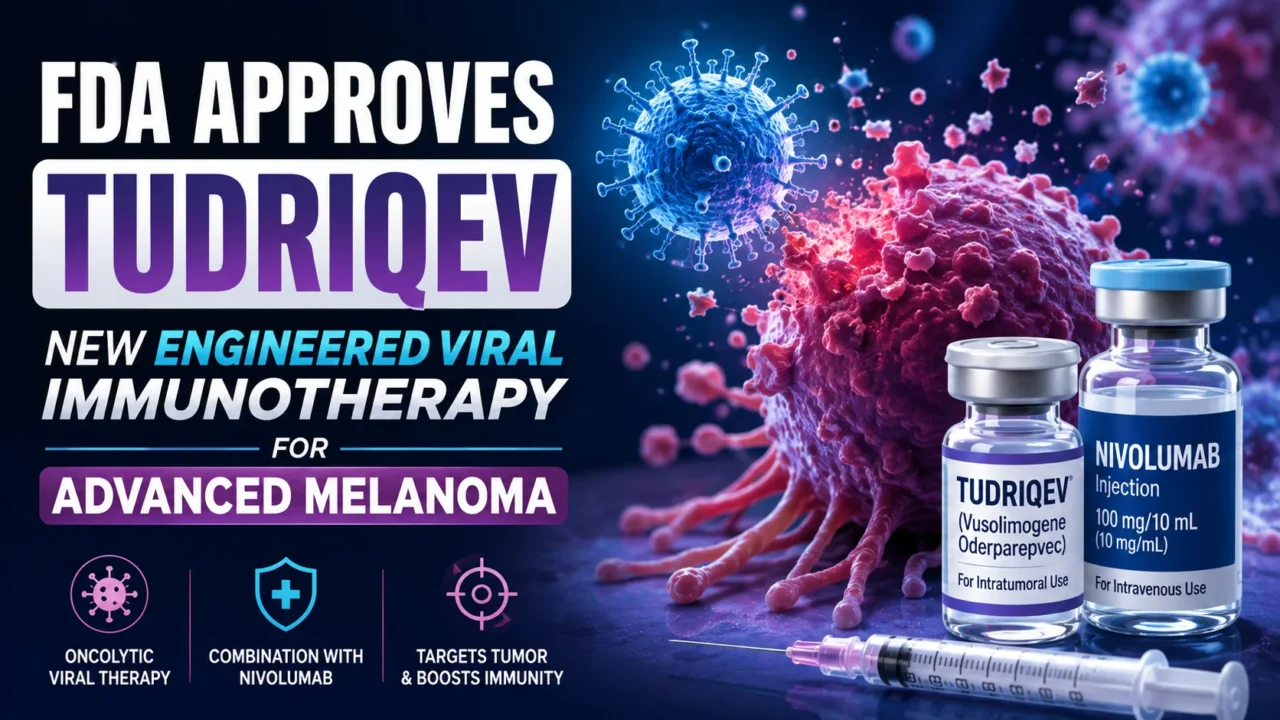

The Tudriqev FDA approval marks an important development in cancer immunotherapy. Tudriqev (vusolimogene oderparepvec), also known as RP1, is a genetically modified oncolytic viral therapy approved in combination with nivolumab for certain adults with unresectable advanced cutaneous melanoma that has progressed after anti-PD-1-based treatment.
The therapy uses a modified herpes simplex virus type 1 (HSV-1) to target tumor cells and stimulate an immune response against cancer.
Medical Disclaimer: This article is for educational and informational purposes only. Treatment decisions should be made by qualified healthcare professionals based on official prescribing information and individual patient circumstances.
Quick Summary
Tudriqev (vusolimogene oderparepvec/RP1) is a genetically modified HSV-1-based oncolytic viral immunotherapy. FDA granted accelerated approval for its use with nivolumab in selected adults with unresectable advanced cutaneous melanoma that progressed after anti-PD-1 therapy. In the reported clinical trial, 24% of evaluable patients achieved an objective response, with a median response duration of 14.1 months.

What Is Tudriqev?
Tudriqev is an oncolytic viral immunotherapy based on a genetically modified form of herpes simplex virus type 1 (HSV-1).
Its generic name is vusolimogene oderparepvec, and it was developed as RP1.
The therapy is designed to work inside tumors by allowing the modified virus to replicate in cancer cells and contribute to their destruction. The resulting tumor-cell destruction can also stimulate the immune system to recognize and attack cancer cells.
Key Facts About Tudriqev
| Feature | Details |
|---|---|
| Brand name | Tudriqev |
| Generic name | Vusolimogene oderparepvec |
| Development name | RP1 |
| Drug type | Oncolytic viral immunotherapy |
| Viral platform | Genetically modified HSV-1 |
| Combination therapy | Nivolumab |
| Main disease | Advanced cutaneous melanoma |
| Route | Intratumoral injection |
| FDA pathway | Accelerated approval |
| Developer | Replimune |
What Is Tudriqev Used For?
Tudriqev is used in combination with nivolumab for adult patients with:
- Unresectable advanced cutaneous melanoma
- Stage IIIB, IIIC or IV disease in the clinical-trial population
- Disease that has progressed following a PD-1-blocking antibody-based regimen
Therefore, Tudriqev is intended for a specific treatment-resistant melanoma population, rather than for all melanoma patients.
Why Is Tudriqev Important for Advanced Melanoma?
PD-1 inhibitors are an important part of modern melanoma treatment. However, some tumors eventually progress despite anti-PD-1 therapy.
This creates a major treatment challenge.
Tudriqev provides a different approach by combining oncolytic viral activity with immune checkpoint inhibition.
The concept can be summarized as:
Modified HSV-1 → tumor infection → viral replication → tumor-cell destruction → immune activation → antitumor immune response
When combined with nivolumab, the approach is intended to enhance the body’s ability to mount an antitumor immune response.

How Does Tudriqev Work?
Tudriqev has an oncolytic and immunotherapeutic mechanism.
1. Direct Tumor-Cell Targeting
Tudriqev is injected directly into accessible tumors.
The modified HSV-1 can replicate within tumor cells, contributing to tumor-cell destruction.
2. Tumor Antigen Release
When tumor cells are destroyed, tumor-associated material can become available to the immune system.
3. Immune Activation
The destruction of tumor cells can stimulate immune responses against cancer.
4. Combination With Nivolumab
Nivolumab is a PD-1 immune checkpoint inhibitor.
Combining Tudriqev with nivolumab may help support an antitumor immune response in patients whose melanoma has progressed following previous immunotherapy.
Tudriqev and Nivolumab: Treatment Administration
Tudriqev is administered by intratumoral injection, meaning it is injected directly into tumors.
According to the approval information provided:
- Tudriqev is administered once every two weeks.
- Treatment includes eight consecutive doses.
- The dose depends on tumor size.
- A lower concentration is used for the first dose.
- A higher concentration is used for subsequent doses.
- Nivolumab is administered intravenously beginning at week 3.
The exact treatment schedule and administration requirements should always be checked against the current official prescribing information.
Clinical Trial Results of Tudriqev
The safety and effectiveness of Tudriqev were evaluated in an open-label, multiregional, single-arm clinical trial.
The study enrolled 140 adult patients with advanced unresectable melanoma who had experienced disease progression following anti-PD-1-based treatment.
Among the 91 patients evaluated for efficacy:
| Clinical Outcome | Result |
|---|---|
| Patients enrolled | 140 |
| Patients evaluated for efficacy | 91 |
| Objective response rate | 24% |
| Median duration of response | 14.1 months |
What Does a 24% Response Rate Mean?
An objective response rate of 24% means that approximately one in four evaluable patients experienced a measurable reduction in tumor burden according to the study’s response criteria.
The median duration of response was 14.1 months, meaning responses among responding patients had a median duration of approximately 14 months.
These results should not be interpreted as meaning that every patient receiving Tudriqev will experience the same response.
Tudriqev Side Effects and Safety
Like other cancer therapies, Tudriqev can cause adverse reactions.
Reported adverse reactions occurring in more than 10% of patients included:
- Fatigue
- Fever
- Infections
- Chills
- Musculoskeletal pain
- Nausea
- Diarrhea
- Injection-site reaction
- Headache
- Cough
- Influenza-like illness
- Rash
- Vomiting
- Itching
- Joint pain
- Constipation
- Decreased appetite
- Dizziness
- Shortness of breath
- Hemorrhage
- Edema
- Abdominal pain
Important Safety Warnings
Because Tudriqev is based on modified HSV-1, important safety considerations include:
- Risk of accidental transmission of herpes infection to close contacts
- Potential development or reactivation of herpes infection
- Complications associated with the injection procedure
Healthcare professionals should follow appropriate handling, administration and infection-control precautions.
What Is FDA Accelerated Approval?
Tudriqev received approval through the FDA accelerated approval pathway.
Accelerated approval can allow certain therapies for serious diseases to reach patients based on surrogate or intermediate endpoints that may reasonably predict clinical benefit.
However, accelerated approval also comes with additional requirements.
The manufacturer must conduct post-approval confirmatory studies to verify and describe the clinical benefit.
Therefore, continued approval can depend on the results of these confirmatory studies.
Tudriqev FDA Approval: Important Regulatory Details
The FDA granted Tudriqev:
- Accelerated Approval
- Breakthrough Therapy designation
- Priority Review
The FDA also convened the Cellular, Tissue, and Gene Therapies Advisory Committee on July 30, 2026, where patients, advocates, clinicians and independent experts participated in the discussion surrounding the application.
Important Point
The accelerated approval does not mean that all long-term questions regarding clinical benefit have been definitively answered.
Post-approval studies are required to verify the clinical benefit of Tudriqev.
Who Can Receive Tudriqev?
The approved indication is specific.
Tudriqev is intended for adult patients with unresectable advanced cutaneous melanoma whose disease has progressed following a PD-1-blocking antibody-based regimen, when used in combination with nivolumab.
Patient eligibility for actual treatment depends on clinical assessment.
Factors considered by the treating oncology team may include:
- Previous treatment history
- Disease progression
- Tumor location and accessibility
- Overall health
- Previous immunotherapy
- Other medical considerations
Individual treatment eligibility should be determined by an oncologist.
Why Is Tudriqev Important for Pharmacy Students?
Tudriqev is an important example of the growing role of biotechnology and immunotherapy in modern pharmacy and oncology.
Pharmacy students can learn several important concepts from this approval:
- Oncolytic viral therapy
- Genetically modified viruses
- HSV-1-based therapeutic platforms
- Cancer immunotherapy
- PD-1 checkpoint inhibition
- Combination immunotherapy
- Intratumoral drug administration
- Accelerated FDA approval
- Breakthrough Therapy designation
- Objective response rate
- Duration of response
- Post-approval confirmatory studies
This topic can also be useful for students preparing for pharmacology, biotechnology, GPAT, NIPER and other pharmacy-related examinations.
Tudriqev vs Nivolumab
Tudriqev and nivolumab work through different but potentially complementary mechanisms.
| Feature | Tudriqev | Nivolumab |
|---|---|---|
| Type | Oncolytic viral immunotherapy | Immune checkpoint inhibitor |
| Main platform | Modified HSV-1 | Monoclonal antibody |
| Target | Tumor cells and immune activation | PD-1 pathway |
| Administration | Intratumoral | Intravenous |
| Role in regimen | Oncolytic immunotherapy | Immunotherapy |
| Combination | Used with nivolumab | Used with Tudriqev |
Important Facts About Tudriqev
For quick revision, remember:
Brand: Tudriqev
Generic: Vusolimogene oderparepvec
Development code: RP1
Virus: Modified HSV-1
Class: Oncolytic viral immunotherapy
Combination: Nivolumab
Disease: Advanced cutaneous melanoma
Route: Intratumoral injection
FDA pathway: Accelerated approval
Objective response: 24% in the reported evaluable population
Median duration of response: 14.1 months
Important Dates
| Event | Date |
|---|---|
| FDA advisory committee meeting | July 30, 2026 |
| FDA approval | August 2026 |
| Approval pathway | Accelerated Approval |
Note: Exact approval-date details should be verified from the latest official FDA announcement before publication.
Official Information and Important Links
For the most accurate and updated information, readers should refer to the official FDA sources and the manufacturer’s official information.
Suggested external links for WordPress:
- FDA Tudriqev approval announcement
- FDA Cellular, Tissue, and Gene Therapies Advisory Committee page
- FDA Accelerated Approval information
- FDA prescribing information/package insert
- Replimune official Tudriqev information
For medical information, always prioritize the official FDA prescribing information over secondary sources.
Frequently Asked Questions
1. What is Tudriqev?
Tudriqev is the brand name for vusolimogene oderparepvec (RP1), a genetically modified HSV-1-based oncolytic viral immunotherapy.
2. What is Tudriqev used for?
Tudriqev is used with nivolumab for certain adult patients with unresectable advanced cutaneous melanoma that progressed after anti-PD-1 therapy.
3. How does Tudriqev work?
Tudriqev is injected into tumors and uses a modified HSV-1 platform designed to replicate in tumor cells, promote tumor-cell destruction and stimulate an antitumor immune response.
4. What is the response rate of Tudriqev?
In the reported clinical trial, 24% of the 91 evaluable patients achieved an objective response.
5. How long did responses to Tudriqev last?
The median duration of response was 14.1 months in the reported trial population.
6. What is the major safety concern with Tudriqev?
Important warnings include the potential for herpes infection transmission or reactivation and complications related to intratumoral injection.
7. Is Tudriqev FDA approved?
Yes. Tudriqev received FDA accelerated approval for its specified use in combination with nivolumab in advanced melanoma.
8. What does accelerated approval mean for Tudriqev?
Accelerated approval means the FDA allowed approval based on certain clinical endpoints while requiring post-approval confirmatory studies to verify clinical benefit.
Conclusion
The Tudriqev FDA approval is an important development in the treatment of advanced melanoma, particularly for patients whose disease has progressed following anti-PD-1 therapy.
Tudriqev, or vusolimogene oderparepvec (RP1), is a genetically modified HSV-1-based oncolytic viral immunotherapy used in combination with nivolumab. Its mechanism combines tumor-directed viral activity with immune stimulation.
In the reported clinical trial, 24% of evaluable patients achieved an objective response, while the median duration of response was 14.1 months.
However, because Tudriqev received accelerated approval, confirmatory studies remain important for verifying its clinical benefit.
For pharmacy students and healthcare professionals, Tudriqev is a valuable example of how oncolytic viruses, cancer immunotherapy, monoclonal antibodies and biotechnology are shaping modern oncology.
Recommended Products