

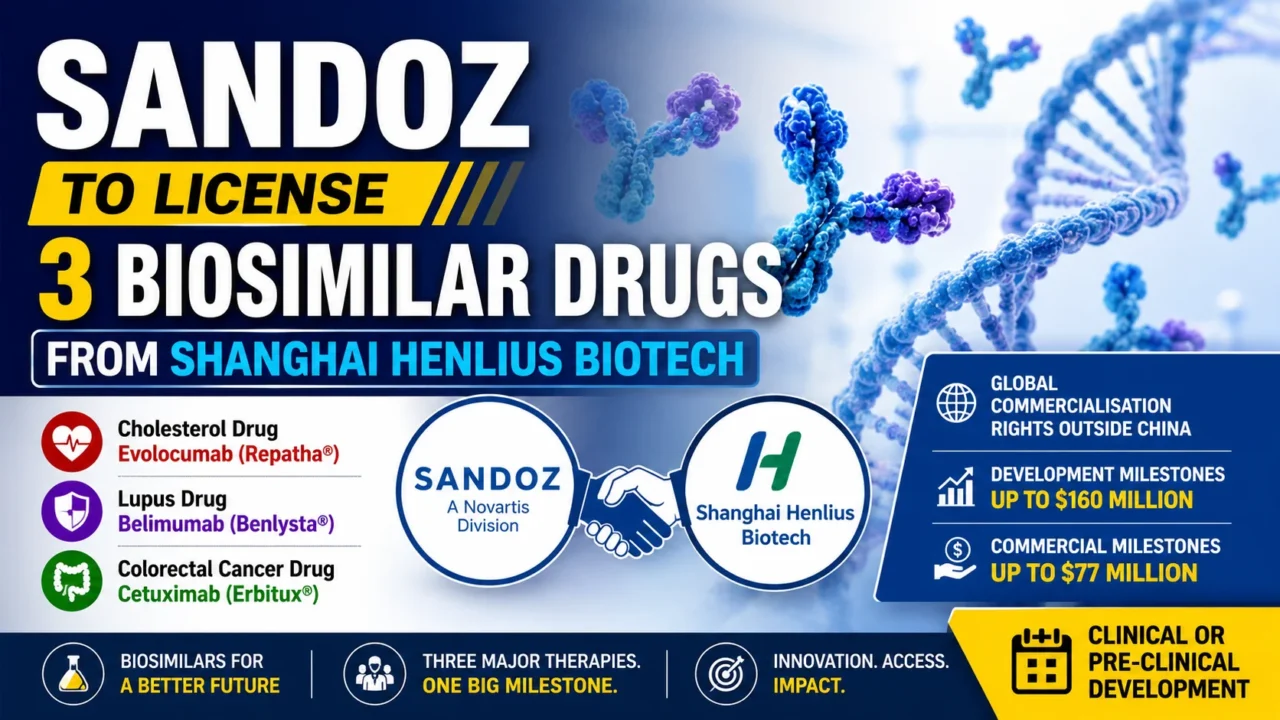

Sandoz biosimilar drugs are at the centre of a new licensing agreement with Shanghai Henlius Biotech. Under the deal, Swiss generic and biosimilar drugmaker Sandoz will license three biosimilar treatments from Henlius covering evolocumab, belimumab and cetuximab.
The three treatments are being developed for cholesterol, lupus and colorectal cancer, respectively. Sandoz will receive global commercialisation rights for the medicines outside China.
Quick Summary
Sandoz will license three biosimilar drugs from Shanghai Henlius Biotech: evolocumab, belimumab and cetuximab. The treatments target cholesterol, lupus and colorectal cancer. The products are in clinical or pre-clinical development, while Sandoz will receive global commercialisation rights outside China. The agreement includes development and commercial milestone payments.

Sandoz-Henlius Biosimilar Deal: Overview
The agreement between Sandoz and Shanghai Henlius Biotech covers three biosimilar treatments.
| Particular | Details |
|---|---|
| Companies | Sandoz and Shanghai Henlius Biotech |
| Number of Biosimilars | 3 |
| Products | Evolocumab, Belimumab, Cetuximab |
| Therapeutic Areas | Cholesterol, Lupus, Colorectal Cancer |
| Development Stage | Clinical or pre-clinical development |
| Sandoz Rights | Global commercialisation rights outside China |
| Development Milestones | Up to $160 million |
| Commercial Milestones | Up to $77 million |
The three treatments are described in the supplied source as being in clinical or pre-clinical development.
Which Three Biosimilar Drugs Will Sandoz License?
The agreement includes biosimilars of three established biological medicines.
1. Evolocumab Biosimilar
The first treatment is a biosimilar version of evolocumab, a cholesterol drug marketed as Repatha by Amgen.
According to the supplied information, global sales revenue for evolocumab was approximately $6.6 billion in 2025.
2. Belimumab Biosimilar
The second treatment is a biosimilar version of belimumab, a medicine for lupus.
Belimumab was discovered by Human Genome Sciences and marketed as Benlysta by GSK.
The supplied source reports global sales of approximately $2.5 billion in 2025.
3. Cetuximab Biosimilar
The third treatment is a biosimilar version of cetuximab, associated with treatment of colorectal cancer.
The medicine was sold as Erbitux and marketed by companies including Bristol-Myers Squibb, Eli Lilly and Merck KGaA, according to the supplied source.
Global sales revenue for cetuximab was approximately $1.7 billion in 2025, based on the information provided in the source.

Sandoz Biosimilar Drugs: Key Products at a Glance
| Biosimilar | Therapeutic Area | Reference/Marketed Product | Reported 2025 Sales |
| Evolocumab | Cholesterol | Repatha | ~$6.6 billion |
| Belimumab | Lupus | Benlysta | ~$2.5 billion |
| Cetuximab | Colorectal cancer | Erbitux | ~$1.7 billion |
The sales figures in the source were attributed to IQVIA data cited in a Henlius filing to the Hong Kong Stock Exchange.
What Are Biosimilar Drugs?
Biosimilars are biological medicines that are highly similar to an existing biologic reference medicine.
Biologic medicines are generally more complex than traditional small-molecule pharmaceutical drugs. Biosimilars are developed to provide similar therapeutic options to their reference biological medicines.
The supplied source describes biosimilars as similar versions of biologic drugs and compares them with generic versions of traditional pharmaceutical products.
What Commercial Rights Will Sandoz Receive?
Under the agreement, Sandoz will receive global commercialisation rights to the three drugs outside China.
This means the agreement covers commercialisation of the three treatments in markets outside China, subject to the terms and development of the products.
The source describes the agreement as part of Sandoz’s strategy to participate in the global biosimilar loss-of-exclusivity market over the coming decade.
Financial Details of the Sandoz-Henlius Agreement
The agreement includes potential payments linked to development and commercial milestones.
| Payment Category | Potential Amount |
| Development Milestone Payments | Up to $160 million |
| Commercial Milestone Payments | Up to $77 million |
| Potential Total | Up to $237 million |
Shanghai Henlius Biotech is eligible for development milestone payments of up to $160 million and commercial milestone payments of up to $77 million, according to the supplied source.
These are milestone-based payments rather than an upfront amount stated in the provided material.
Why Is the Sandoz Biosimilar Deal Important?
The agreement is significant because it brings together three biosimilar candidates across different therapeutic areas.
The treatments cover:
- Cholesterol
- Lupus
- Colorectal cancer
The reference medicines also have substantial reported global sales, creating potential commercial importance for biosimilar versions.
For Sandoz, the deal supports its strategy around the global biosimilar market and medicines approaching loss of exclusivity.
Development Status of the Three Biosimilars
The supplied source states that all three treatments are in clinical or pre-clinical development.
Therefore, specific approval dates, launch dates, regulatory status and commercial availability are Not mentioned in the provided source.
Readers should not assume that these products are already approved or commercially available.
Sandoz and Shanghai Henlius Biotech: Roles in the Agreement
Sandoz
Sandoz is the Swiss generic and biosimilar drugmaker involved in the licensing agreement.
Under the deal, Sandoz will receive global commercialisation rights to the three treatments outside China.
Shanghai Henlius Biotech
Shanghai Henlius Biotech is the company developing the three biosimilar treatments covered by the agreement.
Henlius is also eligible for potential development and commercial milestone payments under the agreement.
2025 Global Sales of Reference Medicines
The supplied source reports the following global sales figures for 2025:
| Reference Medicine | Approximate 2025 Global Sales |
| Evolocumab | $6.6 billion |
| Belimumab | $2.5 billion |
| Cetuximab | $1.7 billion |
The source states that these figures were cited from IQVIA, a health-sector research firm.
What Does This Mean for the Global Biosimilar Market?
The agreement highlights the commercial opportunity associated with biosimilars as biologic medicines move toward loss of exclusivity.
Sandoz stated that the deal represents a milestone in its strategy to capitalise on a significant share of the global biosimilar loss-of-exclusivity market over the next decade.
The three products also give the agreement exposure to multiple therapeutic areas rather than a single disease category.
Key Takeaways
- Sandoz will license three biosimilar drugs from Shanghai Henlius Biotech.
- The products are biosimilars of evolocumab, belimumab and cetuximab.
- The treatments target cholesterol, lupus and colorectal cancer.
- The three treatments are currently in clinical or pre-clinical development.
- Sandoz will receive global commercialisation rights outside China.
- Development milestone payments can reach $160 million.
- Commercial milestone payments can reach $77 million.
- Reported 2025 global sales were approximately $6.6 billion for evolocumab, $2.5 billion for belimumab and $1.7 billion for cetuximab.
- Specific approval and launch dates are Not mentioned in the provided source.
Frequently Asked Questions
1. What is the Sandoz biosimilar deal with Henlius?
Sandoz has entered into an agreement with Shanghai Henlius Biotech to license three biosimilar treatments covering evolocumab, belimumab and cetuximab.
2. Which three biosimilars will Sandoz license?
The three biosimilars are versions of evolocumab, belimumab and cetuximab.
3. What diseases do these biosimilars target?
The treatments are being developed for cholesterol, lupus and colorectal cancer, respectively.
4. What rights will Sandoz receive?
Sandoz will receive global commercialisation rights outside China for the three treatments.
5. How much are the development milestone payments?
Henlius is eligible for development milestone payments of up to $160 million.
6. How much are the commercial milestone payments?
The agreement includes potential commercial milestone payments of up to $77 million.
7. Are the three biosimilars already approved?
The supplied source states that the three treatments are in clinical or pre-clinical development. Specific regulatory approval information is Not mentioned in the provided source.
8. What were the reported 2025 sales of the reference medicines?
The supplied information reports approximately $6.6 billion for evolocumab, $2.5 billion for belimumab and $1.7 billion for cetuximab in global sales during 2025.
Important Facts at a Glance
| Question | Answer |
| Who is licensing the products? | Sandoz |
| Who is providing the biosimilars? | Shanghai Henlius Biotech |
| How many products? | 3 |
| Products | Evolocumab, Belimumab, Cetuximab |
| Therapeutic areas | Cholesterol, Lupus, Colorectal Cancer |
| Development stage | Clinical or pre-clinical |
| Rights | Global commercialisation outside China |
| Development milestones | Up to $160 million |
| Commercial milestones | Up to $77 million |
Internal Linking Suggestions for GDC Classes
Add relevant GDC Classes articles using natural anchor text such as:
- Latest Pharma Industry News
- Latest Pharmaceutical Updates
- Pharma Jobs 2026
- Pharmaceutical Biotechnology
- Biotechnology Career Opportunities
- Biosimilars in Pharmacy
- M.Pharm Pharmaceutics
- Pharma Current Affairs
Use the actual URLs of existing GDC Classes pages. Do not create internal links for pages that do not exist.
External Linking Suggestions
For credibility, external links can be added to:
- Sandoz official website
- Shanghai Henlius Biotech official website
- Official regulatory/company announcement
- Hong Kong Stock Exchange filing referenced in the source
- IQVIA, where appropriate for the cited market data
Only link to the relevant official source or original filing if available.
Conclusion
The Sandoz biosimilar deal with Shanghai Henlius Biotech covers three biosimilar treatments: evolocumab, belimumab and cetuximab. These products are being developed for cholesterol, lupus and colorectal cancer.
Sandoz will receive global commercialisation rights outside China, while Henlius may receive up to $160 million in development milestone payments and up to $77 million in commercial milestone payments.
The agreement is also notable because the reference medicines generated substantial reported global sales in 2025. However, the three biosimilar treatments are still described in the supplied source as being in clinical or pre-clinical development, and specific approval or launch dates are not mentioned.
For pharmacy and pharmaceutical science students, this development is a useful example of how biosimilar development, licensing agreements and loss of exclusivity are shaping the global pharmaceutical industry.
Recommended Products