



Major Relief for Pharmacy Colleges Across India
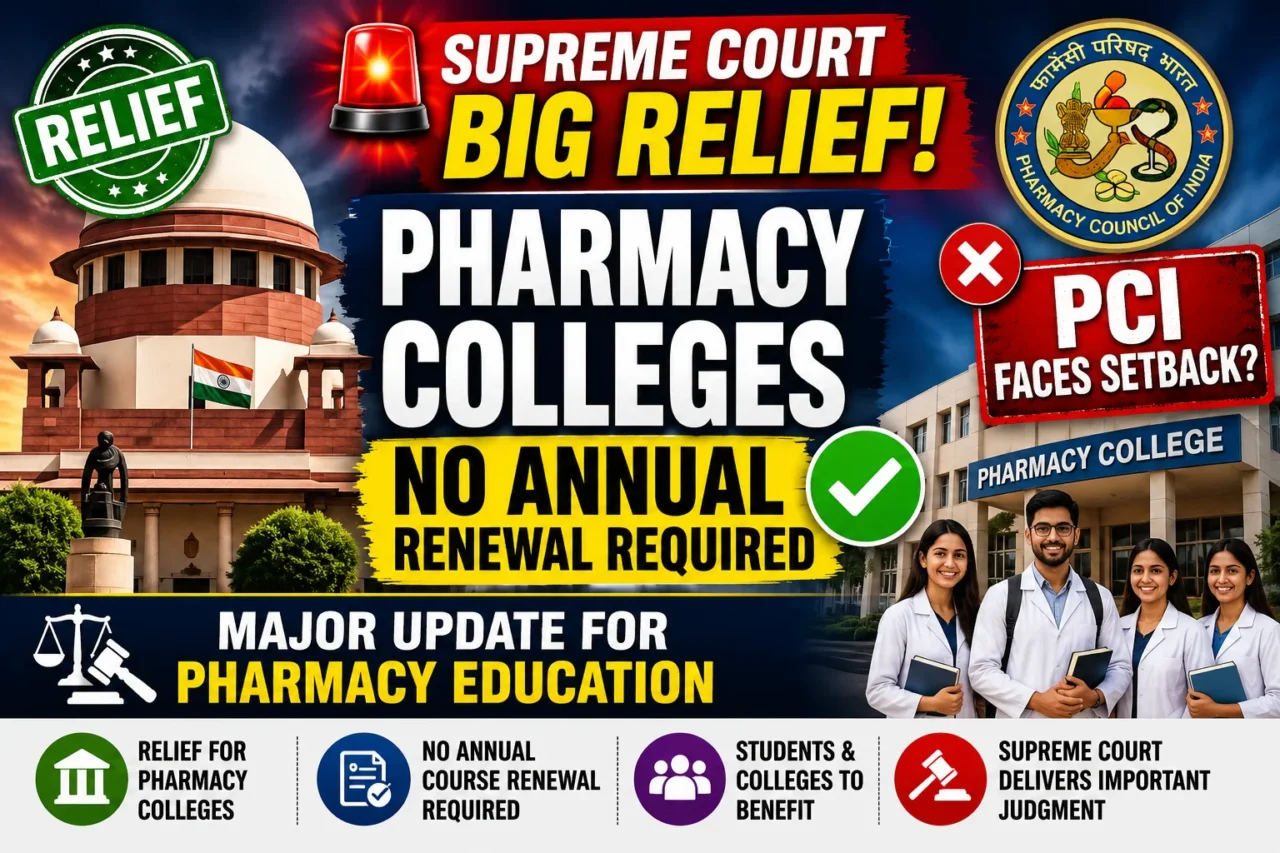
In a significant development for pharmacy education in India, the Supreme Court has refused to grant interim relief to the Pharmacy Council of India (PCI) against a Delhi High Court judgment that stated pharmacy colleges do not need to obtain course approval renewals every year.
The decision is expected to provide substantial relief to pharmacy institutions, reducing administrative burdens and ensuring greater stability in academic operations.
What Was the Delhi High Court’s Decision?
The Delhi High Court had ruled that once the Pharmacy Council of India grants approval to a pharmacy course, that approval should remain valid for the entire duration of the course. Therefore, colleges are not required to seek annual renewal of approval every academic year.
The judgment was welcomed by many pharmacy colleges, which had long argued that the yearly renewal process created unnecessary delays, compliance burdens, and uncertainty.
PCI Approaches the Supreme Court
Challenging the Delhi High Court’s ruling, the Pharmacy Council of India filed a petition before the Supreme Court seeking an interim stay on the order.
However, the Supreme Court declined to grant the requested interim relief, allowing the High Court’s decision to continue operating for the time being.

Supreme Court’s Observations
During the hearing, Chief Justice Surya Kant made important observations regarding the regulatory framework governing professional education.
The Court noted that larger legal questions concerning the functioning of professional, scientific, and technical education regulators may require reconsideration in the current educational landscape.
The Bench also issued notice on broader legal issues raised in the matter, indicating that the case could have far-reaching implications for educational regulation in India.
Impact on Pharmacy Colleges
If the Delhi High Court’s ruling ultimately remains in force, pharmacy colleges may benefit in several ways:
Reduced Administrative Burden
Institutions will no longer need to undergo annual approval renewal procedures for already approved courses.
Improved Academic Planning
Colleges can focus more on educational quality, infrastructure development, and student welfare rather than repetitive regulatory formalities.
Greater Stability for Students
Students may experience fewer disruptions related to approval and affiliation uncertainties.
Efficient Regulatory Process
Regulatory authorities can focus their resources on quality monitoring and compliance inspections rather than routine annual renewals.
Why This Case Matters
The case is not only important for pharmacy colleges but could also influence how professional education regulators function in India. The Supreme Court’s observations suggest that existing regulatory frameworks governing technical and professional education may require modernization to better suit current educational needs.
Conclusion
The Supreme Court’s refusal to stay the Delhi High Court order marks a significant interim victory for pharmacy colleges. For now, institutions can take comfort in the fact that PCI-approved courses may not require annual renewal, subject to the final outcome of the legal proceedings.
The final judgment in this matter could reshape the regulatory landscape of pharmacy education and potentially impact other professional education sectors across India.
Recommended Products