

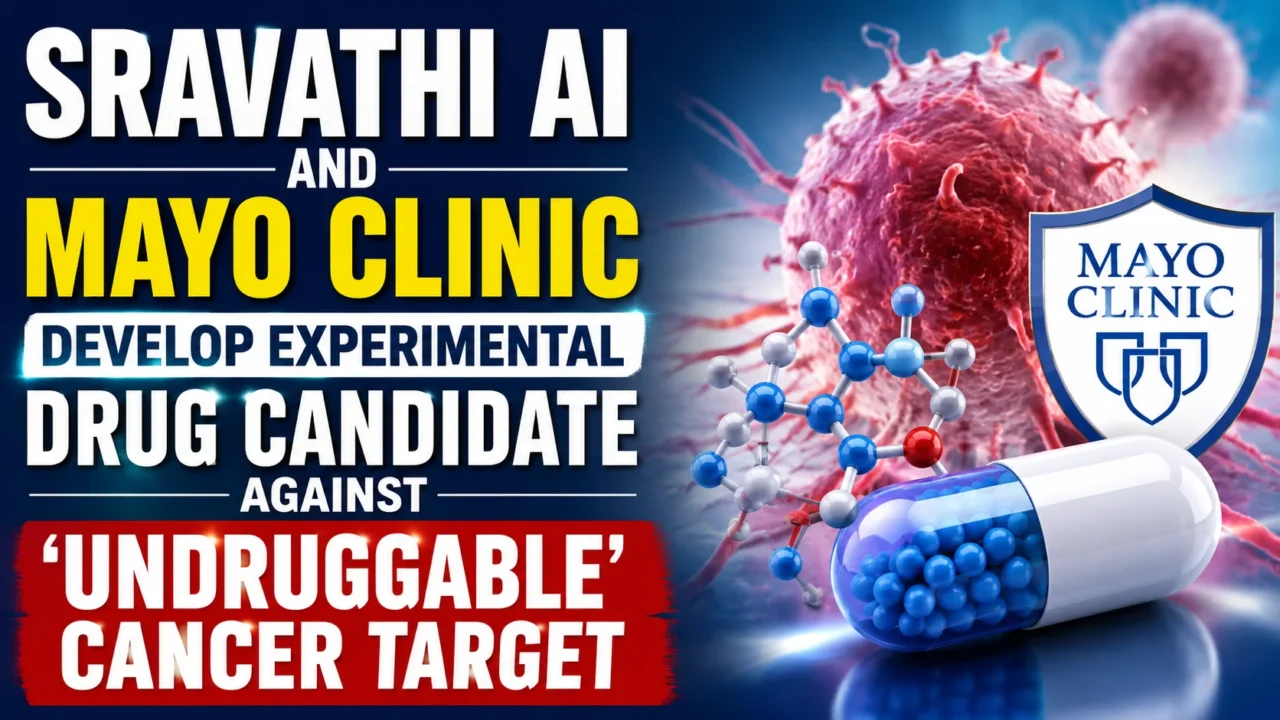

Sravathi AI and Mayo Clinic researchers have developed an experimental cancer drug candidate targeting the PDZ domain of GIPC1, a protein linked to cancer growth and treatment resistance. The AI-assisted drug discovery program identified a small-molecule inhibitor that showed promising results against pancreatic cancer in laboratory and animal studies.
The findings were published in Cell Reports in a study titled “AI-driven discovery and validation of a GIPC1 PDZ domain inhibitor for pancreatic ductal adenocarcinoma.” The research remains preclinical, meaning the experimental candidate has not yet been tested in human clinical trials.

Quick Summary
Sravathi AI and Mayo Clinic researchers used AI-assisted drug discovery to identify a small-molecule inhibitor targeting the GIPC1 PDZ domain. After screening nearly 40,000 compounds, the candidate showed activity against pancreatic cancer models, including slower tumour growth and improved survival. It also enhanced gemcitabine activity, but further studies are needed before human trials.
Sravathi AI and Mayo Clinic GIPC1 Cancer Drug: Overview
| Particular | Details |
|---|---|
| Research partners | Sravathi AI Technology and Mayo Clinic |
| Target | GIPC1 PDZ domain |
| Cancer focus | Pancreatic ductal adenocarcinoma |
| Discovery approach | AI-assisted drug discovery |
| Compounds screened | Nearly 40,000 |
| Drug type | Experimental small-molecule inhibitor |
| Key chemotherapy combination | Gemcitabine |
| Research stage | Preclinical |
| Human clinical trials | Not yet started |
| Publication | Cell Reports, 2026 |
The study describes the identification and validation of a GIPC1 PDZ-domain inhibitor for pancreatic ductal adenocarcinoma.
What Is GIPC1 and Why Is It a Cancer Target?
GIPC1 is a protein involved in cellular processes that can contribute to cancer growth and treatment resistance. Its PDZ domain has been considered a challenging target for conventional small-molecule drug discovery.
The Mayo Clinic research focused on developing a molecule capable of interfering with this target. The approach is significant because targeting difficult protein domains could potentially expand the range of cancer-related proteins that can be addressed through drug discovery.
How AI Was Used to Discover the GIPC1 Inhibitor
The research collaboration used AI-assisted computational approaches to search for potential molecules capable of targeting GIPC1.
According to the published research reports, the team screened nearly 40,000 potential compounds before identifying a molecule that could block GIPC1. The selected candidate was then investigated through laboratory and animal studies.
Sravathi AI describes its broader drug-discovery technology as combining generative AI, predictive AI and physics-based models, with capabilities including molecular design, optimization and computational analysis.
What Did the Experimental Cancer Drug Show?
The experimental GIPC1 inhibitor produced encouraging findings in preclinical models.
Reported observations included:
- Slower tumour growth
- Improved survival in experimental models
- Enhanced activity when combined with gemcitabine
- Preliminary evidence of changes in the tumour microenvironment
These results suggest that GIPC1 inhibition could potentially provide a new approach for investigating treatment strategies in pancreatic cancer. However, these findings are from laboratory and animal research and cannot yet be directly translated into clinical benefit for patients.
GIPC1 Inhibitor and Gemcitabine Combination
One of the notable findings was the interaction between the experimental GIPC1 inhibitor and gemcitabine.
In the reported experimental models, the combination produced greater effects than the experimental drug alone. This raises the possibility that GIPC1-targeted therapy could eventually be investigated as part of a combination-treatment strategy.
However, further research is necessary to determine the safety, effectiveness and reproducibility of this combination before it could be considered for human treatment.
Why Is This Important for Pancreatic Cancer Research?
Pancreatic cancer remains a challenging area of oncology research because of its aggressive behaviour and resistance to available treatments.
The GIPC1 research is important because it explores a new biological target rather than simply developing another molecule against an established target. The study also demonstrates how AI-supported molecular screening can help researchers investigate targets that have historically been difficult to address.
The research therefore represents an early example of how computational drug discovery and experimental cancer biology can work together.
What Makes AI-Assisted Drug Discovery Different?
Traditional drug discovery can involve extensive laboratory screening and optimization. AI-based approaches can support researchers by analysing molecular information, predicting properties and prioritising compounds for experimental testing.
In this project, nearly 40,000 potential compounds were screened before the researchers selected a candidate for further investigation. This illustrates how computational methods can help narrow large chemical spaces before laboratory validation.
However, AI does not replace laboratory and clinical research. A computationally promising molecule still needs extensive validation for efficacy, selectivity, toxicity, pharmacokinetics and other drug-development requirements.

Current Development Stage
Has the GIPC1 Cancer Drug Been Tested in Humans?
No. The candidate remains at the preclinical research stage.
The reported findings come from laboratory and animal studies. Additional research is required to evaluate safety and determine whether the candidate can progress toward human clinical trials.
Is the GIPC1 Inhibitor an Approved Cancer Treatment?
No. The experimental candidate is not an approved cancer treatment and should not be considered a replacement for currently approved therapies.
Sravathi AI’s Role in AI-Powered Drug Discovery
Sravathi AI Technology is an AI-focused company working in pharmaceutical and chemical innovation. Its platform includes AI-based approaches for molecular design, drug discovery, target identification, molecular optimisation and drug repurposing.
The company’s published pipeline includes programmes covering areas such as pancreatic and kidney cancer, solid tumours, immuno-oncology and triple-negative breast cancer.
The collaboration with Mayo Clinic demonstrates how AI technology companies and biomedical research institutions can combine computational approaches with experimental validation.
What Happens Next?
The next stage will require additional preclinical research.
Researchers need to establish whether the candidate has sufficient safety, selectivity and efficacy to justify progression toward clinical development. Additional studies will also be needed to determine whether the observed effects can be reproduced in other relevant cancer models.
Only after successful preclinical development and regulatory evaluation could a candidate potentially move into human clinical trials.
Why Should Pharmacy and Life-Science Students Know About This Development?
The Sravathi AI–Mayo Clinic research is particularly relevant for Pharmacy, Pharmaceutical Sciences, Biotechnology and Life-Science students because it connects several emerging areas of pharmaceutical research:
- Artificial intelligence in drug discovery
- Small-molecule drug design
- Molecular modelling
- Target identification and validation
- Cancer pharmacology
- Protein–protein interaction targets
- Preclinical drug development
- Combination therapy research
For pharmacy students, the development also provides a useful real-world example of how AI, medicinal chemistry, pharmacology and oncology research are increasingly becoming interconnected.
Key Takeaways
- Sravathi AI and Mayo Clinic collaborated on an experimental GIPC1-targeted cancer drug candidate.
- The candidate targets the PDZ domain of GIPC1.
- Nearly 40,000 potential compounds were screened during the discovery process.
- The candidate showed promising activity in preclinical pancreatic cancer models.
- It slowed tumour growth and improved survival in experimental studies.
- The candidate also enhanced the effects of gemcitabine in reported models.
- The research was published in Cell Reports in 2026.
- The candidate has not yet entered human clinical trials.
- Further safety and efficacy studies are required before clinical development can be considered.
Frequently Asked Questions (FAQs)
1. What is the Sravathi AI Mayo Clinic cancer drug?
It is an experimental small-molecule inhibitor targeting the PDZ domain of GIPC1, developed through an AI-assisted drug discovery programme involving Sravathi AI and Mayo Clinic researchers.
2. What cancer does the GIPC1 inhibitor target?
The reported research primarily focuses on pancreatic ductal adenocarcinoma, a form of pancreatic cancer.
3. What is GIPC1?
GIPC1 is a protein associated with cellular processes involved in cancer growth and treatment resistance. Researchers are investigating its PDZ domain as a potential therapeutic target.
4. How many compounds were screened?
The research team screened nearly 40,000 potential compounds using an AI-assisted approach before identifying the candidate for further testing.
5. Does the experimental drug work with gemcitabine?
In preclinical studies, combining the experimental GIPC1 inhibitor with gemcitabine produced greater effects than the experimental treatment alone.
6. Has the GIPC1 inhibitor entered clinical trials?
No. The candidate remains in the preclinical stage and has not yet been tested in humans.
7. Is the GIPC1 inhibitor available to cancer patients?
No. It is an experimental drug candidate and is not currently an approved cancer treatment.
8. Why is this research important?
The research demonstrates how AI-assisted drug discovery can help identify molecules against challenging cancer targets and provides a potential new direction for pancreatic cancer research.
Conclusion
The Sravathi AI and Mayo Clinic GIPC1 cancer drug programme represents an emerging example of AI-assisted drug discovery in oncology. Researchers identified an experimental small-molecule inhibitor targeting the PDZ domain of GIPC1 after screening nearly 40,000 potential compounds.
The candidate showed encouraging results in preclinical pancreatic cancer models, including slower tumour growth, improved survival and enhanced gemcitabine activity.
However, the candidate is still experimental and has not entered human clinical trials. Further safety and efficacy studies will be essential before determining whether this approach can progress toward clinical development.
For pharmacy and life-science students, the research highlights the growing role of AI, medicinal chemistry, pharmacology and computational drug discovery in the development of next-generation medicines.
Recommended Products