


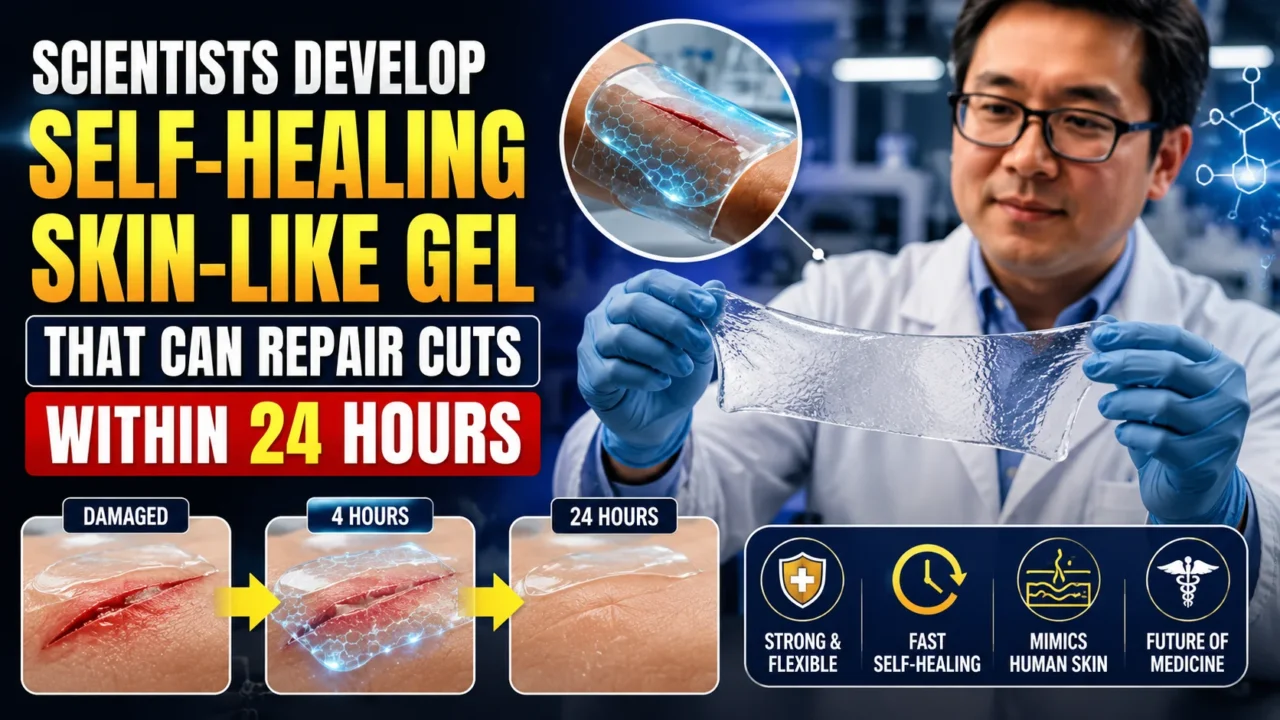

Imagine a material that can repair itself just like human skin. What once sounded like science fiction is now becoming a reality. Scientists have developed an innovative self-healing hydrogel that can repair up to 90% of its damage within just four hours and completely restore itself within 24 hours.
This breakthrough could revolutionize healthcare, regenerative medicine, burn treatment, artificial skin development, and even the field of soft robotics.

What Is a Self-Healing Hydrogel?
A hydrogel is a soft, flexible material made primarily of water and polymer networks. Because of its high water content and tissue-like properties, hydrogels have long been used in medical applications such as wound dressings, drug delivery systems, and tissue engineering.
The newly developed hydrogel goes a step further by possessing self-healing capabilities, allowing it to recover from cuts, tears, or physical damage without external intervention.
How Does the Hydrogel Work?
The hydrogel contains specially designed molecular bonds that can reconnect after being broken. When the material is damaged, these dynamic bonds reform naturally, allowing the gel to restore its structure and mechanical strength.
Researchers found that:
- The material can recover approximately 90% of its original strength within four hours.
- Complete restoration occurs within 24 hours.
- The hydrogel maintains flexibility, stretchability, and durability even after multiple healing cycles.
This behavior closely mimics the natural healing process of human skin.
Why Is This Discovery Important?
Traditional materials often require replacement once damaged. In contrast, self-healing materials can extend product lifespan, reduce waste, and improve safety.
This hydrogel’s unique properties make it highly promising for several applications:
1. Advanced Wound Care
The hydrogel could be used in wound dressings that adapt to movement while maintaining protection and promoting healing.
2. Artificial Skin Development
Researchers believe the material may serve as a foundation for creating artificial skin for burn victims and reconstructive treatments.
3. Regenerative Medicine
The hydrogel may support tissue repair and regeneration by providing a flexible scaffold that mimics natural biological tissues.
4. Soft Robotics
Soft robots require materials that can bend, stretch, and recover from damage. Self-healing hydrogels could significantly improve their durability and performance.
5. Wearable Medical Devices
Flexible medical sensors and wearable health-monitoring devices could benefit from materials that automatically repair minor damage.
Mimicking Human Skin
One of the most remarkable aspects of this hydrogel is its ability to imitate the mechanical properties of human skin.
The material demonstrates:
- High flexibility
- Excellent stretchability
- Strong durability
- Rapid self-repair capability
These features make it particularly attractive for biomedical applications where compatibility with human tissue is essential.
Potential Impact on Healthcare
The development of self-healing materials represents a major step toward smarter medical technologies. Future applications may include:
- Self-repairing wound dressings
- Artificial skin grafts
- Smart implants
- Regenerative tissue scaffolds
- Advanced prosthetics
Such innovations could reduce treatment costs, improve patient outcomes, and accelerate recovery times.
Challenges and Future Research
Although the results are promising, researchers are continuing to investigate:
- Long-term safety and biocompatibility
- Large-scale manufacturing methods
- Clinical applications in humans
- Performance under real-world medical conditions
Further studies and clinical testing will be necessary before the hydrogel becomes widely available for medical use.
Conclusion
The creation of a self-healing skin-like hydrogel marks an exciting advancement in materials science and biomedical engineering. With the ability to repair up to 90% of its damage within hours and fully recover within a day, this innovative material has the potential to transform wound care, regenerative medicine, artificial skin technology, and soft robotics.
As research progresses, self-healing materials may soon become an integral part of next-generation healthcare solutions, bringing us closer to medical technologies that can heal themselves just like the human body.
Recommended Products