

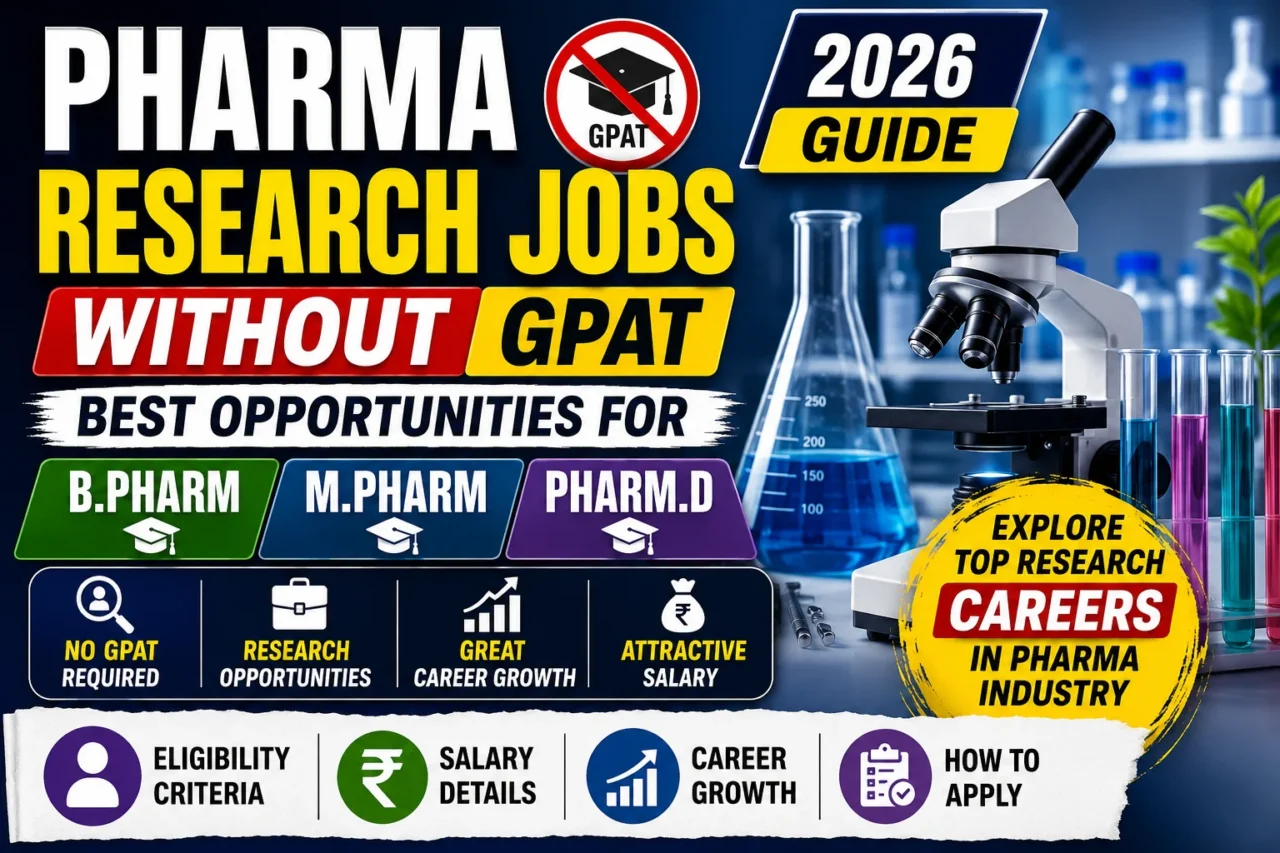

Pharma Research Jobs Without GPAT are available in government institutes, universities, hospitals, and pharmaceutical companies across India. Candidates with B.Pharm, M.Pharm, Pharm.D, and relevant M.Sc. degrees can apply for positions such as Project Associate, Research Assistant, Clinical Research Coordinator, and Pharmacovigilance Associate. Selection is generally based on educational qualifications, technical skills, and interviews rather than GPAT scores.
Pharma Research Jobs Without GPAT
Many pharmacy graduates believe that clearing GPAT is compulsory to start a career in pharmaceutical research. In reality, Pharma Research Jobs Without GPAT are available in many government-funded projects, research institutes, medical colleges, universities, and private pharmaceutical companies.
Although GPAT is useful for scholarships, higher education, and some research fellowships, numerous project-based positions recruit candidates based on academic qualifications, laboratory skills, and interview performance instead of GPAT scores.
If you are a B.Pharm, M.Pharm, Pharm.D, or Life Sciences graduate, this guide will help you understand the best research careers available without GPAT, expected salaries, recruiters, required skills, and future career growth.
Overview
| Particular | Details |
|---|---|
| Focus Area | Pharma Research Careers |
| GPAT Required | Not mandatory for many project-based positions |
| Eligible Candidates | B.Pharm, M.Pharm, Pharm.D, M.Sc. (Relevant Subjects) |
| Job Locations | Government Institutes, Universities, Hospitals, Pharma Companies |
| Selection Process | Application, Shortlisting, Interview (varies by organization) |
| Experience Required | Freshers and Experienced Candidates |
| Career Scope | Research, Clinical Trials, Pharmacovigilance, Drug Development |
Is GPAT Mandatory for Pharma Research Jobs?
No. GPAT is not mandatory for every research position.
Many project-based research vacancies are funded by organizations such as:
- Department of Biotechnology (DBT)
- Department of Science & Technology (DST)
- Indian Council of Medical Research (ICMR)
- Council of Scientific & Industrial Research (CSIR)
- Biotechnology Industry Research Assistance Council (BIRAC)
- State Government Research Projects
- University Research Grants
Some research fellowships require GPAT, GATE, or NET qualifications, while many project-based positions recruit candidates without these examinations.

Best Pharma Research Jobs Without GPAT
| Job Profile | Eligibility | Expected Salary |
|---|---|---|
| Project Associate-I | B.Pharm, M.Pharm, Pharm.D, M.Sc. | ₹25,000–₹37,000/month |
| Project Assistant | B.Pharm, M.Pharm | ₹20,000–₹35,000/month |
| Project Technical Support | D.Pharm (Some Projects), B.Pharm, M.Pharm | ₹20,000–₹40,000/month |
| Research Assistant | B.Pharm, M.Pharm, Pharm.D | ₹25,000–₹45,000/month |
| Clinical Research Coordinator | B.Pharm, Pharm.D, Life Sciences | ₹30,000–₹50,000/month |
| Pharmacovigilance Associate | B.Pharm, M.Pharm, Pharm.D | ₹3–6 LPA |
| Entry-Level Research Scientist | M.Pharm, Pharm.D, M.Sc. | Company-specific |
Eligibility Criteria
Candidates generally require:
- B.Pharm
- M.Pharm
- Pharm.D
- Relevant M.Sc.
- Good academic record
- Practical laboratory skills
- Basic computer knowledge
Some organizations may also prefer research experience or internships.
Top Recruiters
Government Organizations
- CSIR Laboratories
- ICMR Institutes
- AIIMS
- NIPER
- IITs
- Central Universities
- State Universities
- Government Medical Colleges
- Biotechnology Research Centres
Private Companies
- Sun Pharma
- Dr. Reddy’s Laboratories
- Cipla
- Lupin
- Zydus Lifesciences
- Torrent Pharmaceuticals
- Glenmark Pharmaceuticals
- Alkem Laboratories
- Syngene International
- Aurigene Pharmaceutical Services
Essential Skills That Improve Selection Chances
Candidates with practical knowledge in the following areas have a competitive advantage:
- HPLC
- UV Spectroscopy
- Dissolution Testing
- Analytical Method Development
- Cell Culture
- Molecular Biology
- Pharmacology
- Clinical Research
- Biostatistics
- Scientific Writing
- MS Excel
- SPSS
- Data Analysis
Selection Process
Although the selection process varies by organization, most institutes follow these steps:
- Online Application
- Shortlisting
- Written Test (if applicable)
- Technical Interview
- Document Verification
Some project-based recruitments may conduct only an interview.
How to Find Pharma Research Jobs Without GPAT
Regularly check:
- Government institute recruitment portals
- University career pages
- Medical college recruitment websites
- Pharmaceutical company career portals
- Employment News
- LinkedIn Jobs
- Reputed job portals
- GDC Classes Job Updates
Career Growth
A typical research career path is:
Project Assistant → Project Associate → Research Assistant → Senior Research Fellow (where eligible) → Research Associate → Scientist → Principal Scientist
Research experience also strengthens applications for:
- Ph.D. Programmes
- Pharmaceutical R&D
- Government Research Institutes
- Drug Development
- Clinical Research Organizations
Why Should Pharmacy Candidates Choose Research Careers?
Research offers several long-term benefits:
- GPAT is not mandatory for many positions.
- Hands-on laboratory experience.
- Opportunity to work on advanced research projects.
- Better career opportunities in pharmaceutical R&D.
- Exposure to modern analytical instruments.
- Research publications.
- Professional networking.
- Strong foundation for higher studies and Ph.D.
Tips to Get Selected
Improve your chances by:
- Strengthening pharmaceutical subject knowledge.
- Learning practical laboratory techniques.
- Completing internships or research projects.
- Building a professional CV.
- Preparing for technical interviews.
- Applying regularly to multiple institutes.
- Learning software such as Excel, SPSS, and research data analysis tools.
Important Links
| Resource | Purpose |
|---|---|
| DBT Recruitment Portal | Research Project Notifications |
| CSIR Career Portal | Research Vacancies |
| ICMR Career Portal | Medical Research Jobs |
| BIRAC Career Portal | Biotechnology Research Jobs |
| Employment News | Government Job Notifications |
| GDC Classes | Latest Pharmacy Research Jobs & Career Updates |
Conclusion
A successful research career in pharmacy is possible even without a GPAT qualification. Many government institutes, universities, hospitals, and pharmaceutical companies regularly recruit B.Pharm, M.Pharm, Pharm.D, and relevant M.Sc. graduates for research positions based on qualifications, technical skills, and interviews. By continuously improving laboratory skills, gaining practical experience, and staying updated with recruitment notifications, you can build a rewarding career in pharmaceutical research.
Frequently Asked Questions (FAQs)
1. Can I get a pharma research job without GPAT?
Yes. Many project-based research jobs recruit candidates without GPAT based on qualifications and interviews.
2. Which pharmacy courses are eligible?
Generally, B.Pharm, M.Pharm, Pharm.D, and relevant M.Sc. graduates are eligible.
3. Which research job is best for freshers?
Project Assistant, Project Associate-I, and Research Assistant are among the best entry-level options.
4. What is the salary for pharma research jobs without GPAT?
Entry-level salaries typically range from ₹20,000 to ₹50,000 per month, depending on the organization and project. Private-sector Pharmacovigilance roles often start around ₹3–6 LPA.
5. Which organizations recruit pharmacy graduates for research?
Organizations include CSIR, ICMR, AIIMS, NIPER, IITs, universities, medical colleges, and pharmaceutical companies.
6. Do private pharmaceutical companies require GPAT?
Many private pharmaceutical companies do not require GPAT for entry-level research and development positions.
7. Which skills improve selection chances?
Skills such as HPLC, Cell Culture, Molecular Biology, Clinical Research, Scientific Writing, and Data Analysis improve employability.
Recommended Products