

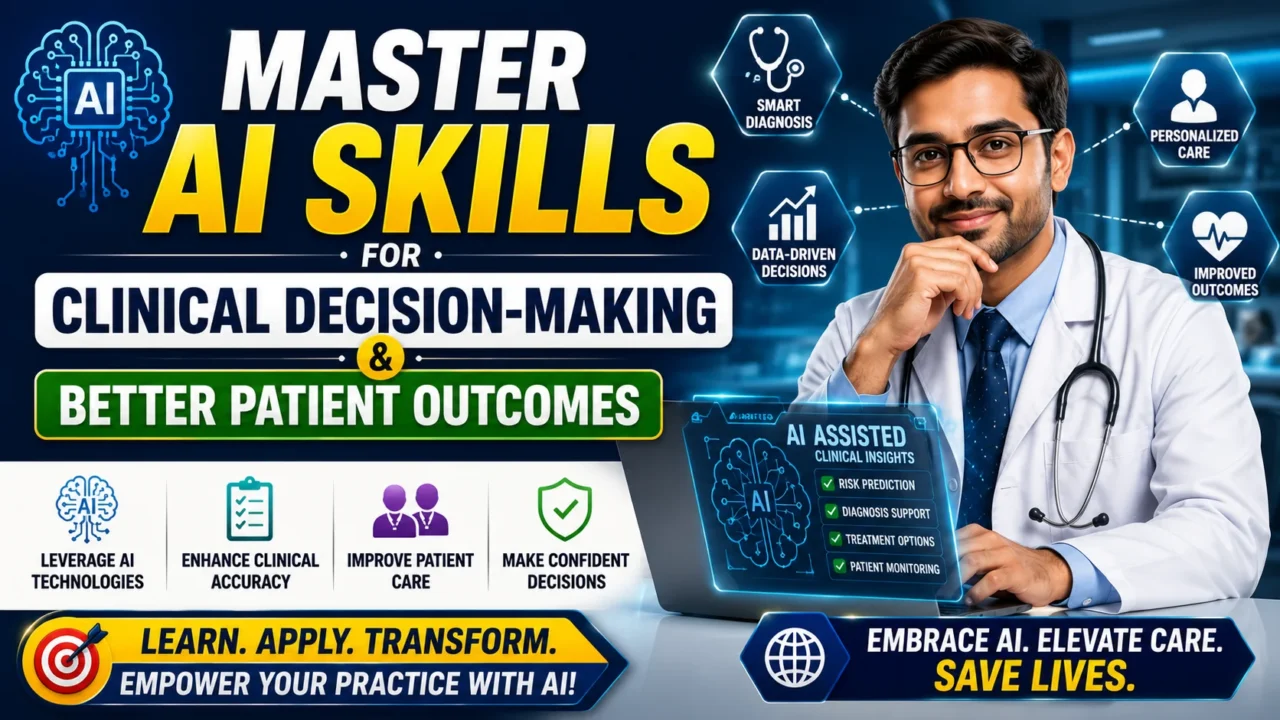

Artificial Intelligence (AI) is transforming healthcare at an unprecedented pace. From diagnosing diseases to recommending personalized treatment plans, AI is becoming an essential tool for healthcare professionals. For doctors, pharmacists, nurses, and clinical researchers, mastering AI skills is no longer optional—it is becoming a necessity for delivering high-quality patient care and improving clinical outcomes.
What is AI in Healthcare?
AI refers to computer systems that can perform tasks that normally require human intelligence, such as learning, reasoning, problem-solving, and decision-making. In healthcare, AI analyzes large volumes of patient data, identifies patterns, and provides valuable insights that help clinicians make informed decisions.
Common applications of AI in healthcare include:
- Disease diagnosis and prediction
- Drug discovery and development
- Clinical decision support systems
- Medical imaging analysis
- Personalized medicine
- Patient monitoring and remote care
- Healthcare workflow automation

Why Clinical Decision-Making Matters
Clinical decision-making involves selecting the most appropriate diagnosis, treatment, and patient management strategy based on available information. Healthcare professionals make countless decisions every day, and even small errors can significantly impact patient outcomes.
AI-powered tools can support clinicians by:
- Reducing diagnostic errors
- Identifying high-risk patients
- Suggesting evidence-based treatment options
- Predicting disease progression
- Improving medication safety
By combining human expertise with AI insights, healthcare professionals can make more accurate and timely decisions.
Benefits of AI for Better Patient Outcomes
1. Early Disease Detection
AI algorithms can analyze patient records, laboratory reports, and imaging data to identify diseases at earlier stages. Early diagnosis often leads to more effective treatment and better recovery rates.
2. Personalized Treatment Plans
Every patient is unique. AI can evaluate genetic, clinical, and lifestyle data to recommend personalized therapies that maximize treatment effectiveness.
3. Improved Medication Management
Clinical pharmacists can use AI tools to identify drug interactions, optimize dosages, and reduce medication errors, ensuring safer patient care.
4. Faster Clinical Decisions
AI can process vast amounts of medical information within seconds, helping healthcare professionals make informed decisions quickly during critical situations.
5. Enhanced Patient Monitoring
Wearable devices and AI-powered monitoring systems can continuously track patient health, allowing early intervention before complications occur.
Essential AI Skills for Healthcare Professionals
To leverage AI effectively, healthcare professionals should develop the following skills:
Understanding AI Fundamentals
Learn the basics of machine learning, deep learning, and predictive analytics.
Data Interpretation
Understand how to analyze healthcare data and interpret AI-generated insights.
Clinical Decision Support Systems
Gain experience using AI-powered software designed to assist in diagnosis and treatment planning.
Healthcare Informatics
Learn how electronic health records (EHRs) and healthcare databases integrate with AI technologies.
Ethical and Regulatory Awareness
Understand patient privacy, data security, and ethical considerations related to AI implementation.
AI and the Future of Clinical Pharmacy
Clinical pharmacists are increasingly using AI for:
- Medication therapy management
- Drug interaction detection
- Adverse drug reaction prediction
- Pharmacovigilance
- Personalized medication recommendations
As healthcare becomes more data-driven, pharmacists with AI skills will play a critical role in optimizing patient care.
Challenges of AI in Healthcare
Despite its advantages, AI also presents challenges:
- Data privacy concerns
- Algorithm bias
- Regulatory compliance
- Need for high-quality healthcare data
- Training and adoption barriers
Healthcare professionals must understand both the opportunities and limitations of AI to use it responsibly.
Conclusion
Artificial Intelligence is revolutionizing healthcare by enabling smarter clinical decision-making and improving patient outcomes. Healthcare professionals who develop AI skills today will be better prepared for the future of medicine. By combining clinical expertise with AI-powered insights, clinicians can enhance diagnostic accuracy, improve treatment effectiveness, reduce errors, and ultimately deliver better care to patients.
Recommended Products