



Breakthrough Research Reveals How Autoimmune Damage Sustains Itself
A team of researchers from Keio University School of Medicine in Japan has uncovered a previously unknown immune mechanism that may be responsible for the persistent autoimmune response seen in Sjögren’s disease. The discovery provides valuable insight into how the disease progresses and could pave the way for more targeted treatments that avoid the widespread immune suppression associated with current therapies.
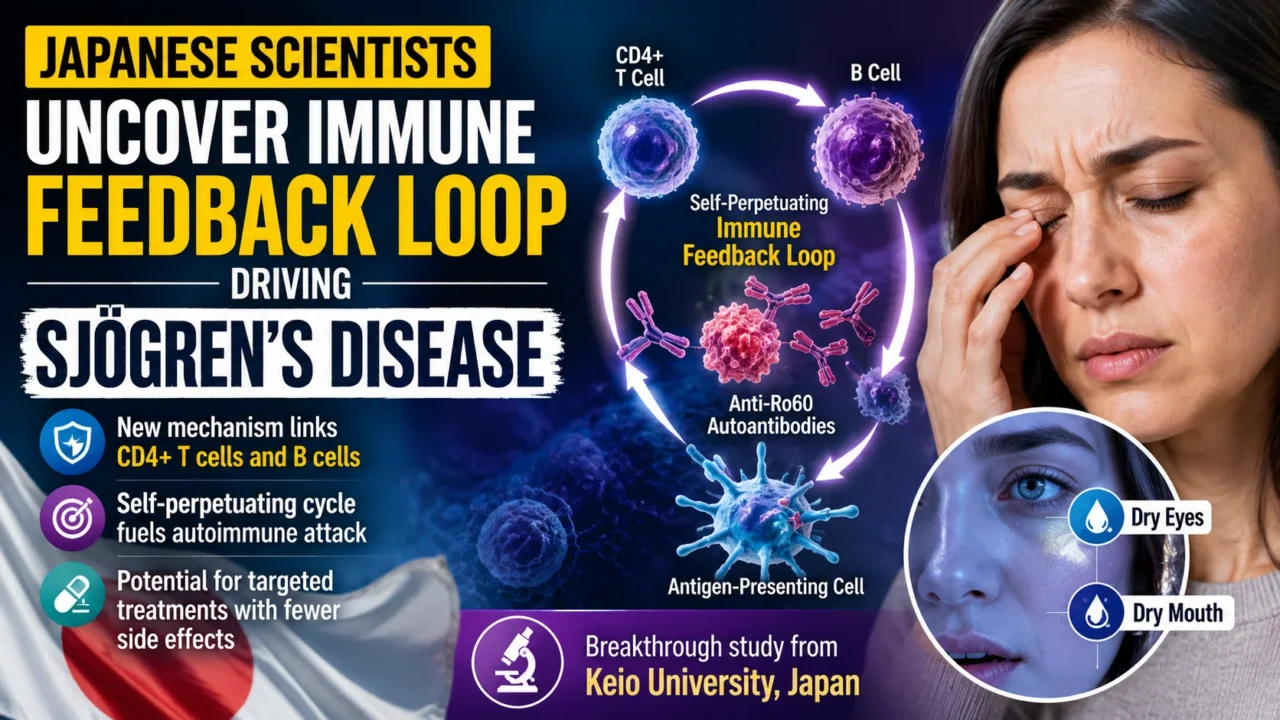
The findings, published in Science Advances on June 3, 2026, reveal a self-sustaining interaction between CD4+ T cells and B cells that continuously fuels inflammation and tissue damage in patients with Sjögren’s disease.
What Is Sjögren’s Disease?
Sjögren’s disease is a chronic autoimmune disorder in which the body’s immune system mistakenly attacks its own moisture-producing glands, particularly the salivary and tear glands. As a result, patients often experience persistent dry mouth and dry eyes.
However, the disease can extend far beyond these symptoms. In more severe cases, it may affect the lungs, kidneys, skin, joints, and nervous system, significantly impacting quality of life.
Despite affecting millions of people worldwide, there is currently no cure for Sjögren’s disease. Existing treatments primarily focus on symptom management and often rely on immunosuppressive medications that weaken the immune system as a whole.
The Mystery Behind Autoimmune Activity
One of the hallmarks of Sjögren’s disease is the production of anti-Ro60 autoantibodies, which mistakenly target a naturally occurring protein called Ro60.
Scientists have long known that B cells, which produce antibodies, play an important role in the disease. However, the involvement of CD4+ T cells, another critical component of the immune system, has remained less understood.
To investigate this relationship, Assistant Professor Masaru Takeshita and his research team analyzed immune cells collected from the salivary glands of patients with Sjögren’s disease.
Using advanced technologies such as single-cell RNA sequencing and T-cell receptor (TCR) analysis, the researchers examined hundreds of immune cell receptors involved in recognizing disease-related targets.
Discovery of Disease-Specific T Cells
The study identified a unique population of CD4+ T cells that specifically recognize fragments of the same Ro60 protein targeted by anti-Ro60 autoantibodies.
This finding is particularly significant because it provides the first direct evidence that both major immune cell populations involved in Sjögren’s disease—T cells and B cells—are responding to the same antigen.
Researchers believe this shared target may be a critical factor in sustaining autoimmune activity over time.
How the Immune Feedback Loop Works
Further investigation revealed a self-perpetuating cycle that may explain why Sjögren’s disease becomes chronic.
The process begins when damaged cells release Ro60 proteins into surrounding tissues. Anti-Ro60 antibodies bind to these proteins, creating immune complexes.
These complexes are then captured by antigen-presenting cells, which process the proteins and display Ro60 fragments to CD4+ T cells.
Once activated, the T cells stimulate B cells to produce even more anti-Ro60 antibodies. This leads to the formation of additional immune complexes, creating a continuous cycle of immune activation and tissue destruction.

The Autoimmune Cycle at a Glance
| Step | Immune Process |
|---|---|
| 1 | Damaged cells release Ro60 proteins |
| 2 | Anti-Ro60 antibodies bind to Ro60 proteins |
| 3 | Immune complexes form |
| 4 | Antigen-presenting cells capture and process complexes |
| 5 | CD4+ T cells become activated |
| 6 | Activated T cells stimulate B cells |
| 7 | B cells produce more anti-Ro60 antibodies |
| 8 | Cycle repeats, sustaining inflammation |
Researchers believe this feedback loop is one of the key drivers of persistent autoimmune activity in Sjögren’s disease.
Findings Apply Across Different Populations
An important aspect of the study is that the immune mechanism was observed in both Japanese and Caucasian patients.
This suggests that the newly identified pathway is not limited to a particular ethnic or genetic background. Instead, it may represent a fundamental disease process shared by many patients with anti-Ro60-positive Sjögren’s disease worldwide.
The consistency across populations strengthens confidence in the findings and increases their potential clinical relevance.
Why This Discovery Matters
Current treatments for Sjögren’s disease generally suppress broad portions of the immune system. While effective in reducing inflammation, these therapies can also weaken normal immune defenses and increase susceptibility to infections.
The newly discovered feedback loop offers a promising alternative therapeutic target.
Rather than suppressing the entire immune system, future treatments could focus on disrupting the specific interaction between Ro60-reactive T cells and B cells.
Potential benefits of such targeted therapies include:
| Potential Advantage | Impact |
|---|---|
| More precise treatment | Targets disease-driving cells directly |
| Reduced immune suppression | Preserves healthy immune function |
| Lower infection risk | Fewer treatment-related complications |
| Slower disease progression | Interrupts the autoimmune cycle |
| Better quality of life | Reduced long-term side effects |
Implications for Future Autoimmune Research
The Keio University research team plans to continue investigating ways to therapeutically interrupt this immune feedback loop.
Beyond Sjögren’s disease, the findings may also provide valuable insights into other autoimmune disorders where T cells, B cells, and autoantibodies work together to sustain chronic inflammation.
Many autoimmune diseases share similar immune pathways, meaning this discovery could have broader implications for future treatment development.
Conclusion
The identification of a self-reinforcing immune feedback loop between CD4+ T cells and B cells marks a significant advancement in understanding Sjögren’s disease.
By revealing how anti-Ro60 antibodies and Ro60-reactive T cells cooperate to sustain chronic inflammation, researchers have uncovered a potential target for next-generation therapies that could treat the disease more effectively and safely.
As scientists continue to unravel the complex mechanisms behind autoimmune disorders, this breakthrough brings new hope for millions of patients seeking treatments that address the root cause of disease rather than simply managing symptoms.
Recommended Products