

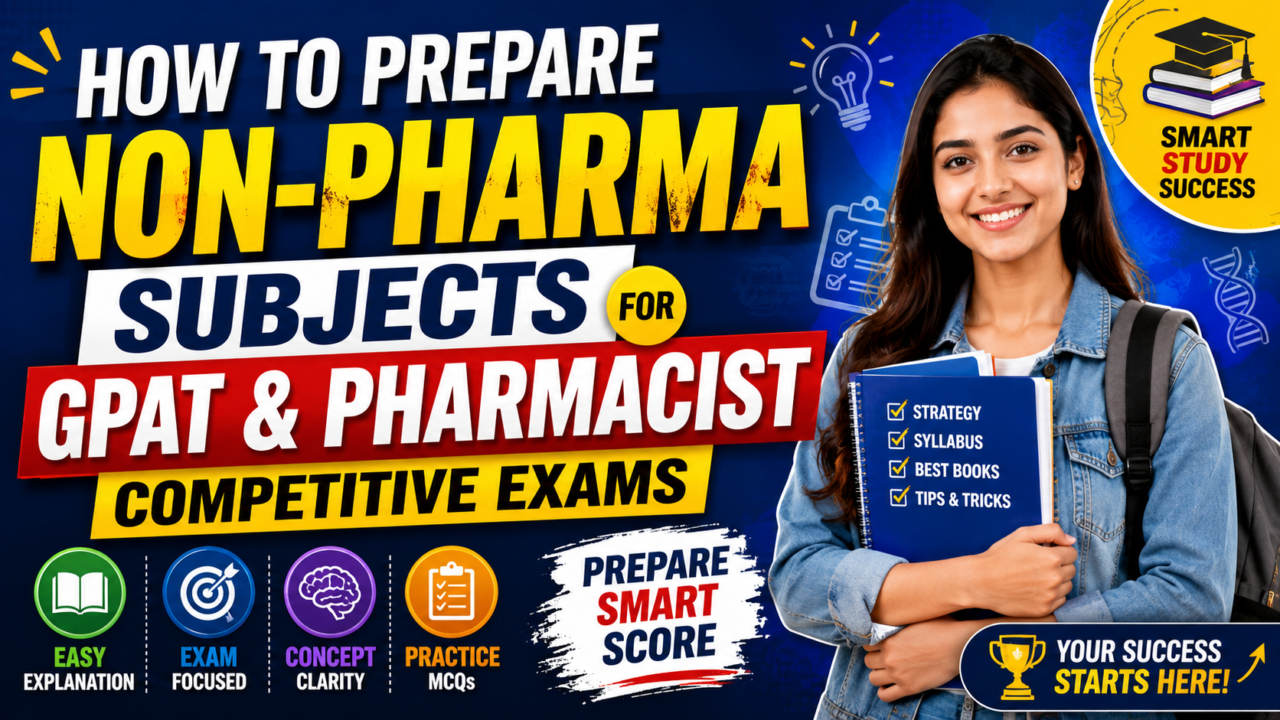

Preparing for GPAT and other pharmacist competitive exams can feel challenging, especially when it comes to non-pharma subjects. Many students focus heavily on core pharmacy topics and ignore subjects like Aptitude, Reasoning, English, General Knowledge, Biochemistry, Pathophysiology, and Microbiology. However, these subjects can play a major role in improving your overall score and rank.
In this blog, we will discuss the best strategy to prepare non-pharma subjects effectively for GPAT and pharmacist competitive exams.
Why Non-Pharma Subjects Are Important
Non-pharma subjects are often considered scoring areas because:
- Questions are usually direct and concept-based.
- Less calculation compared to pharmaceutical subjects.
- Easy to revise regularly.
- Helps improve overall exam score quickly.
A good command of non-pharma subjects can increase your selection chances significantly.
Best Strategy to Prepare Non-Pharma Subjects
1. Understand the Exam Syllabus
Before starting preparation, carefully analyze the syllabus of GPAT or the pharmacist exam you are targeting.
Common non-pharma subjects include:
- Human Anatomy & Physiology
- Pathophysiology
- Biochemistry
- Microbiology
- Pharmaceutical Jurisprudence
- General Aptitude
- Reasoning
- English Language
- Current Affairs
Make a checklist of all topics and divide them according to difficulty level.

2. Start with Easy & Scoring Subjects
Begin preparation with subjects that are easy to understand and highly scoring.
Recommended order:
- Pharmaceutical Jurisprudence
- Human Anatomy & Physiology
- Biochemistry
- Microbiology
- Aptitude & Reasoning
- English & GK
Starting with easy topics builds confidence and improves consistency.
3. Make Short Notes
Non-pharma subjects contain many facts, definitions, and important points. Making short notes helps in quick revision.
Include:
- Important definitions
- Diagrams
- Short tricks
- Important years and acts
- Formulae
- Tables and flowcharts
Use colored pens and sticky notes for better memory retention.
4. Focus on MCQ Practice
Competitive exams are all about practice. Solve MCQs daily from non-pharma subjects.
Benefits of MCQ practice:
- Improves speed
- Identifies weak areas
- Enhances accuracy
- Builds confidence
Try to solve:
- Topic-wise MCQs
- Previous year questions
- Mock tests
5. Follow Previous Year Question Papers
Many questions in pharmacist exams are repeated from previous years.
Analyze:
- Frequently asked topics
- Repeated concepts
- Important chapters
This helps you prepare smartly instead of studying everything randomly.
6. Create a Daily Study Plan
Consistency matters more than long study hours.
Sample Daily Schedule
| Time | Activity |
|---|---|
| 1 Hour | Pharma Subject |
| 45 Minutes | Non-Pharma Subject |
| 30 Minutes | MCQ Practice |
| 15 Minutes | Revision |
Study non-pharma subjects daily even if only for a short time.
7. Use Smart Revision Techniques
Revision is the key to remembering theoretical subjects.
Best revision methods:
- Flashcards
- Mind maps
- Weekly revision
- Formula sheets
- One-page notes
Revise important topics every Sunday.
8. Improve General Aptitude & Reasoning
Many pharmacist exams now include aptitude and reasoning sections.
Practice:
- Percentage
- Ratio & Proportion
- Profit & Loss
- Time & Work
- Blood Relations
- Coding-Decoding
- Logical Reasoning
Daily practice of 20–30 questions is enough.
9. Read Current Affairs Daily
For government pharmacist exams, current affairs and healthcare updates are important.
Focus on:
- Health schemes
- Pharma news
- Government policies
- Important appointments
- Awards and events
Reading daily for 10–15 minutes is sufficient.
10. Attempt Mock Tests Regularly
Mock tests help simulate the real exam environment.
Benefits:
- Time management
- Pressure handling
- Accuracy improvement
- Performance analysis
Try at least:
- 1 mock test weekly initially
- 2–3 mock tests weekly near exam time
Common Mistakes to Avoid
- Ignoring non-pharma subjects
- Studying without revision
- Avoiding mock tests
- Memorizing without understanding
- Not practicing MCQs regularly
Avoid these mistakes to improve your exam performance.
Best Books for Non-Pharma Preparation
Recommended Books
Human Anatomy & Physiology
- Sembulingam
Biochemistry
- Satyanarayana
Microbiology
- Ananthanarayan
Pharmaceutical Jurisprudence
- Bare Act Notes
Aptitude & Reasoning
- RS Aggarwal
Final Tips for Success
- Stay consistent.
- Revise daily.
- Practice MCQs regularly.
- Focus on weak subjects.
- Maintain a healthy routine.
- Avoid stress and overthinking.
Remember, non-pharma subjects can become your strongest scoring area if prepared smartly.
Conclusion
Preparing non-pharma subjects for GPAT and pharmacist competitive exams is not difficult if you follow the right strategy. With proper planning, regular revision, MCQ practice, and smart study techniques, you can score well and improve your overall rank.
Stay disciplined, believe in yourself, and keep practicing consistently. Success will definitely follow.
Best of luck for your GPAT & Pharmacist Competitive Exam Preparation!
Recommended Products