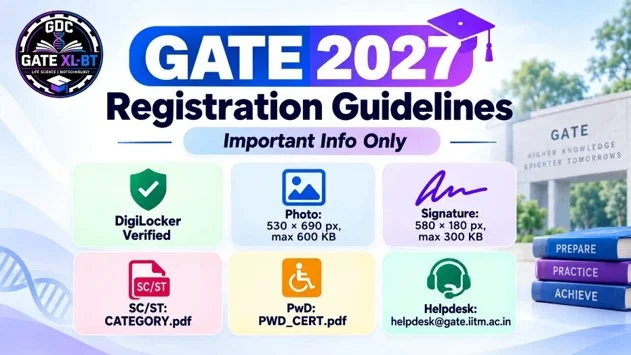
Crack GATE 2026 Life Sciences with the ultimate study plan, smart strategies, and proven preparation tips.
Preparing for GATE 2026 (Life Sciences) can feel overwhelming—but with the right strategy, resources, and mindset, cracking it becomes achievable. This guide gives you a complete roadmap covering exam pattern, syllabus, preparation tips, and career opportunities.
The Graduate Aptitude Test in Engineering (GATE) is a national-level entrance exam conducted annually in India for admission into postgraduate programs like M.Sc., M.Tech, and Ph.D.
Thousands of students appear every year, and the competition is steadily increasing due to growing opportunities in life sciences.
GATE 2026 Exam Pattern (Life Science)
Feature
Details
Mode of Exam
Computer-Based Test
Duration
3 Hours
Total Marks
100
Language
English Only
Papers Allowed
Maximum 2-paper combination
Validity of Score
3 Years
Section-wise Distribution
Section
Questions
Marks
General Aptitude
10
15
Chemistry
17
25
Optional Subjects
40
60
Types of Questions
Question Type
Description
MCQs
Multiple Choice Questions
MSQs
Multiple Select Questions
NAT
Numerical Answer Type
Subjects & Codes (Life Science – XL)
Subject Code
Subject Name
XL-P
Chemistry
XL-Q
Biochemistry
XL-R
Botany
XL-S
Microbiology
XL-T
Zoology
XL-U
Food Technology
Scholarship Benefits
Benefit Type
Details
Monthly Stipend
₹12,400/month
Eligibility
Valid GATE Score
Important Topics (Syllabus Overview)
Chemistry
Topic Area
Key Concepts
Atomic Structure
Quantum theory, electronic configuration
Bonding
Ionic, covalent, VSEPR, hybridization
Thermodynamics
Laws, entropy, Gibbs energy
Electrochemistry
EMF, Nernst equation
Kinetics
Order, rate, activation energy
Biochemistry
Topic Area
Key Concepts
Biomolecules
Proteins, carbohydrates, lipids
Enzymes
Kinetics, inhibition
Metabolism
Glycolysis, TCA cycle, ATP
Molecular Biology
DNA, RNA, protein synthesis
Techniques
Chromatography, electrophoresis
Microbiology
Topic Area
Key Concepts
Microbial Growth
Growth curve, measurement
Genetics
Mutation, recombination
Metabolism
Respiration, fermentation
Immunology
Antibodies, vaccines
Diseases
Pathogenesis, host interaction
Smart Preparation Strategy
Time Management Tips
Strategy
Description
Make Notes
Use free time for short notes
Daily Practice
Solve DPPs regularly
Revision
Revise during travel using audio notes
Library Use
Study consistently in college library
Smart Study Habits
Habit
Benefit
Study Group
Improves understanding via discussion
Learn from Seniors
Avoid common mistakes
Use Free Time
Maximize productivity
Stay Focused
Avoid distractions
Recommended Books
Subject
Book
Physical Chemistry
Ira Levine
Organic Chemistry
Clayden, Greeves & Warren
Biochemistry
Lehninger Principles
Microbiology
Tortora / C.K. Kokare
Inorganic Chemistry
Puri, Sharma & Kalia
Previous Year Cutoff Trends
Year
General
OBC/EWS
SC/ST/PwD
2024
33.5
29.5
22
2023
35.2
30.8
23.4
2022
31.7
28.2
20.8
2021
43.1
30.1
22.7
2020
32.6
28.9
21.5
Career Opportunities After GATE
Career Path
Opportunities
Higher Studies
M.Sc., M.Tech
Research
Ph.D., JRF
Government Jobs
CSIR, DBT, ICMR
PSU Jobs
BIRAC, BIBCOL
Industry
Pharmaceutical companies
Final Tips to Crack GATE 2026
Start early and stay consistent
Focus on concepts, not rote learning
Solve previous year papers
Attempt mock tests regularly
Revise multiple times
Conclusion
GATE is not just an exam—it’s a gateway to top institutes, research careers, and high-paying jobs. With the right strategy and dedication, success is achievable.
Stay consistent, stay focused, and trust the process.
Follow Us
Subscribe our GPAT DISCUSSION CENTER YouTube Channel for more Pharma Updates