

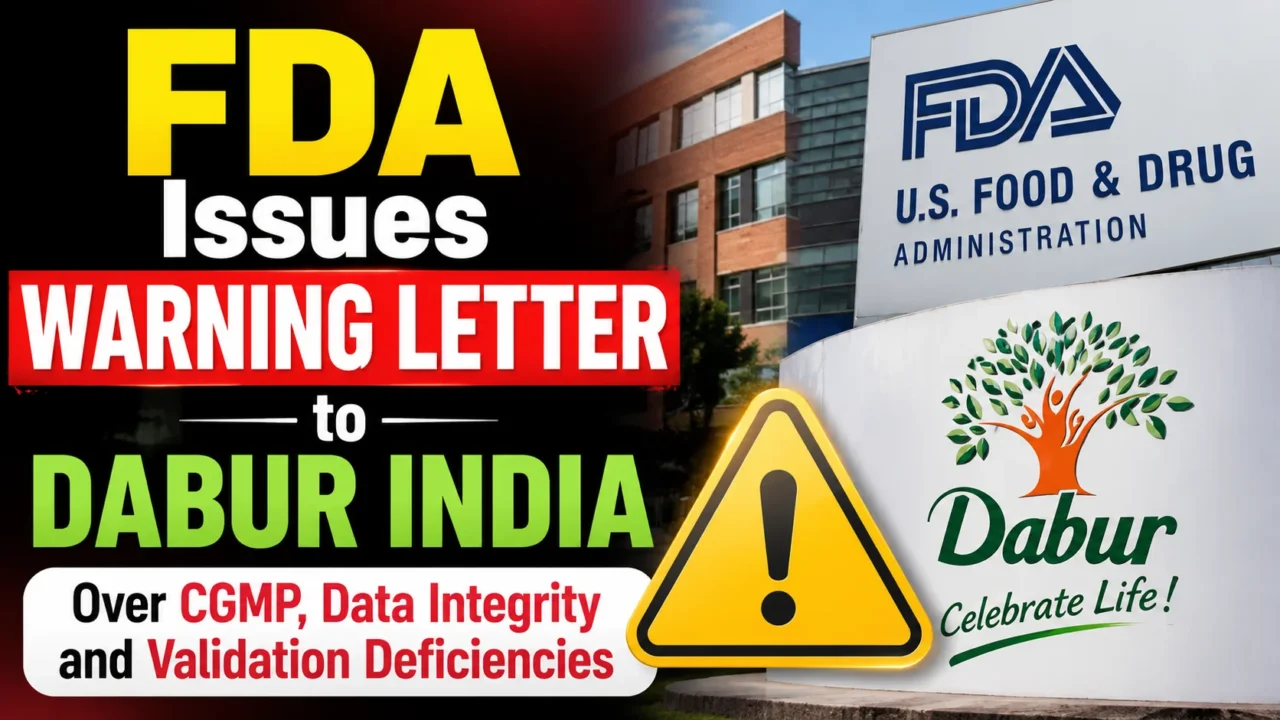

The FDA Warning Letter to Dabur India 2026 highlights significant concerns related to Current Good Manufacturing Practice (CGMP), data integrity, laboratory controls, cleaning validation, process validation and quality unit oversight at Dabur India Limited’s drug manufacturing facility in Saily, Silvassa, Dadra and Nagar Haveli and Daman and Diu, India.
The U.S. Food and Drug Administration (FDA) inspected the facility from January 12 to January 16, 2026 and subsequently issued a warning letter dated July 24, 2026, citing deficiencies in pharmaceutical manufacturing and quality systems.

Quick Summary
The FDA Warning Letter to Dabur India 2026 concerns CGMP and quality-system deficiencies identified during a January 2026 inspection of Dabur’s Silvassa facility. Major concerns included data integrity, laboratory records, cleaning validation, process validation and quality oversight. The FDA requested comprehensive corrective and preventive actions (CAPA) and further remediation.
FDA Warning Letter to Dabur India 2026: Overview
| Particular | Details |
|---|---|
| Company | Dabur India Limited |
| Facility | Saily, Silvassa, Dadra and Nagar Haveli and Daman and Diu, India |
| Inspection Date | January 12–16, 2026 |
| Warning Letter Date | July 24, 2026 |
| FDA Reference | 320-26-105 |
| Product Category | Drugs / OTC Drugs |
| Main Concerns | CGMP, data integrity, laboratory controls, cleaning validation and process validation |
| Import Alert | 66-40 |
| Regulatory Authority | U.S. FDA |
The FDA stated that the facility’s methods, facilities and controls did not conform to applicable CGMP requirements under 21 CFR Parts 210 and 211.
What Is the FDA Warning Letter to Dabur India About?
The FDA identified multiple deficiencies in the pharmaceutical quality systems at Dabur’s Saily, Silvassa facility.
The major areas of concern include:
- Quality control unit oversight
- Data integrity
- Manufacturing and laboratory records
- Laboratory controls
- Cleaning validation
- Process validation
- Equipment and facility qualification
- Documentation practices
- Corrective and preventive actions (CAPA)
The findings indicate that the FDA’s concerns were not limited to a single manufacturing activity but involved multiple interconnected quality systems.
Major FDA Findings at Dabur India
1. Quality Control Unit and Data Integrity Deficiencies
One of the major concerns identified by the FDA involved the quality control unit and data integrity.
During the inspection, FDA investigators requested an equipment usage logbook. According to the warning letter, the company initially delayed providing the record and later provided a logbook that appeared to have been newly created.
The FDA subsequently located the original logbook and determined that the version initially provided had been falsified. The agency stated that several U.S.-marketed OTC products were omitted from the record.
The FDA also identified differences between original analytical data and values reported in batch manufacturing records and certificates of analysis.
The discrepancies involved quality attributes such as:
| Quality Attribute |
|---|
| Residue on ignition |
| Melting range |
| pH |
| Viscosity |
These findings raised serious concerns regarding data integrity, laboratory documentation and quality oversight.
2. Incomplete Laboratory Records
The FDA also identified deficiencies in laboratory documentation and supporting analytical records.
According to the warning letter, certain microbiology plates were documented in laboratory notebooks but were not physically present in the incubators. The records did not adequately explain their location or disposal.
The FDA also stated that the company could not produce certain supporting documents, including:
- Test procedures
- Analytical workbooks
- Test data sheets
- Supporting laboratory data for certain batches of U.S.-marketed drug products
Complete and reliable laboratory records are essential because they allow the quality unit to verify whether drug products meet established specifications.
3. Cleaning Validation Deficiencies
Another significant issue involved the facility’s cleaning validation programme.
The FDA found that cleaning validation for certain non-dedicated manufacturing equipment relied heavily on visual inspection and did not include adequate scientific controls.
The concerns included the absence or inadequacy of:
- Scientifically established maximum allowable carryover limits
- Quantitative residue testing
- Direct surface sampling
- Sampling of difficult-to-clean areas
The FDA also noted that cleaning validation had not been performed for another manufacturing line despite its use for multiple OTC drug products.
Why Is Cleaning Validation Important?
Cleaning validation helps demonstrate that manufacturing equipment can be adequately cleaned between products.
If equipment is not properly cleaned and validated, residues from one product may potentially contaminate another product manufactured using the same equipment.
The FDA therefore requested a comprehensive assessment of potential cross-contamination risks and improvements to Dabur’s cleaning validation programme.

4. Process Validation Deficiencies
The FDA also identified concerns regarding process validation at the facility.
According to the warning letter, adequate process validation had not been performed for a number of OTC drug products manufactured at the site.
The FDA requested a comprehensive validation programme covering areas such as:
- Process performance qualification
- Equipment qualification
- Facility qualification
- Ongoing process monitoring
Why Is Process Validation Important?
Process validation helps demonstrate that a pharmaceutical manufacturing process can consistently produce products that meet predetermined quality specifications.
A robust validation programme is therefore an important part of pharmaceutical manufacturing and CGMP compliance.
FDA-Requested Corrective and Preventive Actions
The FDA requested comprehensive Corrective and Preventive Action (CAPA) measures to address the identified deficiencies.
The remediation areas include:
| CAPA Area | Required Focus |
|---|---|
| Data Integrity | Investigation and remediation of data integrity concerns |
| Quality Unit | Strengthening quality oversight and resources |
| Documentation | Assessment and improvement of documentation systems |
| Laboratory Controls | Strengthening laboratory procedures and records |
| Cleaning Validation | Improved scientific assessment and validation |
| Process Validation | Comprehensive validation programme |
| Risk Assessment | Retrospective assessment of potential risks |
| Training | Appropriate employee training |
| Management Oversight | Increased senior management involvement |
| Independent Review | Assessment by an appropriately qualified consultant |
The FDA also recommended that Dabur engage a qualified consultant to evaluate its operations and assist with CGMP remediation.
Dabur India FDA Import Alert 66-40
The FDA warning letter states that Import Alert 66-40 was placed on drugs and drug products offered for import into the United States from the Dabur facility on June 5, 2026.
The import alert is an important regulatory development associated with the concerns identified at the facility.
Drug Recall Mentioned in the FDA Warning Letter
The warning letter also refers to recall-related actions.
According to the document, the FDA held a teleconference with Dabur on May 13, 2026, during which the agency recommended consideration of removing certain batches from the U.S. market.
The warning letter states that Dabur subsequently issued a voluntary recall on June 2, 2026, involving certain products because of systemic quality failures at the facility.
What Does the FDA Warning Letter Mean for Dabur?
A warning letter indicates that the FDA has identified significant regulatory concerns that require corrective action.
In the Dabur case, the concerns involve multiple pharmaceutical quality systems, including:
Data Integrity → Laboratory Controls → Quality Unit Oversight → Cleaning Validation → Process Validation → CGMP Compliance
Therefore, the FDA’s concerns extend beyond an isolated manufacturing observation and require broader quality-system remediation.
The FDA may conduct further inspections to evaluate whether the corrective actions implemented by the company are effective.
Key Pharmaceutical Quality Issues Highlighted by the Dabur FDA Case
The Dabur case highlights several important pharmaceutical quality concepts.
Data Integrity
Pharmaceutical records and analytical data must be reliable, complete and accurately represent the activities performed.
Laboratory Controls
Laboratory testing must be supported by appropriate procedures, records and underlying analytical data.
Cleaning Validation
Cleaning procedures must be scientifically evaluated to demonstrate their effectiveness and minimise potential cross-contamination risks.
Process Validation
Manufacturing processes should be appropriately validated and monitored to demonstrate consistent product quality.
Quality Unit Oversight
The quality unit plays an important role in ensuring that manufacturing and testing activities comply with established quality requirements.
Why Is This FDA Action Important for Pharmacy Students?
The FDA Warning Letter to Dabur India 2026 is particularly useful for pharmacy students and pharmaceutical professionals because it provides a real-world example of pharmaceutical quality-system failures.
Students preparing for B.Pharm, M.Pharm, GPAT, Drug Inspector, Pharmacist and pharmaceutical industry-related examinations can use this case to understand practical applications of:
- CGMP
- Quality assurance
- Quality control
- Data integrity
- Cleaning validation
- Process validation
- Documentation
- CAPA
- Regulatory affairs
This case can also help students understand how regulatory authorities evaluate pharmaceutical manufacturing facilities.
What Should Pharmaceutical Companies Learn From the Dabur FDA Case?
The case demonstrates the importance of maintaining strong quality systems throughout the pharmaceutical manufacturing lifecycle.
Companies should ensure that:
- Manufacturing records are accurate and complete.
- Laboratory data are properly documented and traceable.
- Quality units have adequate oversight.
- Cleaning procedures are scientifically validated.
- Manufacturing processes are appropriately validated.
- Deviations and quality failures are thoroughly investigated.
- CAPA programmes address the root cause of problems.
- Employees receive appropriate training.
- Management actively oversees the pharmaceutical quality system.
- Data integrity is maintained throughout the entire documentation process.
FDA Warning Letter to Dabur India 2026: Important Timeline
| Date | Event |
|---|---|
| January 12–16, 2026 | FDA inspection of Dabur’s Saily, Silvassa facility |
| May 13, 2026 | FDA teleconference with Dabur regarding certain products |
| June 2, 2026 | Voluntary recall mentioned in the FDA warning letter |
| June 5, 2026 | Import Alert 66-40 placed |
| July 24, 2026 | FDA Warning Letter issued |
Frequently Asked Questions
1. What is the FDA Warning Letter to Dabur India 2026?
The FDA Warning Letter to Dabur India 2026 concerns significant CGMP, data integrity, laboratory control, cleaning validation, process validation and quality oversight deficiencies identified at Dabur’s Saily, Silvassa facility.
2. When did the FDA inspect Dabur’s Silvassa facility?
The FDA inspection was conducted from January 12 to January 16, 2026.
3. When was the FDA Warning Letter issued to Dabur?
The warning letter is dated July 24, 2026.
4. What were the major deficiencies identified by the FDA?
The major concerns included data integrity, quality unit oversight, incomplete laboratory records, cleaning validation, process validation and manufacturing controls.
5. What is Import Alert 66-40 in the Dabur case?
According to the warning letter, Import Alert 66-40 was placed on drugs and drug products offered for import into the United States from the Dabur facility on June 5, 2026.
6. Did Dabur issue a product recall?
According to the FDA warning letter, Dabur issued a voluntary recall on June 2, 2026, involving certain products associated with systemic quality failures at the facility.
7. Why is data integrity important in pharmaceutical manufacturing?
Data integrity helps ensure that laboratory, manufacturing and quality records accurately and reliably represent the activities performed. Reliable data are essential for making decisions about drug quality and compliance.
8. What corrective actions has the FDA requested from Dabur?
The FDA requested comprehensive remediation involving data integrity, quality oversight, laboratory controls, cleaning validation, process validation, risk assessment, CAPA, training and management oversight.
Conclusion
The FDA Warning Letter to Dabur India 2026 highlights significant regulatory concerns involving CGMP compliance, data integrity, laboratory controls, quality unit oversight, cleaning validation and process validation at the company’s Saily, Silvassa manufacturing facility.
The FDA has requested comprehensive investigations, risk assessments and corrective and preventive actions to address the identified deficiencies. The agency has also recommended the involvement of a qualified consultant and may conduct further inspections to evaluate the effectiveness of the company’s remediation efforts.
For pharmacy students, pharmaceutical professionals, quality assurance professionals, regulatory affairs aspirants and drug manufacturing companies, the Dabur case provides an important real-world example of why strong pharmaceutical quality systems, reliable data and scientifically justified validation programmes are essential.
Recommended Products