

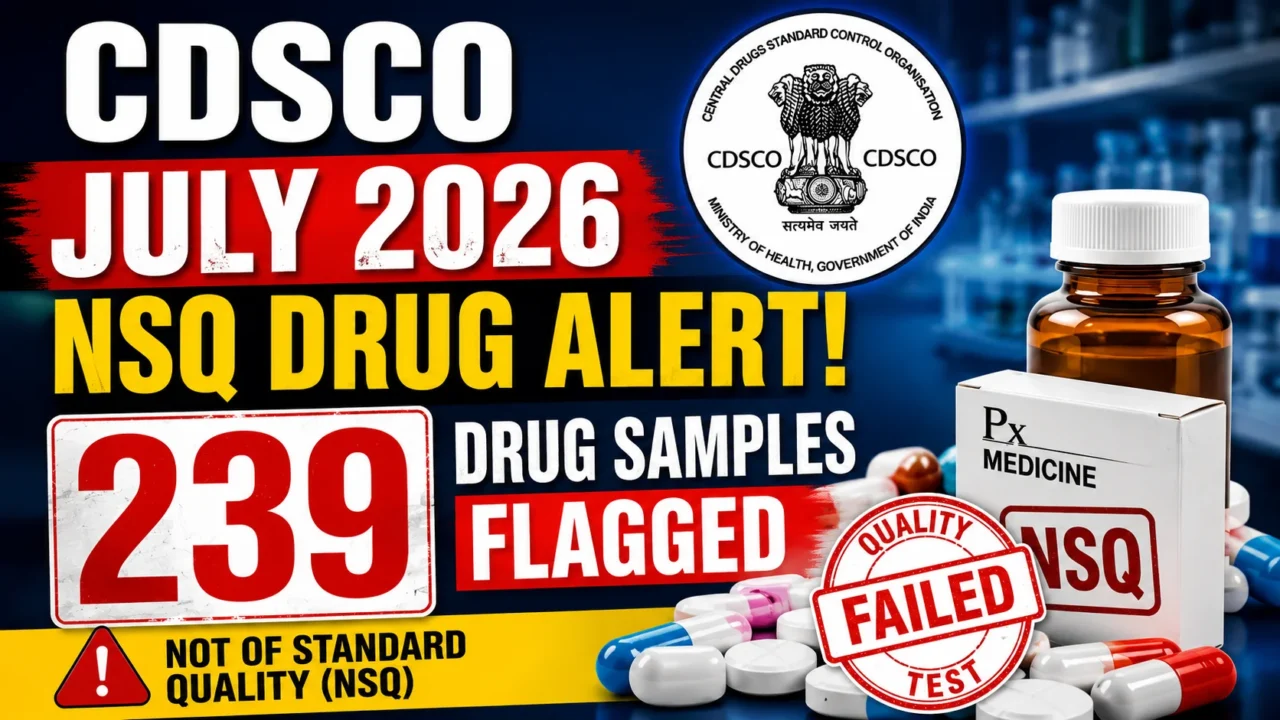

The CDSCO July 2026 NSQ Drug Alert lists at least 239 drug samples reported as Not of Standard Quality (NSQ) during testing by CDSCO and state drug-testing laboratories. The alert covers tablets, capsules, injections, syrups, creams, suspensions and other pharmaceutical products.
The reported quality failures involve parameters such as assay, dissolution, identification, sterility, particulate matter, pH, uniformity of weight and product description.
For pharmacy students, pharmacists and drug regulatory exam aspirants, this alert is important because it provides practical examples of pharmaceutical quality-control failures and post-market drug surveillance in India.
Quick Summary
The CDSCO July 2026 NSQ alert identifies at least 239 drug samples that failed one or more specified quality requirements. Reported issues include assay, dissolution, identification, sterility, particulate matter, pH and description failures. The alert also contains entries classified as misbranded or spurious. The findings apply to the specific samples and batches identified.
CDSCO July 2026 NSQ Alert: Overview
The Central Drugs Standard Control Organization (CDSCO) publishes drug-quality alerts based on samples tested by regulatory laboratories.
The July 2026 alert includes pharmaceutical products from different therapeutic categories and dosage forms. The reported failures vary from reduced active pharmaceutical ingredient content to problems involving dissolution, sterility, identification and particulate contamination.
Key Highlights
| Particular | Details |
|---|---|
| Regulatory authority | CDSCO |
| Alert month | July 2026 |
| Reported NSQ entries | At least 239 |
| Main category | Not of Standard Quality (NSQ) |
| Dosage forms | Tablets, capsules, injections, syrups, creams, suspensions and others |
| Common test failures | Assay, dissolution, identification, sterility, pH, particulate matter and description |
| Other classifications | Misbranded and spurious entries are also included |

Important Drug Samples Listed in the July 2026 Alert
1. Methotrexate Tablets IP 7.5 mg
Two Methotrexate tablet samples manufactured by Macmillon Pharmaceuticals Pvt. Ltd. appear in the alert.
| Product | Batch | Reported issue |
| Methotrexate Tablets IP 7.5 mg | L09-2501 | Description |
| Methotrexate 7.5 mg | L09-2402 | Description |
Both entries were reported for failure under the description parameter.
2. Calcium and Vitamin D3 Tablets IP
Cureza Healthcare Pvt. Ltd. manufactured the reported sample with batch number CH26T203.
The sample failed the calcium dissolution requirement. According to the alert, three of six tablets were below the specified Q-25% limit, while some tablets did not completely dissolve within the prescribed time.
3. Pregabalin Capsules IP 300 mg
The alert includes Pregabalin Capsules IP 300 mg, batch DMC-260508A, manufactured by Divine Medicare.
The reported Pregabalin content was 211.16 mg per capsule against the labelled claim of 300 mg.
This represents a substantial difference between the tested content and the labelled strength.
4. Itraconazole 100 mg
An Itraconazole 100 mg sample, batch MC004, manufactured by MK Healthcare, was also reported.
The reported Itraconazole content was 63.54 mg per capsule, equivalent to 63.54% of the labelled 100 mg. The alert also reported that the composition stated on the label was not in accordance with the IP monograph.
Paracetamol Samples in the NSQ Alert
Paracetamol appears in multiple entries in the July 2026 alert.
Some Paracetamol 500 mg and Paracetamol 650 mg samples were reported for dissolution failures.
One Paracetamol 500 mg sample manufactured by Cotec Healthcare failed the applicable IP 2022 dissolution requirement. Paracetamol 650 mg samples from Zenith Drugs and other manufacturers were also reported for dissolution-related failures.
Injectable Drugs Reported in the Alert
The July 2026 NSQ alert also contains several injectable products with reported quality concerns.
Metronidazole Infusion BP 0.5% w/v
A sample manufactured by Althea Pharma Pvt. Ltd. was reported as not complying with the BP 2025 sterility requirement.
Sodium Chloride Injection IP 0.9% w/v
A Sodium Chloride Injection sample manufactured by MKA Remedies was reported for particulate contamination.

Oxytocin Injection IP 5 IU/ml
The reported Oxytocin injection sample failed requirements relating to:
- Identification by HPLC
- Particulate matter
Ferric Carboxymaltose Injection 50 mg/ml
The sample was reported for failures involving:
- Particulate matter
- Bacterial endotoxin testing
Rabeprazole Sodium Injection
The reported Rabeprazole Sodium Injection sample had issues involving:
- Description
- pH
- Clarity
- Particulate matter
- Assay
Other Important Medicines Reported as NSQ
Several other medicines were listed for assay or identification-related quality concerns.
These include:
- Bupropion Hydrochloride Prolonged Release Tablets IP
- Racecadotril Capsules IP 100 mg
- Telmisartan Tablets IP 20 mg
- Pantoprazole Gastro-resistant Tablets IP
- Betamethasone Valerate Ointment
Some samples also showed reduced active ingredient content.
For example, the reported Pantoprazole sample showed a content of 84.7%, while the reported Betamethasone Valerate ointment sample showed 73.7% content.
Spurious and Misbranded Products
The July 2026 alert also includes products classified as spurious or misbranded.
Diabetis-All Powder
A product named Diabetis-All Powder was reported as spurious after testing identified the presence of Pioglitazone Hydrochloride, with a reported content of 0.32 mg/gm.
Misbranded Medicines
The alert also lists:
- Nimesulide & Paracetamol Tablets
- Amoxycillin & Potassium Clavulanate Tablets
as misbranded drugs in the relevant entries.
Paediatric and Consumer Healthcare Products
The alert also contains quality observations involving paediatric and consumer healthcare products.
Azithromycin Oral Suspension IP 200 mg/5 ml
A reported Azithromycin oral suspension sample had an Azithromycin content of 65.76% of the labelled amount.
The tested sample also showed fungal growth.
Major Types of Quality Failures
The July 2026 alert demonstrates that pharmaceutical quality failures can involve several different testing parameters.
| Quality Parameter | What It Indicates |
| Assay | Amount of active ingredient present |
| Dissolution | Release of drug from the dosage form |
| Identification | Confirmation of the drug/substance identity |
| Sterility | Absence of viable microorganisms where sterility is required |
| Particulate matter | Presence of unwanted particles in applicable products |
| pH | Acidity/alkalinity of the preparation |
| Uniformity of weight | Consistency of dosage-unit weight |
| Description | Physical characteristics and appearance |
| Bacterial endotoxin | Presence of bacterial endotoxins in applicable products |
What Does “Not of Standard Quality” Mean?
Not of Standard Quality (NSQ) means that the particular drug sample tested did not comply with one or more prescribed quality specifications.
An NSQ result is associated with the specific sample and batch identified in the regulatory testing record.
It should not automatically be interpreted as meaning that every batch of the same medicine, or every product manufactured by the same company, is defective.
Important Note for Patients and Pharmacies
Healthcare professionals, pharmacists, distributors and consumers should check the exact product name, manufacturer and batch number when reviewing an NSQ alert.
A medicine should not be considered affected solely because another batch or another product from the same manufacturer appears in an alert.
For any medicine-related concern, patients should consult a qualified healthcare professional rather than stopping or changing treatment on their own.
Why Is the CDSCO NSQ Alert Important for Pharmacy Students?
The CDSCO drug-quality alerts are particularly useful for:
- B.Pharm students
- D.Pharm students
- M.Pharm students
- Pharmacists
- Drug Inspector aspirants
- Pharmaceutical quality-control professionals
- Regulatory-affairs aspirants
- GPAT and other pharmacy competitive-exam candidates
These alerts provide real-world examples of concepts such as assay, dissolution, sterility, identification, quality control and regulatory surveillance.
Important Points for Drug Inspector and Pharmacist Exams
For exam preparation, remember these key concepts:
- NSQ stands for Not of Standard Quality.
- NSQ findings are linked to the specific tested sample and batch.
- Dissolution testing evaluates drug release from a dosage form.
- Assay determines the amount of active pharmaceutical ingredient present.
- Sterility is particularly important for applicable sterile pharmaceutical preparations.
- Particulate-matter testing is important for applicable injectable products.
- Regulatory drug alerts are part of post-market quality surveillance.
Official Source and Important Links
For the complete July 2026 NSQ alert, readers should verify the information from the official CDSCO drug-alert publication/official regulatory record before taking any action.
External Link Suggestion: Add the official CDSCO July 2026 NSQ/Drug Alert PDF or webpage here once the official document URL is available.
Internal Link Suggestions for GDC Classes:
- Pharmacy Current Affairs 2026
- Drug Inspector Exam Preparation
- Pharmacist Exam Preparation
- Pharmaceutical Quality Control MCQs
- Pharmacology MCQs for Competitive Exams
- Pharmaceutical Analysis Notes
- B.Pharm Important Questions
- D.Pharm Competitive Exam Preparation
Frequently Asked Questions (FAQs)
1. What is the CDSCO July 2026 NSQ Drug Alert?
The CDSCO July 2026 NSQ Drug Alert is a regulatory drug-quality alert listing samples reported as Not of Standard Quality during laboratory testing.
2. How many drug samples are listed in the July 2026 NSQ alert?
The July 2026 alert covers at least 239 entries, according to the provided alert information.
3. What does NSQ mean in pharmaceuticals?
NSQ means Not of Standard Quality. It indicates that the tested sample failed one or more applicable prescribed quality specifications.
4. Which types of medicines are included in the alert?
The alert includes tablets, capsules, injections, syrups, creams, suspensions and other pharmaceutical or healthcare products.
5. What are the common reasons for NSQ classification?
Common reported reasons include assay, dissolution, identification, sterility, particulate matter, pH, uniformity of weight and description failures.
6. Does an NSQ alert mean that every batch of a medicine is unsafe?
No. An NSQ finding concerns the specific sample and batch identified in the regulatory testing record. It should not automatically be applied to every batch of the same medicine.
7. Why should pharmacy students study CDSCO drug alerts?
CDSCO alerts provide practical examples of pharmaceutical quality-control and regulatory concepts and can help pharmacy students understand topics relevant to competitive examinations.
8. Where should the July 2026 NSQ list be verified?
The complete information should be verified against the official CDSCO publication or official regulatory document before relying on the details.
Conclusion
The CDSCO July 2026 NSQ Drug Alert highlights the importance of continuous pharmaceutical quality surveillance in India. At least 239 samples were reported with different quality concerns, including failures related to assay, dissolution, identification, sterility, particulate matter, pH and description.
The alert also demonstrates why checking the exact product and batch number is essential before drawing conclusions about a medicine or manufacturer.
For pharmacy students and drug-regulatory exam aspirants, these alerts are valuable real-world examples of pharmaceutical quality control, testing standards and post-market surveillance.
Recommended Products