


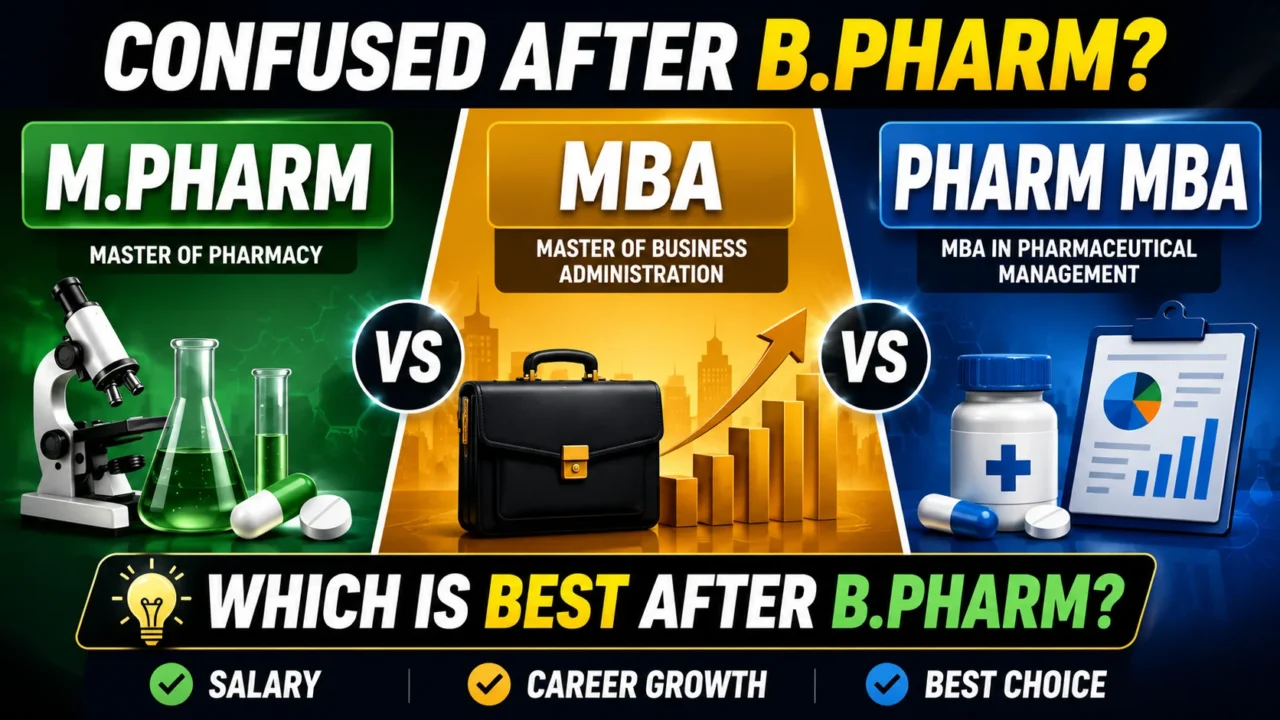

Completing a Bachelor of Pharmacy (B.Pharm) opens multiple career paths, but one question confuses almost every pharmacy graduate:
Should I pursue M.Pharm, General MBA, or Pharm MBA?
The answer depends on your career goals, interests, financial situation, and long-term vision. While all three options can lead to successful careers, they are designed for very different professionals.
This guide provides a complete comparison of M.Pharm, General MBA, and Pharm MBA to help you make an informed decision.
Understanding the Three Career Paths
M.Pharm (Master of Pharmacy)
M.Pharm is a postgraduate degree focused on advanced pharmaceutical sciences. Students specialize in areas such as:
- Pharmaceutics
- Pharmacology
- Pharmaceutical Chemistry
- Quality Assurance
- Clinical Pharmacy
- Regulatory Affairs
This path is ideal for students interested in research, development, academics, and technical pharmaceutical roles.
General MBA
A General MBA focuses on business management and leadership. It is not restricted to any specific industry and prepares students for careers in:
- Marketing
- Finance
- Human Resources
- Operations
- Consulting
- Product Management
A General MBA is suitable for candidates who want to move beyond technical pharmacy roles and enter business leadership.
Pharm MBA
Pharm MBA (MBA in Pharmaceutical Management) combines pharmaceutical knowledge with business skills. It focuses on:
- Pharmaceutical Marketing
- Supply Chain Management
- Regulatory Strategy
- Product Management
- Healthcare Management
- Pharma Operations
It is designed specifically for pharmacy graduates who want managerial roles within the pharmaceutical industry.

Quick Comparison Table
| Parameter | M.Pharm | General MBA | Pharm MBA |
|---|---|---|---|
| Duration | 2 Years | 2 Years | 2 Years |
| Eligibility | B.Pharm | Any Graduate | Preferably Pharmacy Graduates |
| Entrance Exam | GPAT | CAT/XAT/GMAT | NMAT/CMAT/Institute Exam |
| Focus Area | Pharmaceutical Science | Business & Management | Pharma + Business |
| Research Component | Very High | Low | Moderate |
| Business Skills | Limited | Extensive | Strong |
| Industry Flexibility | Low | Very High | Medium |
| PhD Opportunity | Yes | No | No |
| Average Fees | ₹50,000–₹3 Lakh | ₹5–25 Lakh | ₹3–12 Lakh |
| Best For | R&D, QA, Academics | Leadership Roles | Pharma Management |
Eligibility & Admission Process
M.Pharm
Requirements
- B.Pharm degree
- GPAT qualification preferred
- Some universities conduct their own entrance exams
Advantages
- Government colleges are affordable
- GPAT-qualified students may receive stipends
- Strong foundation for research careers
General MBA
Requirements
- Any bachelor’s degree
- CAT, XAT, GMAT, MAT, CMAT, or similar entrance exams
Advantages
- Access to top business schools
- Highest salary potential
- Opportunities across industries
Challenges
- Highly competitive admissions
- Top colleges require excellent entrance scores
Pharm MBA
Requirements
- B.Pharm or related healthcare degree
- NMAT, CMAT, GPAT, or institute-level exams
Advantages
- Pharmacy knowledge remains relevant
- Easier transition into management roles within pharma
Cost Comparison
| Course | Typical Fee Range |
|---|---|
| M.Pharm | ₹50,000 – ₹3 Lakh |
| Pharm MBA | ₹3 Lakh – ₹12 Lakh |
| General MBA | ₹5 Lakh – ₹25+ Lakh |
Most Affordable Option
M.Pharm remains the most economical postgraduate route, especially in government colleges.
Highest Investment
Top-tier MBAs require significant financial commitment but can offer higher returns.
Academic Focus Comparison
| Area | M.Pharm | General MBA | Pharm MBA |
|---|---|---|---|
| Pharmaceutical Science | Excellent | None | Moderate |
| Marketing | Limited | Extensive | Strong |
| Finance | Minimal | Extensive | Basic |
| Research | Very High | Low | Moderate |
| Management | Low | Very High | High |
Career Opportunities
Career Options After M.Pharm
Graduates typically work in:
- Research & Development (R&D)
- Quality Assurance (QA)
- Quality Control (QC)
- Clinical Research
- Regulatory Affairs
- Pharmaceutical Manufacturing
- Academics
Top Recruiters
- Sun Pharma
- Cipla
- Dr. Reddy’s
- Lupin
- Zydus
- Biocon
- CSIR Labs
- CROs
Career Options After General MBA
Graduates can work in almost any industry.
Popular Roles
- Marketing Manager
- Product Manager
- Business Consultant
- Financial Analyst
- Operations Manager
- Strategy Consultant
Top Recruiters
- McKinsey
- BCG
- Bain
- Deloitte
- Goldman Sachs
- Amazon
- P&G
- Tata Group
Career Options After Pharm MBA
Ideal for pharmaceutical business roles.
Popular Roles
- Product Manager
- Brand Manager
- Pharma Marketing Manager
- Market Access Manager
- Regulatory Strategy Manager
- Supply Chain Manager
Top Recruiters
- Pfizer
- Abbott
- GSK
- Novartis
- AstraZeneca
- Sun Pharma
- Lupin
Salary Comparison
| Degree | Average Starting Salary |
|---|---|
| M.Pharm | ₹3–7 LPA |
| Pharm MBA | ₹5–12 LPA |
| General MBA | ₹8–25 LPA |
Highest Salary Potential
A top-tier General MBA generally offers the highest compensation packages.
Stable Technical Career
M.Pharm offers consistent growth in pharmaceutical science roles.
Balanced Option
Pharm MBA provides a combination of respectable salaries and pharmaceutical specialization.
Who Should Choose M.Pharm?
Choose M.Pharm if:
✅ You enjoy laboratory work
✅ You are interested in research
✅ You want a PhD in the future
✅ You prefer scientific and technical careers
✅ You want affordable higher education
Pros
- Deep domain expertise
- Research opportunities
- GPAT stipend benefits
- Direct pathway to PhD
Cons
- Limited business exposure
- Lower salary ceiling compared to top MBAs
Who Should Choose General MBA?
Choose General MBA if:
✅ You want leadership positions
✅ You enjoy business, strategy, and management
✅ You want opportunities beyond pharmaceuticals
✅ You can target a top business school
Pros
- Highest salary potential
- Industry flexibility
- Leadership opportunities
Cons
- Expensive
- Highly competitive admissions
- Pharmacy knowledge becomes less relevant
Who Should Choose Pharm MBA?
Choose Pharm MBA if:
✅ You want management roles within pharma
✅ You enjoy both science and business
✅ You want to remain connected to healthcare
✅ You are interested in pharmaceutical marketing
Pros
- Domain expertise plus business skills
- Strong demand in pharma companies
- Better management opportunities than M.Pharm
Cons
- Limited opportunities outside healthcare
- Quality of programs varies significantly
Five Questions to Ask Before Deciding
1. Do I enjoy science or business more?
- Science → M.Pharm
- Business → MBA
- Both → Pharm MBA
2. Do I want a PhD someday?
- Yes → M.Pharm
3. Do I want to stay in the pharmaceutical industry?
- Yes → M.Pharm or Pharm MBA
- No → General MBA
4. Am I willing to prepare for CAT and compete for top B-schools?
- Yes → General MBA
- No → Pharm MBA may be a better fit
5. What is my budget?
- Low budget → M.Pharm
- Higher investment capacity → MBA options
Best Colleges in India
Top M.Pharm Colleges
- NIPER Mohali
- NIPER Hyderabad
- NIPER Ahmedabad
- ICT Mumbai
- Jamia Hamdard
- Manipal College of Pharmaceutical Sciences
- JSS College of Pharmacy
Top General MBA Colleges
- IIM Ahmedabad
- IIM Bangalore
- IIM Calcutta
- IIM Lucknow
- XLRI Jamshedpur
- FMS Delhi
- ISB Hyderabad
- MDI Gurgaon
Top Pharm MBA Colleges
- NIPER (MBA Pharma Management)
- NMIMS School of Pharmacy
- Symbiosis School of Biological Sciences
- MIT School of Management
- Amity Institute of Pharmacy
Final Verdict
There is no universally best option between M.Pharm, General MBA, and Pharm MBA.
Choose:
| If Your Goal Is | Best Option |
|---|---|
| Research, R&D, QA, PhD | M.Pharm |
| Corporate Leadership & High Salaries | General MBA |
| Pharma Marketing & Management | Pharm MBA |
The right decision depends on what you want to do every day for the next 10–20 years.
If you love science, choose M.Pharm.
If you want to lead businesses, choose a top General MBA.
If you want to lead within the pharmaceutical industry, Pharm MBA is the ideal middle path.
Recommended Products