


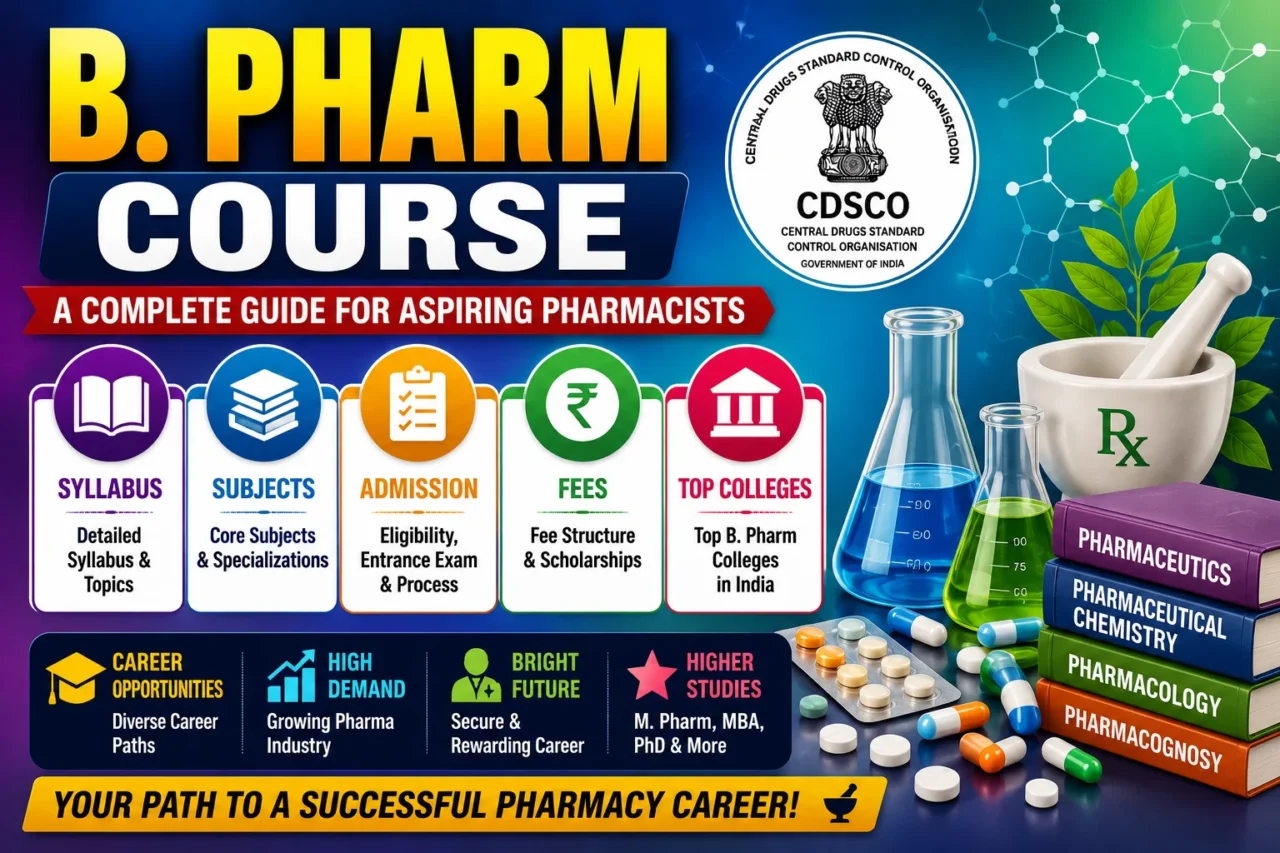

The Bachelor of Pharmacy (B. Pharm) is one of the most popular undergraduate programs for students interested in medicines, healthcare, pharmaceuticals, and drug development. It is a professional degree that prepares students for careers in pharmaceutical industries, hospitals, research laboratories, regulatory affairs, quality control, and clinical research.
Approved by the Pharmacy Council of India, the B. Pharm program combines theoretical knowledge with practical laboratory training to develop skilled pharmacy professionals.
What is B. Pharm?
B. Pharm (Bachelor of Pharmacy) is a 4-year undergraduate degree program divided into 8 semesters. The course focuses on drug formulation, manufacturing, quality assurance, pharmacology, medicinal chemistry, and patient care.
B. Pharm Course Highlights
| Particulars | Details |
|---|---|
| Course Name | Bachelor of Pharmacy (B. Pharm) |
| Course Level | Undergraduate |
| Duration | 4 Years (8 Semesters) |
| Eligibility | 10+2 with Physics, Chemistry, Biology/Mathematics |
| Admission Process | Merit-Based or Entrance Exam |
| Regulatory Body | Pharmacy Council of India (PCI) |
| Average Fees | ₹40,000 – ₹1,50,000 per year (varies by college) |
| Career Options | Pharmacist, Drug Inspector, Regulatory Affairs Associate, Clinical Research Associate, Production Executive |
Eligibility Criteria for B. Pharm Admission
To pursue B. Pharm, candidates must:
Educational Qualification
- Pass 10+2 examination
- Study Physics and Chemistry as compulsory subjects
- Have Biology and/or Mathematics as additional subjects
- Meet the minimum percentage criteria prescribed by the institution
The eligibility requirements are governed by PCI regulations.
B. Pharm Admission Process
Admission may be offered through:
Merit-Based Admission
- Based on Class 12 marks
- Common in many private colleges
Entrance Exam-Based Admission
Popular entrance exams include:
- NEET (accepted by some institutions)
- MHT-CET
- KCET
- WBJEE
- GUJCET
- State-level pharmacy entrance examinations
Admission procedures vary across universities and states.
B. Pharm Syllabus (Semester-Wise)
The B. Pharm syllabus is designed according to PCI guidelines and includes theoretical and practical training.
First Year
Semester I
- Human Anatomy & Physiology I
- Pharmaceutical Analysis I
- Pharmaceutics I
- Pharmaceutical Inorganic Chemistry
- Communication Skills
- Remedial Biology / Remedial Mathematics
Semester II
- Human Anatomy & Physiology II
- Pharmaceutical Organic Chemistry I
- Biochemistry
- Pathophysiology
- Computer Applications in Pharmacy
- Environmental Sciences
Second Year
Semester III
- Pharmaceutical Organic Chemistry II
- Physical Pharmaceutics I
- Pharmaceutical Microbiology
- Pharmaceutical Engineering
- Medicinal Chemistry I
- Pharmacology I
Semester IV
- Medicinal Chemistry II
- Pharmacology II
- Pharmacognosy & Phytochemistry I
- Physical Pharmaceutics II
- Pharmaceutical Jurisprudence
- Research Methodology & Biostatistics
Third Year
Semester V
- Medicinal Chemistry III
- Pharmacology III
- Pharmacognosy & Phytochemistry II
- Industrial Pharmacy I
- Pharmaceutical Biotechnology
- Quality Assurance
Semester VI
- Medicinal Chemistry IV
- Pharmacology IV
- Herbal Drug Technology
- Biopharmaceutics & Pharmacokinetics
- Pharmaceutical Quality Assurance
- Industrial Pharmacy II
Final Year
Semester VII
- Instrumental Methods of Analysis
- Pharmacy Practice
- Novel Drug Delivery Systems
- Clinical Pharmacy
- Pharmacovigilance
- Elective Subjects
Semester VIII
- Project Work
- Advanced Electives
- Research Activities
- Industrial Exposure
- Entrepreneurship & Innovation Modules
- Professional Development Courses
Practical Training in B. Pharm
Laboratory training is an essential component of the curriculum.
Students perform practicals in:
- Pharmaceutics Lab
- Pharmacology Lab
- Pharmaceutical Chemistry Lab
- Microbiology Lab
- Pharmacognosy Lab
- Quality Control Lab
Many institutions also provide industrial visits and internships.
| SYLLABUS PDF | CLICK HERE |
B. Pharm Course Fees
Course fees vary depending on the institution.
| College Type | Approximate Annual Fees |
|---|---|
| Government Colleges | ₹20,000 – ₹80,000 |
| Private Colleges | ₹40,000 – ₹1,50,000+ |
| Deemed Universities | ₹1 Lakh – ₹4 Lakh+ |
Top B. Pharm Colleges in India
Some of the reputed institutions offering B. Pharm include:
- National Institute of Pharmaceutical Education and Research
- Jamia Hamdard
- Institute of Chemical Technology
- Manipal College of Pharmaceutical Sciences
- JSS College of Pharmacy
These institutions are known for quality education, research opportunities, and industry collaborations.
Career Opportunities After B. Pharm
Graduates can pursue careers in:
Pharmaceutical Industry
- Production Officer
- Quality Control Analyst
- Quality Assurance Executive
- Formulation Scientist
Regulatory Affairs
- Regulatory Affairs Associate
- Drug Registration Executive
Clinical Research
- Clinical Research Associate
- Pharmacovigilance Executive
Government Sector
- Drug Inspector
- Government Pharmacist
- CDSCO Officer
- Regulatory Officer
Healthcare Sector
- Hospital Pharmacist
- Community Pharmacist
Higher Education Options
After B. Pharm, students may pursue:
- M. Pharm
- Pharm.D (Post Baccalaureate)
- MBA (Pharmaceutical Management)
- Clinical Research Programs
- Regulatory Affairs Courses
- PhD in Pharmaceutical Sciences
Skills Developed During B. Pharm
Students develop:
✔ Drug formulation knowledge
✔ Analytical and laboratory skills
✔ Regulatory compliance understanding
✔ Research and development expertise
✔ Quality assurance competencies
✔ Communication and patient counseling skills
Why Choose B. Pharm?
B. Pharm offers a unique combination of healthcare and science. With the rapid growth of the pharmaceutical industry, biotechnology sector, clinical research organizations, and regulatory agencies, pharmacy graduates have diverse career opportunities in India and abroad.
The program serves as an excellent foundation for careers in drug development, regulatory affairs, healthcare services, pharmaceutical marketing, and research.
Conclusion
B. Pharm is a highly rewarding professional degree for students interested in medicines, healthcare, and pharmaceutical sciences. With a PCI-approved curriculum, practical laboratory training, industry exposure, and strong career prospects, the course opens doors to opportunities in pharmaceutical industries, hospitals, research organizations, and government regulatory agencies. Choosing the right college and developing strong technical skills during the program can significantly enhance career growth in the pharmaceutical sector.
Recommended Products