


Quick Summary
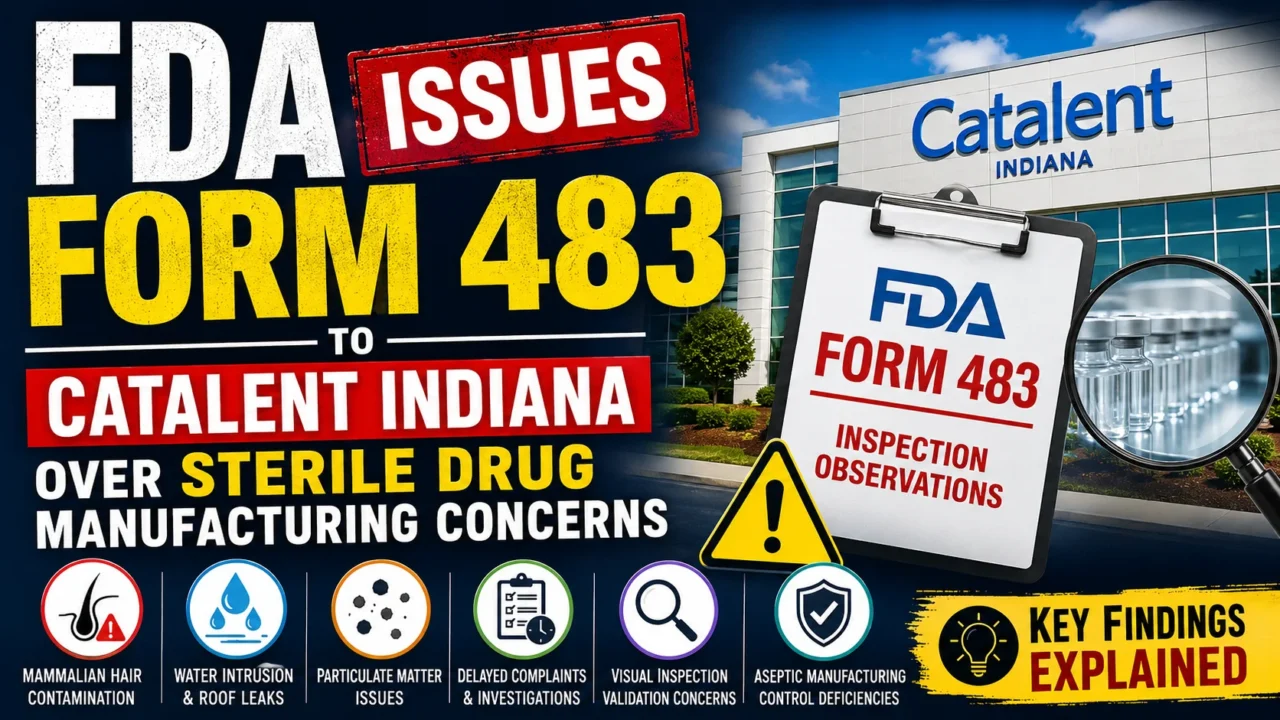
The U.S. FDA has issued a Form FDA 483 to Catalent Indiana LLC after identifying observations related to sterile drug manufacturing, contamination control, deviation investigations, complaint handling, and aseptic processing during an April 2026 inspection. A Form 483 is an inspectional observation and does not represent a final regulatory action.
FDA Issues Form 483 to Catalent Indiana Following April 2026 Inspection
The FDA Form 483 Catalent Indiana inspection report has drawn attention across the pharmaceutical industry after the U.S. Food and Drug Administration (FDA) documented several observations at Catalent Indiana LLC, Bloomington, Indiana.
The inspection was conducted from April 13 to April 24, 2026, and focused on the company’s sterile drug manufacturing operations. FDA investigators observed deficiencies involving contamination control, quality investigations, complaint handling, aseptic manufacturing practices, and process validation.
It is important to note that Form FDA 483 is not a final regulatory decision. Companies are provided an opportunity to respond and implement corrective actions before FDA determines whether further regulatory action is necessary.
Overview
| Particular | Details |
|---|---|
| Company | Catalent Indiana LLC |
| Facility Location | Bloomington, Indiana, USA |
| Regulatory Authority | U.S. Food and Drug Administration (FDA) |
| Inspection Dates | April 13–24, 2026 |
| Document Issued | Form FDA 483 |
| Manufacturing Type | Sterile Drug Products |
| Status | Inspection Observations Issued |

What is FDA Form 483?
A Form FDA 483 is issued when FDA investigators identify conditions that may indicate non-compliance with Current Good Manufacturing Practice (cGMP) regulations during an inspection.
A Form 483:
- Is not a Warning Letter.
- Does not represent a final FDA decision.
- Gives the company an opportunity to submit corrective and preventive actions (CAPA).
- May be followed by additional regulatory action if observations are not adequately addressed.
Key FDA Form 483 Observations at Catalent Indiana
1. Repeated Mammalian Hair Contamination
FDA investigators reported recurring incidents involving mammalian hair found in finished sterile drug products.
FDA Observations
- Similar contamination events have continued since 2025.
- Root cause investigations remained incomplete.
- Corrective actions were not sufficient to prevent recurrence.
- Multiple investigations remained open for extended periods.
FDA questioned whether the company had effectively identified and eliminated the source of contamination.
2. Water Intrusion in Sterile Manufacturing Areas
Another major concern involved repeated roof leaks and water intrusion into classified aseptic manufacturing areas.
FDA Findings
- Three water intrusion incidents occurred within approximately two months.
- Multiple media fill studies were aborted.
- Manufacturing resumed without adequate interim controls.
- Potential impact on commercial batches was not fully assessed.
Water intrusion in sterile production areas increases the risk of microbiological contamination and requires comprehensive investigation.
3. Deficiencies in Particulate Matter Investigations
FDA observed that visible foreign particles detected during inspection were often classified as intrinsic without sufficient scientific justification.
Examples included:
- Polyester fibers
- Plastic fragments
- Other foreign particulate matter
FDA also questioned the company’s criteria for initiating expanded inspections after critical defects were identified.

4. Delays in Complaint Handling and Batch Investigations
The inspection identified weaknesses in complaint management and manufacturing investigations.
FDA noted:
- Delayed complaint closure
- Long-pending deviation investigations
- Incomplete root cause analysis
- Delayed CAPA implementation
- Insufficient assessment of product impact
One complaint involving Container Closure Integrity Testing (CCIT) failure resulted in a product recall, but FDA found that follow-up investigations were not completed in a timely manner.
5. Visual Inspection Validation Concerns
FDA stated that visual inspection methods had not been sufficiently validated to demonstrate consistent detection of critical defects.
The agency questioned whether inspection personnel and inspection systems were capable of reliably identifying defective sterile products.
6. Weaknesses in Aseptic Manufacturing Controls
FDA also identified concerns regarding contamination prevention during aseptic manufacturing.
Investigators reported that procedures intended to prevent microbiological contamination lacked sufficient validation and scientific evidence.
Summary of FDA Observations
| Observation | FDA Concern |
|---|---|
| Mammalian hair contamination | Recurring contamination with incomplete investigations |
| Water intrusion | Roof leaks affecting sterile manufacturing areas |
| Particulate matter | Inadequate investigation of foreign particles |
| Complaint handling | Delayed investigations and CAPA implementation |
| Visual inspection | Insufficient validation of inspection methods |
| Aseptic controls | Weak contamination prevention measures |
Why This Inspection Matters
Sterile drug manufacturing requires strict compliance with Current Good Manufacturing Practices (cGMP) to ensure product quality and patient safety.
The FDA observations highlight the importance of:
- Effective contamination control
- Timely deviation investigations
- Strong CAPA systems
- Validated aseptic processes
- Reliable visual inspection programs
- Comprehensive complaint management
These areas are fundamental to maintaining product quality and regulatory compliance.
What Happens After Form FDA 483?
After receiving Form FDA 483, a company typically:
- Reviews each FDA observation.
- Conducts detailed root cause investigations.
- Implements corrective and preventive actions (CAPA).
- Submits a written response to FDA.
- May undergo follow-up inspections.
FDA then evaluates the company’s response before deciding whether further regulatory action is required.
Important Information
| Particular | Details |
|---|---|
| Official Document | FDA Form 483 |
| Enforcement Action | No |
| Warning Letter Issued | Not mentioned |
| Product Recall | One recall referenced during inspection |
| Final Regulatory Decision | Not yet determined |
Why Should Pharmacy Students and Professionals Read FDA Form 483 Reports?
Understanding FDA inspection observations helps pharmacy professionals strengthen their knowledge of pharmaceutical quality systems.
Benefits include:
- Better understanding of cGMP compliance
- Learning real-world quality assurance issues
- Understanding contamination control strategies
- Improving knowledge for GPAT, NIPER, Drug Inspector, and industrial pharmacy interviews
- Staying updated with global pharmaceutical regulatory practices
Conclusion
The FDA Form 483 issued to Catalent Indiana LLC highlights several observations related to contamination control, sterile manufacturing, quality investigations, complaint handling, and process validation. While these findings require corrective action, a Form 483 is not a final regulatory decision.
Catalent now has the opportunity to address the FDA’s observations through corrective and preventive actions. The FDA will review the company’s response before deciding whether any further regulatory action is necessary.
Frequently Asked Questions (FAQs)
1. What is FDA Form 483?
FDA Form 483 is an inspectional document issued when FDA investigators identify conditions that may violate cGMP regulations during a facility inspection.
2. Is Form FDA 483 a Warning Letter?
No. Form FDA 483 is not a Warning Letter. It provides companies with an opportunity to respond before FDA determines whether additional regulatory action is necessary.
3. Why did FDA issue Form 483 to Catalent Indiana?
The FDA cited observations related to contamination control, sterile manufacturing, deviation investigations, complaint handling, visual inspection validation, and aseptic process controls.
4. Were products recalled because of this inspection?
The inspection report referenced one recall related to a container closure integrity testing (CCIT) failure. No additional recalls were announced as part of the Form 483 itself.
5. Does Form 483 mean Catalent violated FDA regulations?
Not necessarily. Form 483 documents inspection observations. FDA will review the company’s response before making any final regulatory determination.
6. What happens after a company receives Form FDA 483?
The company submits a written response outlining corrective and preventive actions (CAPA). FDA evaluates the response and decides whether further action is required.
7. Why are aseptic manufacturing controls important?
Validated aseptic processes help prevent microbiological contamination and ensure the safety and quality of sterile drug products.
8. Where can I read the official FDA Form 483?
The official inspection document can be accessed through the FDA’s publicly available inspection records or other official sources if released.
Recommended Products