


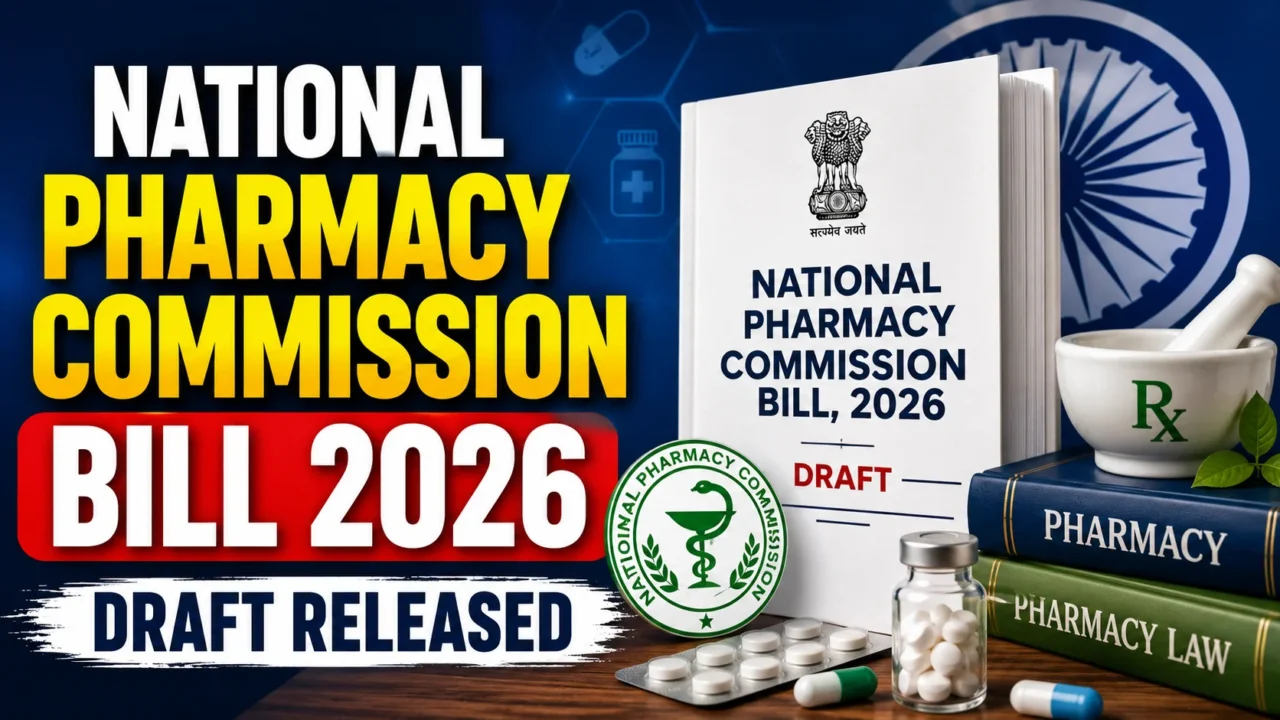

The Ministry of Health & Family Welfare, Government of India, has released the Draft National Pharmacy Commission (NPC) Bill, 2026 for public consultation. The proposed legislation aims to replace the Pharmacy Act, 1948 with a modern regulatory framework designed to improve pharmacy education, professional standards, healthcare delivery, and research across India.
The draft has been published to invite comments from stakeholders before it is finalized. Once enacted, it will establish the National Pharmacy Commission (NPC) as the apex regulatory body for pharmacy education and professional practice in India.

Why is the National Pharmacy Commission Bill Being Introduced?
The Pharmacy Act, 1948 has governed pharmacy education and registration in India for decades. However, the pharmacy profession has undergone significant transformation due to advancements in healthcare, pharmaceutical sciences, biotechnology, artificial intelligence, digital health, and clinical pharmacy.
The Government believes there is a need for a modern regulatory system that:
- Improves pharmacy education
- Ensures availability of qualified pharmacists
- Promotes research and innovation
- Strengthens ethical practices
- Enhances global employability of Indian pharmacists
- Improves quality assurance and accreditation
These objectives form the foundation of the National Pharmacy Commission Bill, 2026.
Objectives of the National Pharmacy Commission Bill 2026
The Bill aims to:
- Promote quality pharmacy education.
- Improve access to affordable pharmaceutical education.
- Ensure availability of competent pharmacy professionals.
- Encourage pharmacy research and innovation.
- Promote modern pharmaceutical technologies.
- Maintain professional ethics.
- Improve patient safety.
- Strengthen pharmacy regulation across India.
- Introduce competency-based education.
- Increase international recognition of Indian pharmacy qualifications.
Pharmacy Act, 1948 to be Repealed
One of the biggest proposals under the draft legislation is the repeal of the Pharmacy Act, 1948.
Once the NPC Bill becomes law, the National Pharmacy Commission will replace the existing regulatory framework established under the Pharmacy Act.
What is the National Pharmacy Commission?
The National Pharmacy Commission will be a statutory body established by the Central Government to regulate:
- Pharmacy education
- Pharmacy institutions
- Pharmacy professionals
- Registration
- Licensing
- Accreditation
- Ethics
- Assessment
- Research
Its headquarters will be located in New Delhi.
Composition of the National Pharmacy Commission
The Commission will consist of:
- One Chairperson
- Fifteen Ex-officio Members
- Thirteen Part-time Members
The Commission will include representatives from:
- Ministry of Health & Family Welfare
- Ministry of AYUSH
- Drug Controller General of India (DCGI)
- National Medical Commission
- Department of Pharmaceuticals
- NIPER
- Pharmacy Industry
- State Pharmacy Councils
- Pharmacy Education Experts
- UGC/Viksit Bharat Shiksha Adhishthan representatives
Four Boards Under National Pharmacy Commission
The draft Bill proposes four specialized boards:
1. Pharmacy Education Board (Modern System of Medicine)
Responsible for:
- Pharmacy curriculum
- Educational standards
- Teaching quality
- Faculty standards
2. Pharmacy Education Board (Indian System of Medicine & Homoeopathy)
Responsible for regulating pharmacy education in:
- Ayurveda
- Siddha
- Unani
- Sowa-Rigpa
- Homoeopathy
3. Pharmacy Assessment and Rating Board
Responsible for:
- Inspection
- Accreditation
- Assessment
- Institutional rating
- Quality monitoring
4. Pharmacy Ethics and Registration Board
Responsible for:
- Registration of pharmacists
- Professional ethics
- National Register
- Licensing
- Disciplinary actions
These boards will function under the supervision of the National Pharmacy Commission.

National Exit Test (Pharmacy): Biggest Reform
One of the most significant changes proposed in the Bill is the introduction of the National Exit Test (Pharmacy).
The common examination will be conducted for:
- Granting licence to practice pharmacy
- Registration in the National Register
- Registration in the State Register
- Admission to postgraduate pharmacy courses after implementation
Foreign pharmacy graduates seeking registration in India will also be required to qualify the National Exit Test. The test is proposed to become operational within five years from the commencement of the Act.
National Register and State Register
The Bill introduces:
National Register
A centralized register containing details of licensed pharmacy professionals.
State Register
Each State Pharmacy Council will maintain a State Register linked with the National Register.
Only registered professionals will be eligible to practice pharmacy.
Recognition of Pharmacy Qualifications
The Commission will regulate:
- Diploma courses
- Degree programmes
- Postgraduate programmes
- Foreign qualifications
- Recognition of pharmacy institutions
Only recognized qualifications will be valid for registration under the proposed Act.
Major Functions of the National Pharmacy Commission
The Commission will:
- Regulate pharmacy education.
- Develop competency-based curriculum.
- Frame admission policies.
- Prescribe faculty standards.
- Promote research.
- Introduce innovative learning.
- Encourage industry collaboration.
- Maintain ethical standards.
- Assess manpower requirements.
- Conduct National Exit Test.
- Regulate pharmacy institutions.
- Coordinate with State Pharmacy Councils.
Promotion of Research and Innovation
The Bill places strong emphasis on:
- Pharmaceutical research
- Digital pharmacy
- Artificial Intelligence
- Clinical pharmacy
- Pharmacy informatics
- Industry collaboration
- Innovation in pharmaceutical sciences
It also encourages adoption of modern technologies to improve pharmacy education and healthcare delivery.
Global Mobility of Pharmacists
The draft legislation seeks to improve international employability by:
- Introducing competency-based education.
- Aligning education with global standards.
- Integrating soft skills into pharmacy curriculum.
- Inviting international experts.
- Facilitating global recognition of Indian pharmacy professionals.
Impact on Pharmacy Students
Students may experience:
- Better quality education
- Uniform educational standards
- National-level competency assessment
- Improved employability
- Better research opportunities
- Enhanced practical training
- Increased international recognition
Impact on Pharmacy Colleges
Institutions may need to:
- Upgrade infrastructure
- Improve faculty quality
- Meet accreditation standards
- Strengthen practical training
- Focus on outcome-based education
- Participate in regular assessments and ratings
Impact on Registered Pharmacists
For practicing pharmacists, the Bill may lead to:
- Stronger professional recognition
- Improved ethical regulation
- Better career opportunities
- Standardized licensing framework
- Enhanced professional development
Key Highlights of NPC Bill 2026
- Pharmacy Act, 1948 proposed to be repealed.
- National Pharmacy Commission to replace the existing framework.
- Four independent regulatory boards.
- National Exit Test (Pharmacy).
- National Register of Pharmacists.
- Competency-based pharmacy education.
- Uniform educational standards.
- Strong accreditation mechanism.
- Better research ecosystem.
- Improved ethics and professional regulation.
- Enhanced global mobility for pharmacists.
Conclusion
The National Pharmacy Commission Bill, 2026 represents one of the most significant proposed reforms in India’s pharmacy sector. By replacing the Pharmacy Act, 1948, the draft aims to modernize pharmacy education, strengthen professional regulation, introduce a National Exit Test, improve accreditation, and promote research and innovation. If enacted, the legislation has the potential to reshape the future of pharmacy education and professional practice in India while aligning the profession with global standards. As the Bill is currently in the draft stage, stakeholders have the opportunity to provide feedback before it is finalized.
Frequently Asked Questions (FAQs)
1. What is the National Pharmacy Commission Bill 2026?
It is a draft legislation proposed by the Government of India to establish the National Pharmacy Commission and replace the Pharmacy Act, 1948.
2. Will the Pharmacy Act, 1948 be repealed?
Yes. The draft Bill proposes repealing the Pharmacy Act, 1948 after the new law comes into force.
3. What is the National Exit Test (Pharmacy)?
It is a proposed common examination for obtaining a licence to practice pharmacy, registration, and eventually for postgraduate admissions.
4. How many Boards will function under the NPC?
There will be four Boards:
- Pharmacy Education Board (Modern System)
- Pharmacy Education Board (Indian System of Medicine & Homoeopathy)
- Pharmacy Assessment and Rating Board
- Pharmacy Ethics and Registration Board
5. Is the NPC Bill 2026 currently in force?
No. It is a draft Bill released for public consultation and will come into force only after being enacted by Parliament and notified by the Central Government.
Recommended Products