


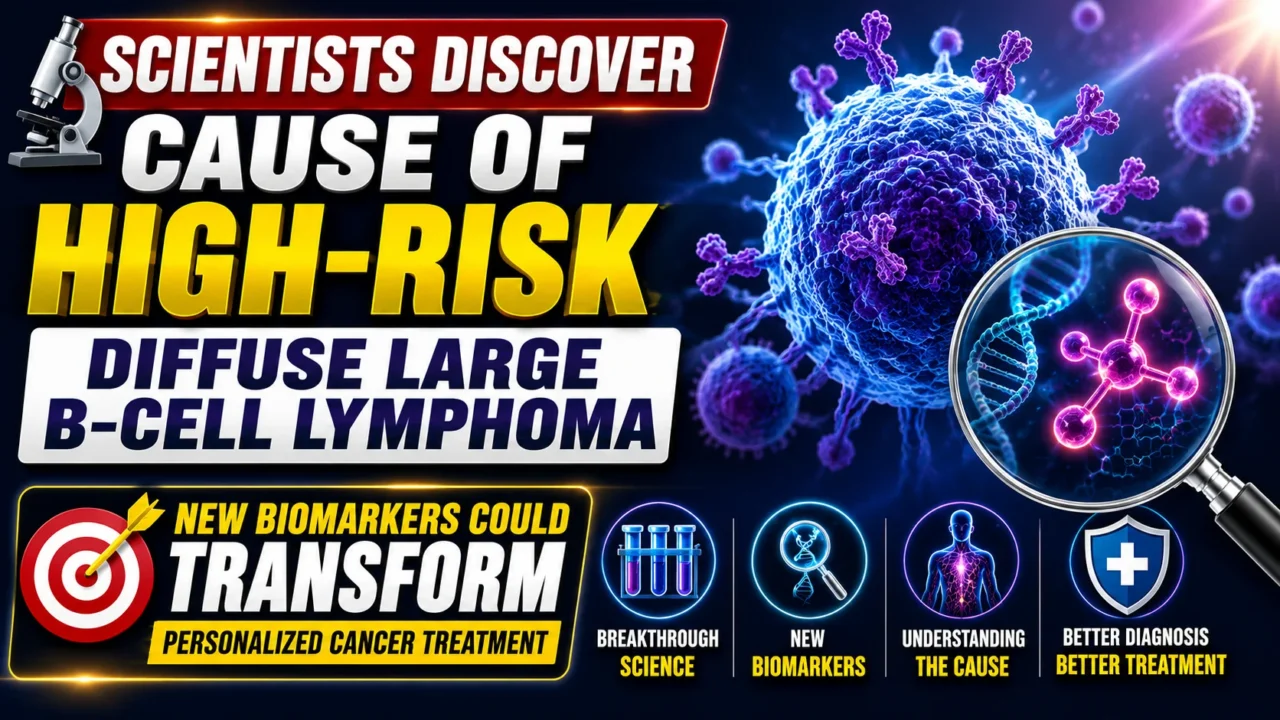

Researchers have identified a new high-risk subtype of Diffuse Large B-Cell Lymphoma (DLBCL) called Proteogenotype 4 (PG4). Published in Nature Genetics, the study found molecular biomarkers linked to poor treatment response. The discovery may help doctors identify high-risk patients earlier and develop personalized therapies for this aggressive blood cancer.
What is High-Risk Diffuse Large B-Cell Lymphoma?
High-Risk Diffuse Large B-Cell Lymphoma (DLBCL) is an aggressive form of non-Hodgkin lymphoma that does not respond well to standard first-line treatments in some patients. A new international study has identified the biological mechanisms behind this high-risk subtype, offering hope for more accurate diagnosis and personalized treatment.
The research, published in Nature Genetics, was led by scientists from Goethe University Frankfurt, Universitätsmedizin Frankfurt, the German Cancer Consortium (DKTK), and the Frankfurt Cancer Institute.
Overview
| Particular | Details |
|---|---|
| Disease | Diffuse Large B-Cell Lymphoma (DLBCL) |
| Published In | Nature Genetics |
| Lead Institutions | Goethe University Frankfurt, Universitätsmedizin Frankfurt, DKTK, Frankfurt Cancer Institute |
| Patients Studied | 478 |
| Main Discovery | High-risk molecular subtype PG4 |
| Key Technology | Multi-omics, Proteomics, AI, Machine Learning |
| Clinical Importance | Early detection of high-risk patients and personalized treatment |
What is Diffuse Large B-Cell Lymphoma (DLBCL)?
Diffuse Large B-Cell Lymphoma (DLBCL) is the most common aggressive type of non-Hodgkin lymphoma. More than 150,000 people worldwide are diagnosed each year.
The disease develops from abnormal B lymphocytes, a type of white blood cell that plays an important role in the immune system.
Although standard treatments cure many patients, approximately one-third experience relapse or treatment resistance.

Current Treatment Options
Standard first-line therapies include:
- R-CHOP
- Pola-R-CHP
Patients who do not respond may require:
- CAR T-cell Therapy
- Additional targeted therapies
- Clinical trial-based treatments
How Was the Study Performed?
Researchers analyzed tumor samples from 478 DLBCL patients using a comprehensive multi-omics approach.
The study included:
- Genetic mutation analysis
- Gene expression profiling
- Proteomic analysis
- Artificial Intelligence
- Interpretable Machine Learning
The findings were confirmed through high-resolution single-cell tumor analysis.
Key Discovery: Proteogenotype 4 (PG4)
Researchers identified a previously unknown subgroup called Proteogenotype 4 (PG4).
Features of PG4
- High MYC oncogene activation
- Rapid tumor growth
- Poor response to chemotherapy
- Similar biology despite different mutations
- High risk of relapse
This discovery helps classify patients more accurately before treatment begins.

MYC Oncogene: Why It Matters
The MYC oncogene regulates normal cell growth.
In PG4 tumors:
- MYC becomes abnormally activated.
- Cancer cells divide rapidly.
- Tumors become more aggressive.
- Standard chemotherapy becomes less effective.
Blocking MYC-related pathways may become a promising therapeutic strategy.
Immunologically “Cold” Tumor Microenvironment
One of the most important findings was that PG4 tumors have an immunologically cold microenvironment.
This means:
- Very few immune cells infiltrate the tumor.
- Cytotoxic T-cell activity is suppressed.
- The immune system cannot effectively destroy cancer cells.
This contributes significantly to poor treatment outcomes.
Role of Artificial Intelligence
Artificial Intelligence and interpretable machine learning helped researchers combine genetic, proteomic, and molecular data.
AI identified:
- Hidden biomarkers
- High-risk patient groups
- Molecular pathways associated with treatment resistance
This highlights the growing role of AI in precision oncology.
Future of Personalized Cancer Treatment
Researchers successfully blocked MYC-associated pathways in laboratory-grown PG4 lymphoma cells.
The results showed:
- Selective killing of cancer cells
- Potential targeted therapies
- Better personalized treatment strategies
- Improved precision medicine
Further clinical studies are required before routine clinical use.
Why is This Discovery Important?
This breakthrough could help doctors:
- Identify high-risk patients earlier.
- Select personalized treatment plans.
- Improve survival rates.
- Reduce treatment failure.
- Accelerate targeted drug development.
Why Should Pharmacy Students Know This?
This research is highly relevant for:
- B.Pharm Students
- M.Pharm Students
- Pharm.D Students
- GPAT Aspirants
- NIPER Aspirants
- Pharmacology Students
- Oncology Researchers
- Clinical Research Professionals
- Pharmacovigilance Professionals
Understanding biomarkers, molecular oncology, AI-driven diagnostics, and precision medicine is becoming increasingly important in pharmacy education and modern healthcare.
Key Takeaways
- Researchers discovered a new high-risk DLBCL subtype called PG4.
- PG4 tumors show excessive MYC activation.
- The study analyzed tumors from 478 patients.
- AI and multi-omics identified new precision biomarkers.
- PG4 tumors have a suppressed immune microenvironment.
- MYC pathway inhibition successfully killed lymphoma cells in laboratory studies.
- Personalized therapies may improve outcomes for high-risk patients.
Frequently Asked Questions (FAQs)
1. What is High-Risk Diffuse Large B-Cell Lymphoma?
It is an aggressive subtype of DLBCL that has a poor response to standard first-line treatment and a higher risk of relapse.
2. What is PG4?
PG4 (Proteogenotype 4) is a newly identified molecular subtype associated with poor prognosis and MYC activation.
3. What is the MYC oncogene?
MYC is a gene that controls cell growth. Its excessive activation promotes aggressive cancer development.
4. How many patients were included?
Researchers studied tumor samples from 478 patients.
5. How was AI used?
Artificial Intelligence integrated multi-omics data to identify biomarkers and classify high-risk tumors.
6. Can this discovery improve treatment?
Yes. It may enable earlier diagnosis, personalized therapy selection, and improved patient outcomes after further clinical validation.
Conclusion
The discovery of Proteogenotype 4 (PG4) represents a major advance in understanding High-Risk Diffuse Large B-Cell Lymphoma. By combining multi-omics technologies, Artificial Intelligence, and proteomics, researchers identified molecular signatures that predict poor treatment response. These findings could revolutionize precision oncology by enabling earlier diagnosis, targeted therapies, and personalized treatment strategies for patients with aggressive DLBCL.
Recommended Products