


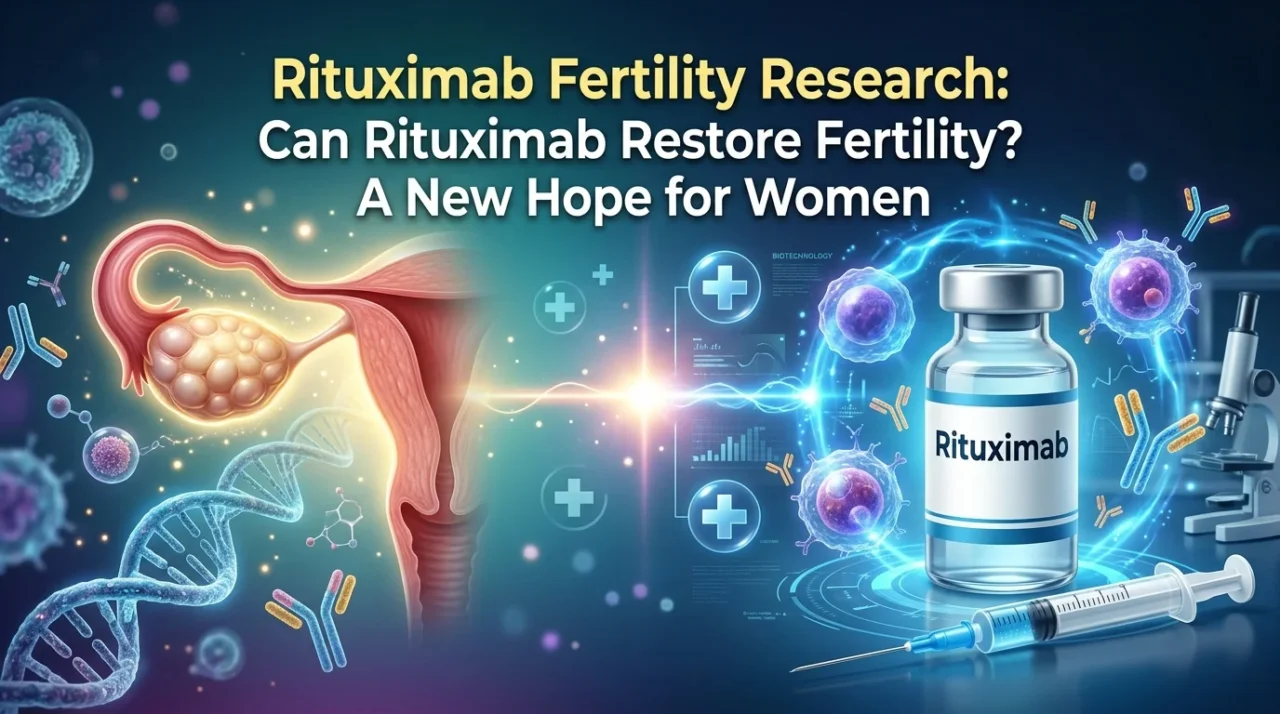

The latest Rituximab Fertility Research has generated significant interest among Pharmacy students and healthcare professionals. Researchers have reported that rituximab, a monoclonal antibody originally approved in 1997 for certain blood cancers, may help restore fertility in some women affected by specific autoimmune conditions. According to the reported study, three out of ten women later gave birth to healthy babies following rituximab treatment. However, these findings are based on ongoing clinical research and should not be interpreted as routine clinical use for infertility.

Quick Summary
Recent clinical research suggests that rituximab, an anti-CD20 monoclonal antibody, may improve fertility outcomes in certain women with autoimmune disorders. In the reported study, three of ten women delivered healthy babies after treatment. Although the findings are promising, further large-scale clinical studies are needed before widespread clinical adoption.
Overview
| Particular | Details |
|---|---|
| Drug Name | Rituximab |
| Drug Class | Monoclonal Antibody |
| Target | CD20-positive B Lymphocytes |
| First Approval | 1997 |
| Original Indication | Blood Cancers |
| Current Research | Fertility Restoration in Selected Women |
| Study Status | Clinical Research |
What is Rituximab?
Rituximab is a chimeric monoclonal antibody that specifically targets the CD20 antigen present on B lymphocytes. By reducing abnormal B-cell activity, it is widely used for the treatment of:
- Non-Hodgkin Lymphoma
- Chronic Lymphocytic Leukemia
- Rheumatoid Arthritis
- ANCA-associated Vasculitis
- Certain Autoimmune Diseases
Why is Rituximab Being Studied for Fertility?
Researchers believe that certain autoimmune diseases may damage ovarian function through immune-mediated mechanisms.
Since rituximab suppresses abnormal B-cell activity, investigators are exploring whether controlling autoimmune inflammation could improve ovarian function and fertility in selected patients.
This remains an active area of clinical research.
Key Findings of the Study
According to the reported research:
| Finding | Result |
|---|---|
| Women Included | 10 |
| Healthy Births | 3 |
| Drug Studied | Rituximab |
| Research Type | Clinical Study |
These findings are preliminary and require confirmation through larger clinical trials.
Mechanism of Action
Rituximab works by:
- Binding to the CD20 receptor
- Destroying abnormal B lymphocytes
- Reducing autoimmune activity
- Decreasing inflammatory responses
Researchers are evaluating whether these effects may indirectly support ovarian recovery in selected patients.
Clinical Significance for Pharmacy Students
This research highlights how an existing medicine can be evaluated for new therapeutic indications through drug repurposing.
Pharmacy students should understand concepts including:
- Drug Repurposing
- Monoclonal Antibodies
- Clinical Trials
- Immunology
- Autoimmune Disorders
- Evidence-Based Medicine
Current Limitations
Although the findings are encouraging, several limitations remain:
- Small study population
- Additional clinical trials required
- Long-term safety requires further evaluation
- Not approved as a standard fertility treatment
Why Should Pharmacy Students Know About This Research?
This study is important because it demonstrates:
- Expansion of indications through research
- Clinical application of monoclonal antibodies
- Translational medicine
- Personalized medicine
- Advances in reproductive immunology
Understanding such research helps Pharmacy students prepare for careers in clinical pharmacy, pharmacology, biotechnology, and pharmaceutical research.
Pharmacy Perspective
The Rituximab Fertility Research reinforces the importance of:
- Clinical evidence before new indications
- Drug safety monitoring
- Pharmacovigilance
- Rational drug use
- Regulatory approval process

Future Research
Scientists are expected to continue investigating:
- Larger patient populations
- Long-term pregnancy outcomes
- Safety during conception
- Optimal treatment protocols
- Mechanisms involved in ovarian recovery
Frequently Asked Questions (FAQs)
1. What is Rituximab?
Rituximab is a monoclonal antibody that targets CD20-positive B lymphocytes and is used to treat certain cancers and autoimmune diseases.
2. Why is Rituximab in the news?
Researchers are studying whether rituximab may help restore fertility in certain women affected by autoimmune disorders.
3. Did women become pregnant after treatment?
According to the reported clinical research, three out of ten women later gave birth to healthy babies.
4. Is Rituximab approved for infertility treatment?
No. Rituximab is not currently approved as a routine treatment for infertility. Further research is needed.
5. What type of drug is Rituximab?
It is a monoclonal antibody.
6. What is the mechanism of action?
Rituximab binds to CD20-positive B cells, leading to their depletion and reducing abnormal immune activity.
7. Why is this important for Pharmacy students?
It demonstrates drug repurposing, clinical research, immunology, pharmacology, and evidence-based medicine.
8. What is the biggest takeaway?
Existing medicines may gain new therapeutic uses through well-designed clinical research, but regulatory approval depends on strong scientific evidence.
Internal Linking Suggestions (GDC Classes)
- Monoclonal Antibodies Notes
- Pharmacology Notes
- Clinical Pharmacy
- Drug Repurposing
- Biotechnology Notes
- Immunology Notes
- Pharmacovigilance
- GPAT Pharmacology
External Linking Suggestions
- U.S. FDA – Rituximab Drug Information
- European Medicines Agency (EMA)
- PubMed (Clinical Research Publications)
- Official published research article (when available)
Conclusion
The Rituximab Fertility Research provides an interesting example of how an established medicine may find new therapeutic applications through clinical investigation. While the reported findings offer hope for selected women with autoimmune-related fertility issues, rituximab is not currently an approved fertility treatment. For Pharmacy students and professionals, this study highlights the importance of drug repurposing, immunology, clinical trials, and evidence-based medicine in advancing pharmaceutical science.
Recommended Products