

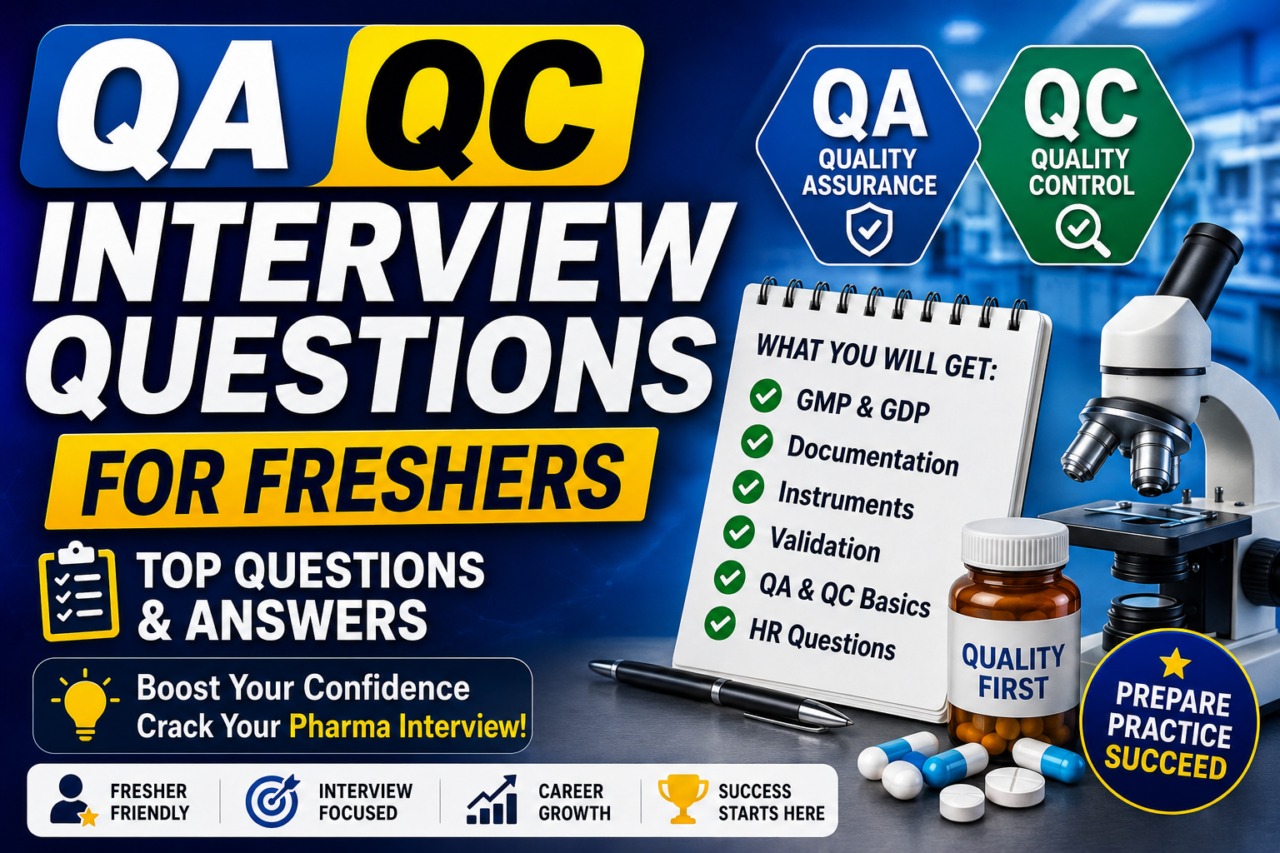

Getting a job in the pharmaceutical industry as a fresher can feel challenging, especially when facing interviews for Quality Assurance (QA) and Quality Control (QC) departments. Most pharma companies ask basic pharmaceutical, GMP, laboratory, and practical industry-related questions to test your knowledge and confidence.
If you are preparing for a QA or QC interview after B.Pharm, D.Pharm, M.Pharm, or BSc, this blog will help you understand the most common interview questions and their answers.
Difference Between QA and QC
Before attending the interview, every fresher should clearly understand the difference between QA and QC.
Quality Assurance (QA)
QA focuses on maintaining systems, procedures, and documentation to ensure product quality.
Main Work of QA
- SOP preparation
- Batch record review
- Validation
- Documentation control
- GMP compliance
- Audit handling
Quality Control (QC)
QC focuses on testing and analyzing raw materials, in-process samples, and finished products.
Main Work of QC
- Chemical testing
- Instrument handling
- Sample analysis
- Stability testing
- Laboratory documentation
Most Common QA QC Interview Questions for Freshers
1. Tell Me About Yourself
Sample Answer
“My name is Rahul Sharma. I completed my B.Pharm from XYZ College. I am interested in the pharmaceutical industry, especially QA/QC departments. I have basic knowledge of GMP, SOPs, and pharmaceutical manufacturing processes. I am a quick learner and want to build my career in the pharma industry.”
Tip
Keep your introduction short, confident, and professional.
2. What is GMP?
Answer
GMP stands for Good Manufacturing Practices. These are guidelines that ensure pharmaceutical products are consistently produced and controlled according to quality standards.
Importance of GMP
- Ensures product quality
- Prevents contamination
- Maintains patient safety

3. What is the Difference Between QA and QC?
Answer
- QA focuses on preventing defects through systems and documentation.
- QC focuses on detecting defects through testing and analysis.
4. What is SOP?
Answer
SOP stands for Standard Operating Procedure. It is a written document that explains step-by-step instructions for performing a specific task in pharmaceutical companies.
5. Why Do You Want to Join QA/QC Department?
Sample Answer
“I am interested in quality systems and pharmaceutical standards. QA/QC departments play an important role in maintaining medicine quality and patient safety, which motivates me to build my career in this field.”
6. What is Calibration?
Answer
Calibration is the process of comparing an instrument with a standard reference to ensure accurate results.
Example
Calibration of:
- Weighing balance
- pH meter
- HPLC instruments
7. What is Validation?
Answer
Validation is documented evidence proving that a process, method, or system consistently gives expected results.
Types of Validation
- Process validation
- Cleaning validation
- Method validation
8. What is pH?
Answer
pH is a measure of acidity or alkalinity of a solution on a scale of 0 to 14.
- pH less than 7 = Acidic
- pH 7 = Neutral
- pH more than 7 = Basic
9. What is HPLC?
Answer
HPLC stands for High Performance Liquid Chromatography. It is an analytical technique used to separate, identify, and quantify components in pharmaceutical samples.
10. What is a Batch Number?
Answer
A batch number is a unique identification number assigned to a specific quantity of product manufactured under similar conditions.
It helps in:
- Product tracking
- Quality investigation
- Recall management
11. What is Stability Testing?
Answer
Stability testing checks how the quality of a drug changes over time under different environmental conditions like temperature and humidity.
12. What is GLP?
Answer
GLP stands for Good Laboratory Practices. These guidelines ensure laboratory testing is conducted accurately and safely.
13. What Are the Qualities of a QA/QC Professional?
Sample Answer
A QA/QC professional should have:
- Attention to detail
- Documentation skills
- Technical knowledge
- Problem-solving ability
- Discipline and honesty
14. What is the Role of Documentation in Pharma?
Answer
Documentation provides written proof that all pharmaceutical activities are performed according to approved procedures and quality standards.
15. Are You Comfortable Working in Shifts?
Sample Answer
“Yes, I am comfortable working in shifts and willing to adapt according to company requirements.”
Basic Technical Questions Asked in QC Interviews
Freshers may also face simple technical questions like:
- What is molarity?
- What is normality?
- What is chromatography?
- What is titration?
- What is dissolution?
- What is disintegration test?
- What is assay?
Prepare basic pharmaceutical analysis concepts carefully.
HR Questions Asked in Pharma Interviews
Apart from technical questions, HR may ask:
Why Should We Hire You?
Sample Answer
“I am a quick learner, hardworking, and interested in building a long-term career in the pharmaceutical industry. I am ready to learn and give my best to the company.”
What Are Your Strengths?
Sample Answer
“My strengths are discipline, positive attitude, teamwork, and willingness to learn new things.”
What Are Your Weaknesses?
Sample Answer
“I sometimes focus too much on details, but I am improving my time management skills.”
Tips to Crack QA QC Interviews
1. Revise Basic Pharmacy Subjects
Focus on:
- Pharmaceutics
- Pharmaceutical Analysis
- Industrial Pharmacy
2. Learn GMP and SOP Basics
These topics are asked in almost every pharma interview.
3. Improve Communication Skills
Try to answer confidently and clearly.
4. Practice Self-Introduction
Your introduction creates the first impression.
5. Dress Professionally
Wear formal clothes during interviews.
Common Mistakes Freshers Should Avoid
- Giving very long answers
- Speaking with low confidence
- Not knowing basic pharma terms
- Poor communication
- Incorrect body language
Final Words
QA and QC are among the best career options in the pharmaceutical industry for freshers. Most pharma interviews focus on basic pharmaceutical knowledge, GMP concepts, SOPs, laboratory understanding, and communication skills.
With proper preparation and confidence, freshers can successfully crack pharma company interviews and start a rewarding career in the pharmaceutical industry.
Prepare consistently, stay confident, and keep improving your industry knowledge to achieve success in QA/QC jobs.
Recommended Products