


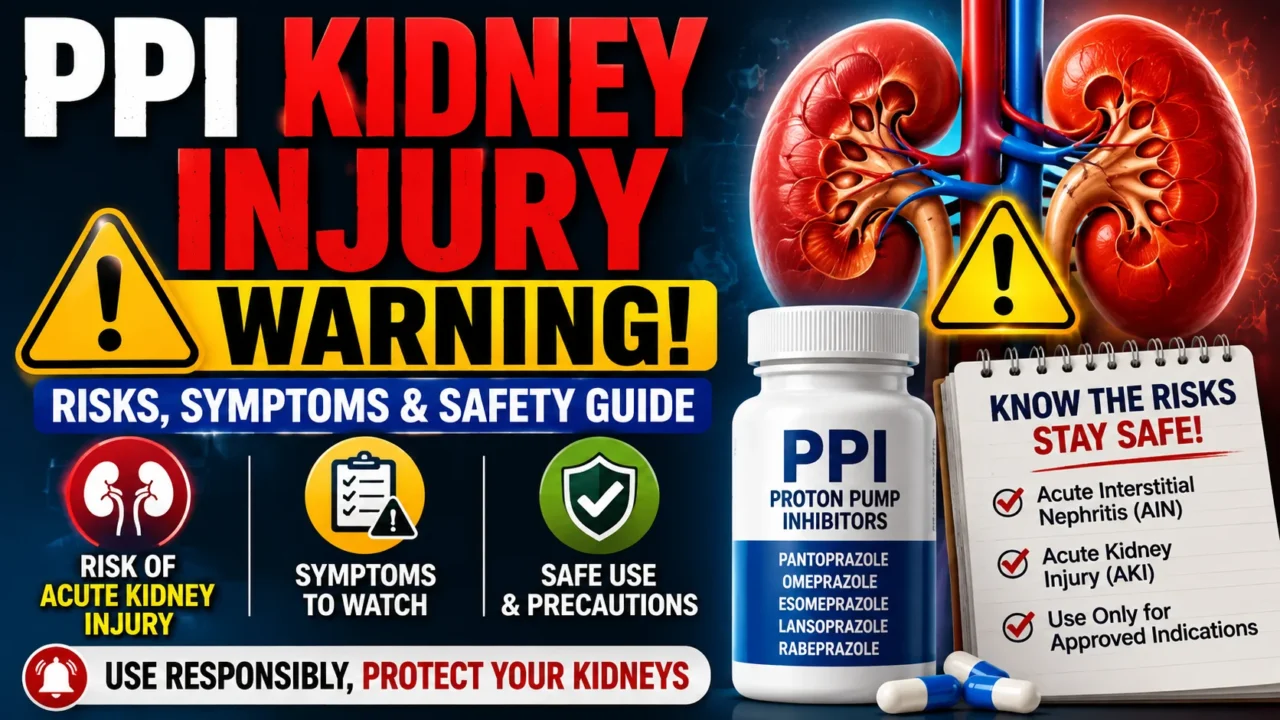

Acidity, heartburn and acid reflux are common problems, and medicines that reduce stomach acid are widely used for their treatment. However, proton pump inhibitors (PPIs) such as pantoprazole, omeprazole, lansoprazole and esomeprazole have been associated with kidney-related adverse effects, including acute interstitial nephritis and acute kidney injury (AKI). In India, a 2019 regulatory action called for an acute kidney injury warning to be included in prescribing information for PPIs.
Important: This article is for educational purposes. Do not stop or change a prescribed medicine without consulting your doctor or pharmacist.
Quick Summary
Proton pump inhibitors (PPIs) are effective medicines for acid-related disorders, but they should be used appropriately. A 2019 Indian regulatory directive called for an acute kidney injury warning in PPI prescribing information. Long-term or unnecessary use should be reviewed by a healthcare professional, particularly in patients with kidney-related risk factors.

What Are Antacids and PPIs?
The term “antacid” is often used broadly, but not all acidity medicines are pharmacologically the same.
Antacids
Traditional antacids work mainly by neutralizing gastric acid in the stomach.
Examples include preparations containing:
- Aluminium hydroxide
- Magnesium hydroxide
- Calcium carbonate
- Sodium bicarbonate
Proton Pump Inhibitors (PPIs)
PPIs work differently. They suppress gastric acid secretion by inhibiting the H⁺/K⁺-ATPase proton pump in gastric parietal cells.
Common PPIs include:
| PPI | Common Use |
|---|---|
| Pantoprazole | GERD, acid-related disorders |
| Omeprazole | GERD, peptic ulcer disease |
| Esomeprazole | GERD, acid-related disorders |
| Lansoprazole | GERD, peptic ulcer disease |
| Rabeprazole | GERD and other acid-related conditions |
Important: The kidney-warning issue discussed in the Indian 2019 directive specifically concerned proton pump inhibitors and their combinations, rather than every product that can be described as an antacid.
Why Is There a Kidney Injury Warning?
In November 2019, reports stated that India’s Drugs Controller General directed state regulatory authorities to ask manufacturers of PPIs to incorporate acute kidney injury as an adverse drug reaction (ADR) in prescribing information.
The action followed review of adverse-drug-reaction reports and expert recommendations involving PPI medicines.
The warning applied to medicines containing PPIs such as:
- Pantoprazole
- Omeprazole
- Lansoprazole
- Esomeprazole
- Their combinations
This regulatory action was intended to improve awareness of a potential kidney-related adverse effect associated with these medicines.
Can PPIs Cause Acute Kidney Injury?
PPIs have been associated with acute kidney injury, particularly through acute interstitial nephritis (AIN), a form of kidney inflammation.
This does not mean that everyone taking a PPI will develop kidney injury.
PPIs are widely used and can be appropriate and beneficial when there is a clear indication. The concern is particularly relevant when medicines are used without an appropriate indication, unnecessarily for prolonged periods, or without periodic review.
Key Point
PPI use ≠ guaranteed kidney damage.
The correct message is that kidney injury is a recognized potential adverse effect that healthcare professionals should be aware of.

What Is Acute Kidney Injury?
Acute kidney injury (AKI) is a sudden decline in kidney function.
It can develop over a relatively short period and may result from several different causes, including:
- Dehydration
- Severe infection
- Certain medicines
- Reduced blood flow to the kidneys
- Urinary obstruction
- Kidney inflammation
Drug-induced acute interstitial nephritis is one possible cause of AKI.
What Is Acute Interstitial Nephritis?
Acute interstitial nephritis (AIN) is inflammation of the kidney’s interstitial tissue and is commonly associated with medications.
Several medicines can cause AIN, and PPIs are among the drug classes associated with this adverse effect.
Possible symptoms can be nonspecific, such as:
- Fatigue
- Nausea
- Reduced urine output
- Fever
- Rash
However, many patients may not develop the classic combination of symptoms.
Therefore, unexplained deterioration in kidney function in a person taking potentially causative medicines requires medical evaluation.
Does Long-Term PPI Use Always Cause Kidney Disease?
No.
This is an important distinction.
Observational studies have reported associations between PPI use and certain kidney outcomes, including chronic kidney disease. However, observational associations do not by themselves prove that PPIs directly cause chronic kidney disease in every person who takes them.
At the same time, acute interstitial nephritis is a recognized adverse reaction associated with PPIs.
Therefore, PPIs should be used when clinically indicated and reviewed periodically rather than being taken indefinitely without medical supervision.
Why Should PPIs Not Be Used Unnecessarily?
PPIs are highly effective when appropriately prescribed.
They may be indicated for conditions such as:
- Gastroesophageal reflux disease (GERD)
- Peptic ulcer disease
- Certain complications of acid reflux
- H. pylori eradication regimens
- Prevention of certain NSAID-associated ulcers
- Other specific acid-related conditions
However, the appropriate dose and duration depend on the indication and patient factors.
The 2019 report quoted a nephrologist recommending that PPIs ideally be used for approved indications and, where possible, for less than eight weeks, with monitoring of kidney function and magnesium when longer treatment is necessary. This should not be interpreted as a universal maximum duration for every patient; some conditions require longer treatment under medical supervision.
When Should Kidney Function Be Considered?
Healthcare professionals may consider kidney-function assessment when clinically appropriate, particularly in patients who:
- Have pre-existing kidney disease
- Develop unexplained changes in kidney function
- Take multiple medicines that may affect the kidneys
- Require prolonged PPI therapy
- Have other risk factors for kidney injury
The exact monitoring plan should be individualized.
Warning Signs That Need Medical Attention
A person taking a PPI should seek medical advice if they develop concerning symptoms such as:
- Markedly reduced urine output
- New or worsening swelling
- Unusual fatigue
- Persistent nausea or vomiting
- Blood in urine
- Unexplained fever or rash
- Sudden deterioration in general health
These symptoms can have many causes and do not automatically mean that a PPI is responsible.
How Can PPIs Be Used Safely?
Safe use does not mean avoiding PPIs completely. It means using them appropriately.
Follow these principles:
1. Use PPIs for a clear indication
Take them when prescribed or recommended for an appropriate condition.
2. Avoid unnecessary self-medication
Do not continue acid-suppressing medicines indefinitely simply because they are easily available.
3. Review long-term therapy
If a PPI has been used for a prolonged period, discuss whether it is still necessary with a healthcare professional.
4. Consider other medicines
Tell your doctor or pharmacist about all prescription, OTC and herbal medicines you use.
5. Monitor when clinically indicated
Patients requiring prolonged therapy or those with risk factors may need appropriate laboratory monitoring.
Popular PPI Brands Shown in the Infographic
The infographic accompanying this article lists several popular PPI-containing brands and their manufacturers. However, brand popularity or sales value does not indicate that a product is more dangerous or safer than another.
For medication safety, the important factors include:
- Active ingredient
- Dose
- Indication
- Duration
- Patient-specific risk factors
- Drug interactions
- Appropriate monitoring
Therefore, brand ranking should not be interpreted as a safety ranking.
Antacids vs PPIs: What Is the Difference?
| Feature | Antacids | PPIs |
|---|---|---|
| Main action | Neutralize existing stomach acid | Suppress acid secretion |
| Examples | Aluminium/Magnesium hydroxide, calcium carbonate | Pantoprazole, omeprazole |
| Onset | Generally rapid symptom relief | Slower onset but stronger acid suppression |
| Main role | Symptomatic relief | Treatment/prevention of acid-related conditions |
| Kidney considerations | Depend on ingredient and patient factors | Kidney-related adverse effects, including AIN, are recognized |
| Long-term use | Depends on product and indication | Should be periodically reviewed |
Are PPIs Unsafe?
No. PPIs are not inherently unsafe.
They are important medicines with established benefits.
The concern is inappropriate or unnecessary use and failure to recognize potential adverse effects.
For patients with a genuine indication, the benefits of PPI therapy may outweigh potential risks.
The goal is therefore:
Right drug + Right indication + Right dose + Right duration + Appropriate monitoring
Why Is This Important for Pharmacy Students?
This topic is highly relevant for B.Pharm, D.Pharm and M.Pharm students because it connects pharmacology, adverse drug reactions and pharmacovigilance.
Important exam points:
- Drug class: Proton Pump Inhibitors
- Examples: Pantoprazole, Omeprazole, Lansoprazole, Esomeprazole
- Target: H⁺/K⁺-ATPase
- Main effect: Decreased gastric acid secretion
- Important renal adverse effect: Acute interstitial nephritis
- Potential consequence: Acute kidney injury
- Regulatory action in India: 2019 warning concerning AKI in PPI prescribing information
This can be useful for GPAT, NIPER, Drug Inspector, Pharmacist and other pharmacy competitive examinations.
Key Takeaways
- PPIs are widely used medicines for acid-related disorders.
- Common PPIs include pantoprazole, omeprazole, lansoprazole and esomeprazole.
- Acute kidney injury is a recognized safety concern associated with PPI therapy.
- Acute interstitial nephritis is an important mechanism of PPI-associated kidney injury.
- India’s 2019 regulatory action called for an AKI warning in PPI prescribing information.
- Long-term PPI therapy should be reviewed periodically.
- Patients should not stop medically necessary PPI treatment without consulting their healthcare professional.
- The term “antacid” should not be used interchangeably with “PPI” because these medicines have different mechanisms.
Frequently Asked Questions
1. Can antacids cause kidney problems?
Some antacid ingredients can require special consideration in people with kidney disease, while PPIs have a recognized association with kidney adverse effects such as acute interstitial nephritis. The risk depends on the specific medicine and patient.
2. Which PPIs are associated with acute kidney injury?
PPIs including pantoprazole, omeprazole, lansoprazole and esomeprazole have been associated with kidney-related adverse effects, including acute interstitial nephritis.
3. Is pantoprazole bad for the kidneys?
Pantoprazole can be an appropriate and effective medicine when clinically indicated. However, like other PPIs, it has recognized potential kidney-related adverse effects. It should be used according to medical advice.
4. Should I stop my PPI because of the kidney warning?
No. Do not stop a prescribed PPI without discussing it with your doctor. The benefits may outweigh the risks depending on why you are taking it.
5. What is the main kidney adverse effect of PPIs?
Acute interstitial nephritis is an important recognized renal adverse effect associated with PPIs and can result in acute kidney injury.
6. Can long-term PPI use cause chronic kidney disease?
Some observational studies have found an association between PPI use and chronic kidney disease, but such studies do not establish that PPIs directly cause CKD in every patient. Long-term therapy should be periodically reviewed.
7. How long can PPIs be taken safely?
There is no single duration that applies to everyone. Treatment duration depends on the medical indication. Some patients need short courses, while others may require longer treatment under medical supervision.
8. What should patients taking PPIs do?
Use the medicine only for an appropriate indication, follow the prescribed dose, avoid unnecessary prolonged self-medication and discuss long-term treatment with a healthcare professional.
Conclusion
The kidney injury warning associated with proton pump inhibitors is an important medication-safety and pharmacovigilance issue. PPIs such as pantoprazole, omeprazole, lansoprazole and esomeprazole are valuable medicines for treating acid-related disorders, but they can also be associated with renal adverse effects, including acute interstitial nephritis and acute kidney injury.
The Indian regulatory action reported in 2019 highlighted the need to include acute kidney injury as an adverse drug reaction in PPI prescribing information.
The correct takeaway is not to fear all acidity medicines, but to use them rationally. Patients should take PPIs for appropriate indications, avoid unnecessary long-term self-medication and discuss prolonged treatment or concerning symptoms with a qualified healthcare professional.
Recommended Products