

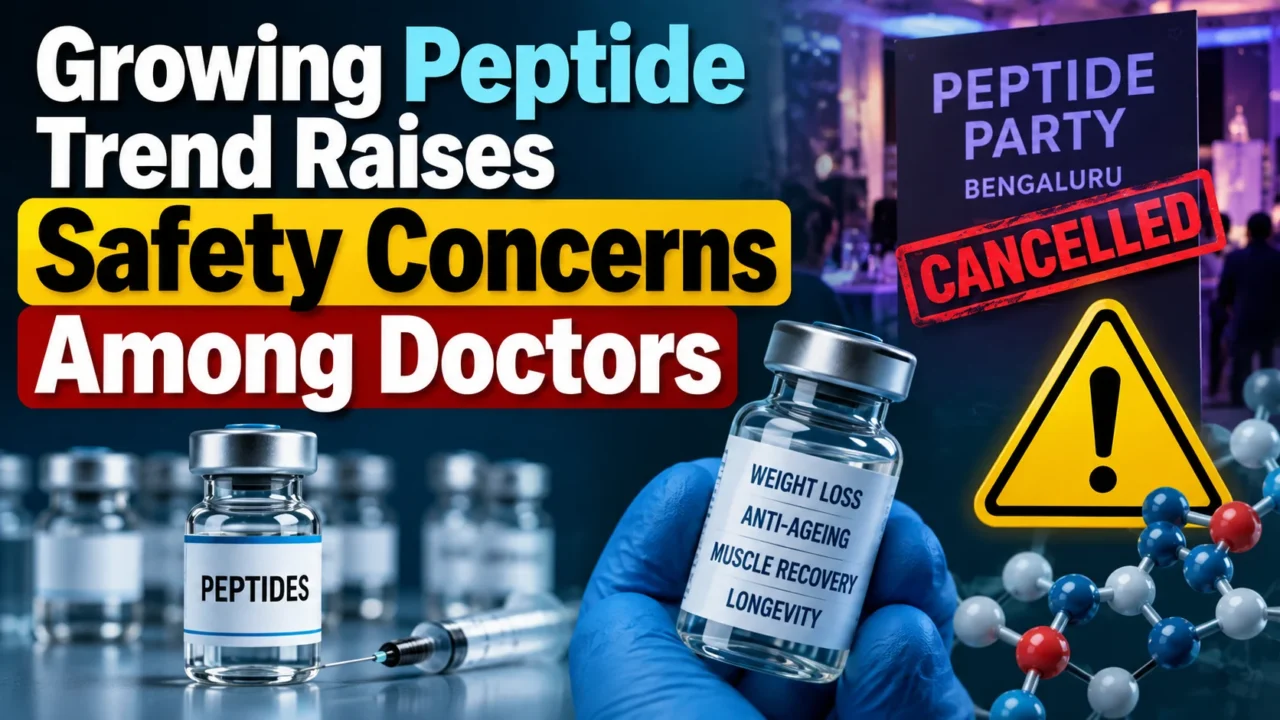

Peptide therapy safety has become a growing concern as peptide-based products gain popularity for weight loss, muscle recovery, anti-ageing and longevity. Doctors and healthcare experts are warning consumers about the risks of using experimental or unapproved peptide products without proper medical supervision.
The issue received attention after a proposed “Peptide Party” in Bengaluru was cancelled following regulatory intervention, highlighting concerns about the growing use of peptide-based products outside conventional medical settings.
Quick Summary
Peptides are short chains of amino acids that can act as signalling molecules in the body. While some peptide-based medicines have established medical uses, many products promoted online may lack adequate clinical evidence or regulatory approval. Doctors advise consumers to verify the product, consult qualified healthcare professionals and avoid unsupervised injections.

What Are Peptides?
Peptides are short chains of amino acids that perform different biological functions and can act as signalling molecules in the body.
Some peptide-based medicines have well-established medical applications and have undergone extensive scientific research and regulatory evaluation. Examples include insulin and GLP-1-based medicines.
However, the term “peptide” does not refer to one specific medicine or treatment. Different peptides can have different mechanisms of action, medical uses, doses and safety profiles.
Therefore, a peptide product promoted online should not automatically be considered safe simply because it belongs to the peptide category.
Why Are Doctors Concerned About Peptide Therapy?
Doctors are concerned about the increasing popularity of peptides through:
- Social media platforms
- Wellness influencers
- Fitness communities
- Online marketplaces
- Celebrity endorsements
- Personal testimonials
According to doctors quoted in the report, this trend may encourage consumers to experiment with peptide products without adequate medical guidance.
Dr Naval K Vikram, Professor in the Department of Medicine at AIIMS, Delhi, stressed that peptides should not be considered a single category of medicines. Some have extensive clinical evidence, while others remain experimental.
Is Every Peptide Safe?
No.
The safety and effectiveness of a peptide depend on factors such as its specific compound, dose, indication, formulation, manufacturing quality and available clinical evidence.
For example, evidence supporting an established medicine such as semaglutide does not automatically establish the safety or effectiveness of every peptide marketed for weight loss, muscle recovery or longevity.
Peptides in the Wellness Industry
Peptides are increasingly promoted for a wide range of wellness and health-related purposes.
| Commonly Promoted Use | Key Concern |
|---|---|
| Weight loss | Evidence and regulatory status vary by product |
| Muscle recovery | Some products may be experimental |
| Anti-ageing | Long-term evidence may be limited |
| Longevity | Many claims require stronger clinical evidence |
| Better sleep | Evidence may vary between compounds |
| Cognitive benefits | Not every marketed product has established clinical use |
Consumers should distinguish between clinically established medicines and products promoted primarily through wellness or social media channels.
Risks of Self-Injection
One of the major concerns surrounding experimental peptides is self-injection.
Dr Ravinder Goswami, Professor of Endocrinology at AIIMS, Delhi, highlighted concerns about consumers not knowing whether a product actually contains the stated compound or concentration.
Additional risks may arise from:
- Incorrect storage
- Incorrect dilution
- Improper administration
- Uncertain product composition
- Use without medical supervision
For compounds that do not have sufficient human safety data, their long-term effects may also remain uncertain.
What Is Peptide Stacking?
Peptide stacking refers to combining multiple peptide compounds.
Experts have cautioned against combining experimental compounds without appropriate medical supervision because the safety and interactions of such combinations may not be adequately established.
The fact that individual compounds are marketed for similar purposes does not mean that using them together is safe or effective.
“Peptide” Does Not Mean “Safe”
The word peptide itself is not a guarantee of safety.
Different peptides may have completely different:
- Mechanisms of action
- Medical indications
- Dosages
- Adverse-effect profiles
- Clinical evidence
- Regulatory status
A compound showing promising results in laboratory or animal studies cannot automatically be considered suitable for human use.
This distinction is especially important as consumers encounter increasingly complex peptide-related claims online.
Established Peptide Medicines vs Experimental Compounds
There is an important difference between approved or established peptide medicines and experimental peptide compounds.
| Established Peptide Medicines | Experimental Peptide Compounds |
|---|---|
| Supported by clinical research | May have limited human evidence |
| Subject to regulatory evaluation | Regulatory status may vary |
| Manufactured under applicable quality standards | Product quality may be uncertain |
| Used for defined medical indications | Often promoted for broader wellness claims |
| Subject to safety monitoring | Long-term safety may be unknown |

Medicines such as semaglutide and tirzepatide have undergone clinical development and regulatory evaluation for their approved uses.
However, their established medical use should not be interpreted as evidence that every peptide product sold or promoted online is equally safe or effective.
What Should Consumers Do Before Using Peptides?
People considering peptide-based treatment should take several precautions.
1. Consult a Qualified Healthcare Professional
Discuss the treatment with a qualified healthcare professional who can assess whether it is appropriate for the individual’s medical needs.
2. Check the Regulatory Status
Consumers should determine whether the specific product has the appropriate regulatory approval for the intended use.
3. Verify the Product and Source
The product’s source, composition, quality and storage requirements should be verified before use.
4. Avoid Unsupervised Self-Injection
Injectable products should not be used without appropriate medical guidance, particularly when their safety and composition are uncertain.
5. Do Not Rely Only on Social Media Claims
Influencer testimonials and personal success stories are not substitutes for clinical evidence.
6. Avoid Unsupervised Peptide Stacking
Combining multiple experimental compounds without professional guidance may create additional safety concerns.
Why Should Pharmacy Candidates Know About Peptide Safety?
For B.Pharm, M.Pharm, Pharm.D and other pharmacy students, understanding peptide-based therapies is relevant to modern pharmacology and pharmaceutical sciences.
Pharmacy candidates should understand the difference between:
- Evidence-based medicines and experimental compounds
- Clinical evidence and anecdotal claims
- Regulatory approval and online marketing
- Therapeutic benefits and potential adverse effects
- Drug quality and uncertain product composition
This knowledge can help pharmacy professionals provide more informed health education and communicate medicine-related information responsibly.
Bengaluru “Peptide Party” and Growing Public Interest
The proposed “Peptide Party” in Bengaluru, which was cancelled following regulatory intervention, drew attention to the increasing visibility of peptide products outside conventional healthcare settings.
The episode reflects a broader trend in which peptide-related products are increasingly discussed in the fitness, wellness, anti-ageing and longevity markets.
However, increased popularity does not necessarily mean that every product has established evidence for safety or effectiveness.
Key Takeaways on Peptide Therapy Safety
| Key Point | What Consumers Should Know |
|---|---|
| Peptides | A broad group of compounds with different biological effects |
| Established medicines | Some peptide medicines have well-established medical uses |
| Experimental peptides | May lack sufficient human safety and effectiveness data |
| Self-injection | Can create additional safety and administration concerns |
| Peptide stacking | Combining experimental compounds may increase uncertainty |
| Social media claims | Testimonials do not replace scientific evidence |
| Best approach | Consult a qualified healthcare professional |
FAQs on Peptide Therapy Safety
1. What are peptides?
Peptides are short chains of amino acids that can perform different biological functions and act as signalling molecules in the body.
2. Are all peptide therapies safe?
No. Different peptides have different mechanisms, uses, evidence and safety profiles. Some peptide-based medicines are well established, while others may be experimental.
3. What are the main risks of experimental peptide products?
Potential concerns include uncertain product composition, incorrect storage or dilution, improper administration and limited human safety data.
4. What is peptide stacking?
Peptide stacking means combining multiple peptide compounds. Experts have cautioned against using combinations of experimental peptides without appropriate medical supervision.
5. Are peptide injections safe for self-use?
Self-injection of experimental or uncertain products can create additional safety concerns. Consumers should seek appropriate medical guidance before using injectable treatments.
6. Is semaglutide evidence applicable to all peptides?
No. Evidence supporting semaglutide for its approved uses does not establish the safety or effectiveness of every other peptide product.
7. Why are doctors concerned about peptides promoted online?
Doctors are concerned that social media, influencers and online fitness communities may encourage people to use products without adequate medical advice or understanding of their regulatory status.
8. What should consumers check before using a peptide product?
Consumers should check the product’s regulatory status, source, composition and intended medical use and consult a qualified healthcare professional.
Conclusion
The growing interest in peptide therapy reflects increasing public interest in weight loss, fitness, anti-ageing and longevity treatments. However, the safety of a peptide product depends on its specific compound, evidence, quality, intended use and regulatory status.
The Bengaluru “Peptide Party” episode has highlighted concerns about peptide-based products moving beyond conventional medical settings into the wider wellness industry.
Consumers should therefore distinguish between clinically established peptide medicines and experimental products promoted online. Medical decisions should be based on scientific evidence, appropriate regulatory evaluation and professional healthcare advice rather than social media claims or testimonials.
Recommended Products