


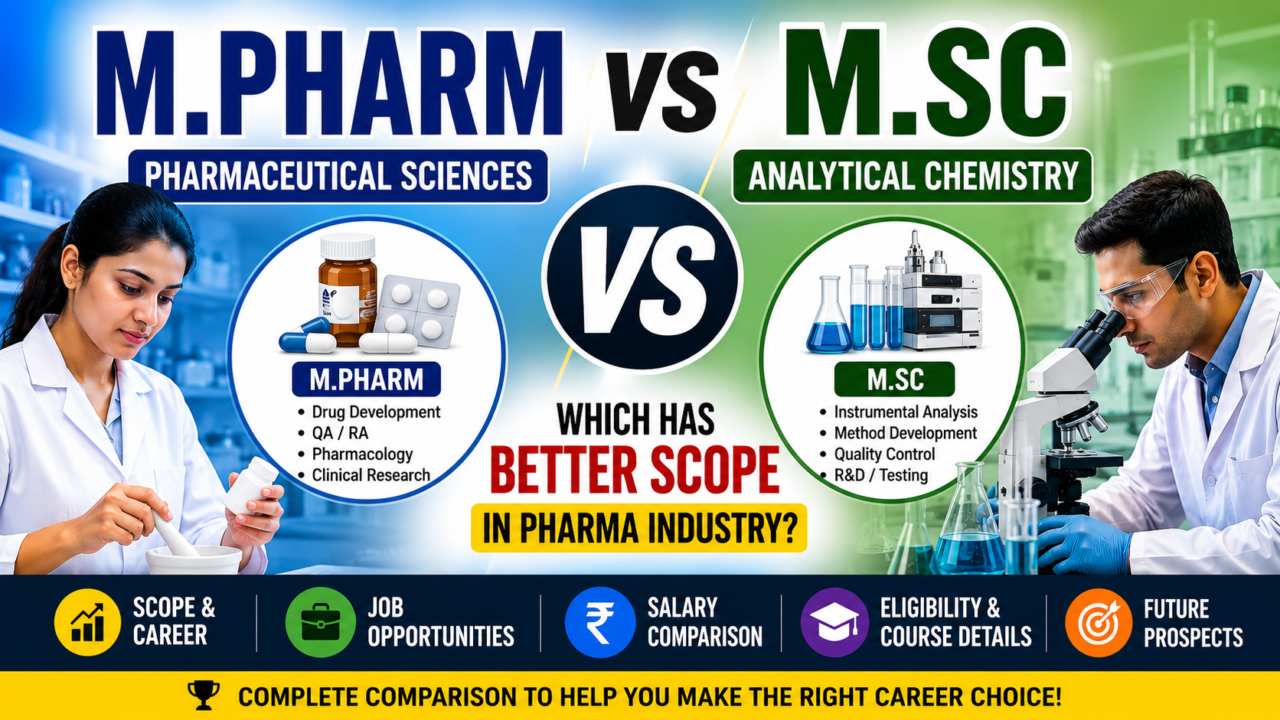

The pharmaceutical industry is one of the fastest-growing sectors in India and globally. Students from pharmacy and chemistry backgrounds often face one common question:
Which course offers better career opportunities in the pharma industry — M.Pharm or M.Sc Analytical Chemistry?
Both degrees provide strong career options, but the right choice depends on your interests, career goals, salary expectations, and preferred work profile.
In this blog, we will compare M.Pharm vs M.Sc Analytical Chemistry based on scope, jobs, salary, skills, and future demand in the pharmaceutical industry.

What is M.Pharm?
Pharmacy (Master of Pharmacy) is a postgraduate degree focused on pharmaceutical sciences, drug formulation, clinical research, pharmacology, quality assurance, and regulatory affairs.
Popular specializations include:
- Pharmaceutics
- Pharmacology
- Pharmaceutical Analysis
- Quality Assurance
- Industrial Pharmacy
Duration
2 Years
Eligibility
Bachelor of Pharmacy (B.Pharm)
What is M.Sc Analytical Chemistry?
Analytical Chemistry is a postgraduate science degree focused on chemical analysis, laboratory testing, instrumentation, and quality control techniques.
Students learn advanced analytical instruments such as:
- HPLC
- GC-MS
- UV Spectroscopy
- FTIR
- Chromatography
- Wet Lab Analysis
Duration
2 Years
Eligibility
B.Sc Chemistry or related science degree
M.Pharm vs M.Sc Analytical Chemistry: Major Differences
| Feature | M.Pharm | M.Sc Analytical Chemistry |
|---|---|---|
| Industry Focus | Pharmaceutical & Healthcare | Chemical & Pharma Testing |
| Background Required | B.Pharm | B.Sc Chemistry |
| Main Skills | Drug development, QA, regulatory | Instrumentation & analysis |
| Pharma Industry Demand | Very High | High |
| Research Opportunities | Excellent | Excellent |
| Clinical Knowledge | Strong | Limited |
| Lab Instrument Expertise | Moderate to High | Very High |
| Regulatory Roles | More opportunities | Fewer opportunities |
Scope in Pharma Industry
Scope of M.Pharm in Pharma Industry
M.Pharm graduates are highly preferred in pharmaceutical companies because they have direct knowledge of medicines, formulations, regulations, and manufacturing processes.
Top Job Roles
- Quality Assurance Officer
- Regulatory Affairs Executive
- Production Manager
- Formulation Scientist
- Pharmacovigilance Associate
- Clinical Research Associate
Top Recruiters
- Sun Pharmaceutical
- Dr. Reddy’s Laboratories
- Cipla
- Lupin Limited
- Aurobindo Pharma
Average Salary
- Freshers: ₹3–6 LPA
- Experienced Professionals: ₹8–15 LPA+
Scope of M.Sc Analytical Chemistry in Pharma Industry
M.Sc Analytical Chemistry graduates are in strong demand in pharmaceutical testing laboratories and quality control departments.
Their expertise in analytical instruments makes them valuable for testing and validation work.
Top Job Roles
- QC Analyst
- Analytical Scientist
- R&D Chemist
- Method Development Analyst
- Stability Testing Officer
- Instrumentation Specialist
Industries Hiring
- Pharma companies
- Chemical industries
- Food testing labs
- Environmental labs
- Research laboratories
Average Salary
- Freshers: ₹2.5–5 LPA
- Experienced Professionals: ₹7–12 LPA+
Which Degree Has Better Scope?
The answer depends on your career goals.
Choose M.Pharm If You Want:
- Direct entry into pharmaceutical industries
- Regulatory affairs careers
- Drug formulation and development roles
- Clinical research opportunities
- Better long-term growth in pharma
Choose M.Sc Analytical Chemistry If You Want:
- Strong laboratory and analytical work
- Expertise in sophisticated instruments
- Research-oriented chemistry careers
- Testing and quality control specialization
Future Demand in 2026 and Beyond
The pharma industry is rapidly expanding due to:
- Increased medicine demand
- Generic drug manufacturing
- Research and development growth
- Export opportunities
- Government healthcare initiatives
Future Trend
- M.Pharm graduates may get broader pharma management and regulatory opportunities.
- M.Sc Analytical Chemistry professionals may see high demand in QC, analytical R&D, and instrumentation sectors.
Both fields have good future potential.
Salary Comparison
| Experience | M.Pharm | M.Sc Analytical Chemistry |
|---|---|---|
| Fresher | ₹3–6 LPA | ₹2.5–5 LPA |
| 5 Years Experience | ₹7–12 LPA | ₹6–10 LPA |
| Senior Level | ₹15 LPA+ | ₹12 LPA+ |
Which is Better for Government Jobs?
M.Pharm
Better opportunities in:
- Drug Inspector exams
- Pharmacist roles
- Government pharma labs
- Research organizations
M.Sc Analytical Chemistry
Better opportunities in:
- Chemical laboratories
- Research institutes
- Scientific assistant positions
- Environmental testing labs
Final Verdict
Both M.Pharm and M.Sc Analytical Chemistry offer excellent opportunities in the pharmaceutical industry.
- If your goal is a complete pharma career with better industry exposure, regulatory knowledge, and growth opportunities, M.Pharm is generally considered better.
- If you are passionate about laboratory analysis, instruments, testing, and chemical research, M.Sc Analytical Chemistry is an excellent choice.
Your success ultimately depends on:
- Skills
- Internship experience
- Communication
- Technical expertise
- Industry exposure
Frequently Asked Questions (FAQs)
Is M.Pharm better than M.Sc Analytical Chemistry?
For core pharma industry roles, M.Pharm usually has broader opportunities. However, M.Sc Analytical Chemistry is highly valuable for QC and analytical R&D.
Can M.Sc Analytical Chemistry students work in pharma companies?
Yes, many pharma companies hire analytical chemistry graduates for QC, QA, and testing roles.
Which has higher salary: M.Pharm or M.Sc Chemistry?
Generally, M.Pharm offers slightly higher salary growth in pharma industries.
Which course is best for research?
Both are excellent, but M.Sc Analytical Chemistry is stronger in analytical research and instrumentation.
Conclusion:
Choose the degree based on your interest, not only salary. Both careers have strong future demand in India’s growing pharmaceutical sector.
Recommended Products