


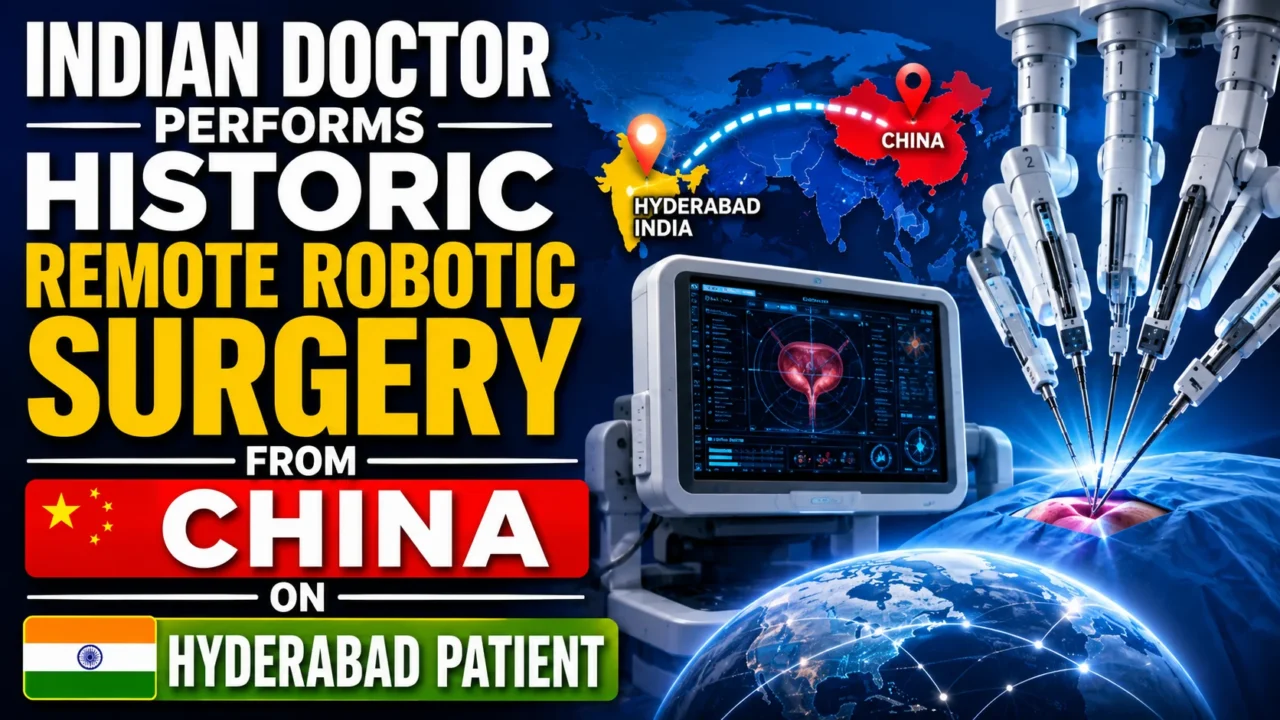

In a remarkable milestone for global healthcare and medical technology, an Indian-origin urologist successfully performed a long-distance robotic surgery on a patient located in Hyderabad while operating remotely from Wuhan, China. The groundbreaking procedure highlights the transformative potential of robotic surgery, ultra-low latency 5G networks, and advanced telemedicine technologies.

A Medical Breakthrough Across Borders
Dr. Syed Mohammed Ghouse, an Indian-origin urologist, carried out the robotic bladder surgery from Wuhan, China, on a patient situated nearly 3,000 kilometers away in Hyderabad, India. The surgery was performed using a state-of-the-art robotic surgical system connected through high-speed 5G technology, enabling real-time communication and precise surgical control.
This achievement demonstrates how geographical barriers can be overcome with advanced medical technologies, making specialized healthcare accessible to patients regardless of their location.
How Remote Robotic Surgery Works
Remote robotic surgery involves a surgeon controlling robotic instruments from a distant location. The system translates the surgeon’s hand movements into highly precise robotic actions performed on the patient.
Key technologies involved include:
- Robotic surgical platforms
- Ultra-low latency 5G connectivity
- High-definition video transmission
- Real-time data communication
- Advanced surgical imaging systems
These technologies ensure that the surgeon can operate with accuracy, precision, and minimal delay despite being thousands of kilometers away.
Benefits of Remote Robotic Surgery
1. Access to Expert Surgeons
Patients can receive treatment from highly specialized surgeons without needing to travel internationally.
2. Reduced Healthcare Inequality
Remote surgery can bring advanced medical care to underserved and remote regions.
3. Faster Medical Response
Emergency and complex procedures can be performed by experts regardless of geographical limitations.
4. Enhanced Precision
Robotic systems provide greater accuracy, reducing the risk of complications and improving patient outcomes.
5. Future of Global Healthcare
The success of such procedures paves the way for a connected healthcare ecosystem where medical expertise can be shared globally.
The Role of 5G Technology
One of the most critical factors behind the success of this surgery was the use of ultra-low latency 5G connectivity. Even a small delay during surgery can affect precision. The advanced network ensured seamless transmission of commands, video feeds, and patient data between China and India in real time.
Experts believe that the combination of robotics and 5G technology will revolutionize healthcare delivery in the coming years.
Significance for India
India has rapidly emerged as a global hub for healthcare innovation and medical excellence. This successful cross-border robotic surgery demonstrates the country’s growing role in adopting cutting-edge healthcare technologies and improving patient access to world-class treatment.
The achievement also highlights the potential for future collaborations between countries in advancing digital healthcare solutions.
Challenges Ahead
Despite the success, widespread adoption of remote robotic surgery will require:
- Strong telecommunications infrastructure
- Regulatory approvals across countries
- Enhanced cybersecurity measures
- Affordable access to robotic systems
- Training for healthcare professionals
Addressing these challenges will be crucial for making remote surgery a mainstream healthcare solution.
Conclusion
The successful robotic bladder surgery performed by Dr. Syed Mohammed Ghouse from Wuhan on a patient in Hyderabad marks a significant leap forward in modern medicine. By combining robotic surgical systems with ultra-fast 5G technology, healthcare professionals have demonstrated that distance is no longer a barrier to delivering expert medical care.
As technology continues to evolve, remote robotic surgery could become a vital component of global healthcare, offering patients access to specialized treatment anytime and anywhere in the world.
Recommended Products