

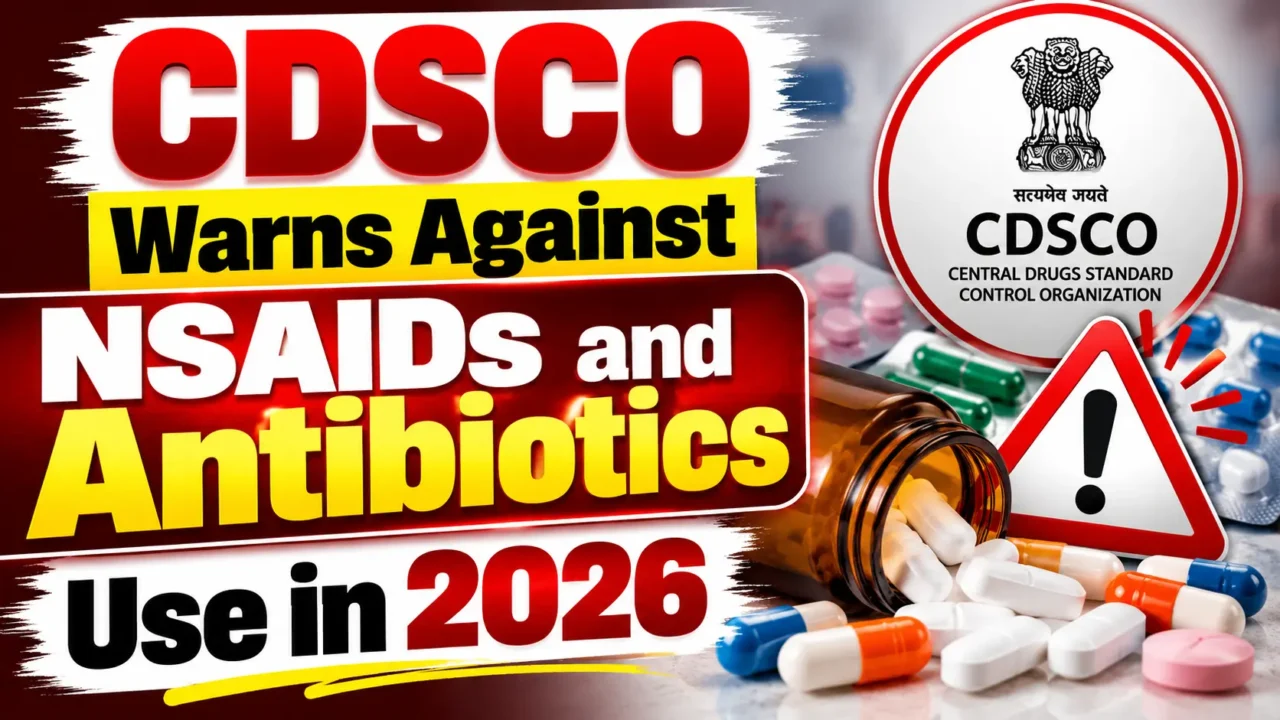

New Delhi, September 2026: The CDSCO circular on NSAIDs and antibiotics 2026 advises against the indiscriminate, repeated or prolonged use of painkillers and antibiotics without appropriate medical advice. The circular highlights concerns related to renal complications, inappropriate antibiotic use and antimicrobial resistance.
The advisory, dated 21 September 2026, was issued by the New Drugs Division of the Central Drugs Standard Control Organisation (CDSCO) and is addressed to the general public, healthcare professionals, pharmacists, retailers, wholesalers, hospitals and healthcare institutions.
CDSCO Circular on NSAIDs and Antibiotics
The Central Drugs Standard Control Organisation (CDSCO) has issued an advisory focusing on the safe and rational use of NSAIDs and antibiotics.
The circular refers to the regulatory framework under the Drugs and Cosmetics Act, 1940 and the Drugs Rules, 1945.
According to the advisory, medicines covered under prescription schedules must be supplied in accordance with the applicable requirements.
Key Points at a Glance
| Topic | CDSCO Advisory |
|---|---|
| NSAIDs | Avoid indiscriminate, repeated or prolonged use |
| Antibiotics | Avoid self-medication and unnecessary use |
| Renal risk | Exercise caution in patients at risk of renal impairment |
| Antibiotic resistance | Promote antimicrobial stewardship |
| Schedule H medicines | Follow applicable prescription requirements |
| Schedule H1 medicines | Follow applicable prescription requirements and warnings |
| Pharmacists | Follow statutory requirements for sale and distribution |
| Doctors | Prescribe medicines only when clinically indicated |
| Hospitals | Strengthen rational prescribing and monitoring |

Why Has CDSCO Issued This Advisory?
NSAIDs and antibiotics are widely used medicines, but inappropriate use can create avoidable risks.
The CDSCO advisory particularly focuses on two important concerns:
- Renal complications associated with inappropriate NSAID use
- Antimicrobial resistance associated with inappropriate antibiotic use
The advisory therefore emphasizes appropriate prescribing, responsible dispensing and avoiding unnecessary self-medication.
NSAIDs and Prescription Requirements
NSAIDs are commonly used to manage pain, inflammation and fever.
According to the CDSCO circular, most NSAIDs are included under Schedule H and are subject to applicable prescription requirements.
They should not be sold by retail without a prescription from a Registered Medical Practitioner, subject to the applicable provisions of the Drugs Rules, 1945.
Risks of Inappropriate NSAID Use
CDSCO has advised healthcare professionals to consider relevant risk factors before prescribing NSAIDs.
Particular caution is advised in patients with:
- Renal impairment
- Dehydration
- Cardiovascular disease
- Other conditions that may increase NSAID-related risks
Healthcare professionals have also been advised to consider the lowest effective dose for the shortest appropriate duration, particularly in patients at increased risk of renal impairment.
Antibiotics and Prescription Requirements
Most antibiotics are included under Schedule H1 and carry prescribed warnings regarding their use.
The CDSCO advisory emphasizes that antibiotics should be used only when clinically indicated and according to appropriate medical advice.
Why Antibiotic Self-Medication Should Be Avoided
Antibiotics should not be taken without appropriate medical advice simply because a person has fever, cough, cold or another symptom.
Many uncomplicated viral infections do not require antibiotic treatment.
Inappropriate antibiotic use can contribute to antimicrobial resistance (AMR), which can make infections more difficult to treat.
CDSCO Advice for the General Public
The CDSCO circular provides several important messages for patients and the general public.
Do Not Self-Medicate With Antibiotics
Antibiotics should not be used without appropriate medical advice.
Patients should also avoid using leftover antibiotics from an earlier illness or sharing prescribed antibiotics with another person.
Avoid Repeated Use of Painkillers Without Medical Advice
People should not repeatedly use NSAIDs or other painkillers for persistent or recurring symptoms without seeking medical advice.
If pain, fever or other symptoms continue or return, medical evaluation may be required.
Inform Your Healthcare Professional About Kidney Problems
People with pre-existing kidney disease or other risk factors for renal impairment should inform their healthcare professional before using NSAIDs.
Advice for Doctors and Healthcare Professionals
CDSCO has advised healthcare professionals to prescribe NSAIDs and antibiotics only when clinically indicated.
Before prescribing, factors such as the following should be considered:
- Patient’s clinical condition
- Age
- Co-morbidities
- Concomitant medicines
- Relevant risk factors
- Potential risks associated with treatment
Recommendations for NSAID Prescribing
Healthcare professionals should consider:
- The lowest effective dose
- The shortest appropriate duration
- Patient-specific risk factors
- Renal function and other relevant clinical conditions
Recommendations for Antibiotic Prescribing
Antibiotic prescribing should follow antimicrobial stewardship principles.
Where appropriate, healthcare professionals should consider:
- Likely causative organism
- Site of infection
- Severity of infection
- Microbiological investigations
- Local susceptibility patterns
Unnecessary combination therapy, inappropriate antibiotic selection, incorrect dosing and unnecessarily prolonged treatment should be avoided.

Instructions for Pharmacists, Retailers and Distributors
The CDSCO advisory also highlights the responsibilities of pharmacists, retailers and distributors.
Key Instructions
- Schedule H and H1 medicines should be sold according to the applicable provisions of the Drugs Rules, 1945.
- Pharmacists and retailers should not encourage self-medication with antibiotics or prescription-only NSAIDs.
- Prescribed warnings and conditions of sale on medicine labels should be observed.
- Prescription requirements for applicable medicines should be followed.
Why Is This Important for Pharmacists?
Pharmacists are an important point of contact between patients and medicines. Responsible dispensing can help reduce inappropriate medicine use and support rational therapy.
Hospitals and Healthcare Institutions
CDSCO has advised hospitals and healthcare institutions to strengthen systems for the rational use of NSAIDs and antibiotics.
This includes:
- Prescription review
- Rational prescribing
- Antimicrobial stewardship
- Appropriate patient counselling
- Monitoring of medicine use
Role of State and Union Territory Drug Control Authorities
State and Union Territory Drug Control Authorities have been requested to create awareness among healthcare professionals, pharmacists, retailers and the general public.
They have also been requested to ensure compliance with applicable provisions of the Drugs and Cosmetics Act, 1940 and Drugs Rules, 1945.
Important Regulatory Details
| Particular | Details |
|---|---|
| Authority | Central Drugs Standard Control Organisation (CDSCO) |
| Division | New Drugs Division |
| Circular Date | 21 September 2026 |
| Subject | Indiscriminate use of painkillers (NSAIDs), antibiotics and associated risks |
| Key Risks Highlighted | Renal complications and antimicrobial resistance |
| Relevant Law | Drugs and Cosmetics Act, 1940 |
| Relevant Rules | Drugs Rules, 1945 |
| Main Stakeholders | Public, doctors, pharmacists, retailers, distributors and hospitals |
| Signed By | Dr. Rajeev Singh Raghuvanshi, Drugs Controller General (India) |
Why Should Pharmacy Candidates Know About This Update?
This CDSCO update is particularly relevant for B.Pharm, D.Pharm and M.Pharm students, pharmacists and pharmacy job aspirants.
The circular connects directly with important pharmacy topics such as:
- Schedule H and H1 drugs
- Prescription requirements
- Rational drug use
- Antibiotic stewardship
- Antimicrobial resistance
- Adverse drug reactions
- Pharmacist responsibilities
- Drugs and Cosmetics Act and Rules
These topics can also be useful for students preparing for pharmacist recruitment examinations and pharmacy competitive exams.
Important Points for Pharmacy Students
For quick revision, remember these points:
NSAIDs → Renal Risk → Appropriate Dose → Appropriate Duration
Antibiotics → Avoid Self-Medication → Rational Use → Antimicrobial Stewardship
Schedule H/H1 → Follow Applicable Prescription Requirements
Frequently Asked Questions (FAQs)
1. What is the latest CDSCO circular on NSAIDs and antibiotics?
CDSCO issued a circular dated 21 September 2026 advising against the indiscriminate use of NSAIDs and antibiotics and highlighting risks including renal complications and antimicrobial resistance.
2. Why has CDSCO warned against NSAID misuse?
The advisory highlights the risks associated with inappropriate NSAID use, particularly in patients with factors that may increase the risk of renal impairment.
3. Can antibiotics be taken without a prescription?
The CDSCO advisory emphasizes that antibiotics should not be used for self-medication and that applicable prescription requirements for Schedule H1 medicines must be followed.
4. Are most NSAIDs Schedule H drugs?
The CDSCO circular states that most NSAIDs are included under Schedule H and are subject to applicable prescription requirements.
5. Are most antibiotics Schedule H1 drugs?
The circular states that most antibiotic drugs are included under Schedule H1 and carry prescribed warnings and conditions of sale.
6. Why should antibiotics not be used unnecessarily?
Unnecessary or inappropriate antibiotic use can contribute to antimicrobial resistance, which can make infections more difficult to treat.
7. What should pharmacists do regarding Schedule H and H1 medicines?
Pharmacists and retailers should comply with the applicable provisions of the Drugs Rules, 1945, including prescription requirements and prescribed conditions of sale.
8. What should patients do if pain or fever continues?
Patients should seek appropriate medical advice if pain, fever or other symptoms persist or recur instead of repeatedly self-medicating with painkillers or antibiotics.
Suggested GDC Classes Internal Links
Add relevant internal links from this article to existing GDC Classes content, such as:
- Pharmacist Recruitment Updates
- Pharmacy Competitive Exam Preparation
- Drug Inspector Preparation
- Pharmacology Notes
- Pharmacy Law and Ethics
- Pharmacovigilance
- Latest Pharmacy Jobs
- GPAT Preparation
Use descriptive anchor text rather than generic anchors such as “Click Here.”
Conclusion
The CDSCO circular on NSAIDs and antibiotics 2026 emphasizes the importance of safe, rational and responsible medicine use. It advises the public to avoid self-medication, healthcare professionals to prescribe medicines only when clinically indicated, and pharmacists and retailers to follow applicable prescription and sale requirements.
Recommended Products