


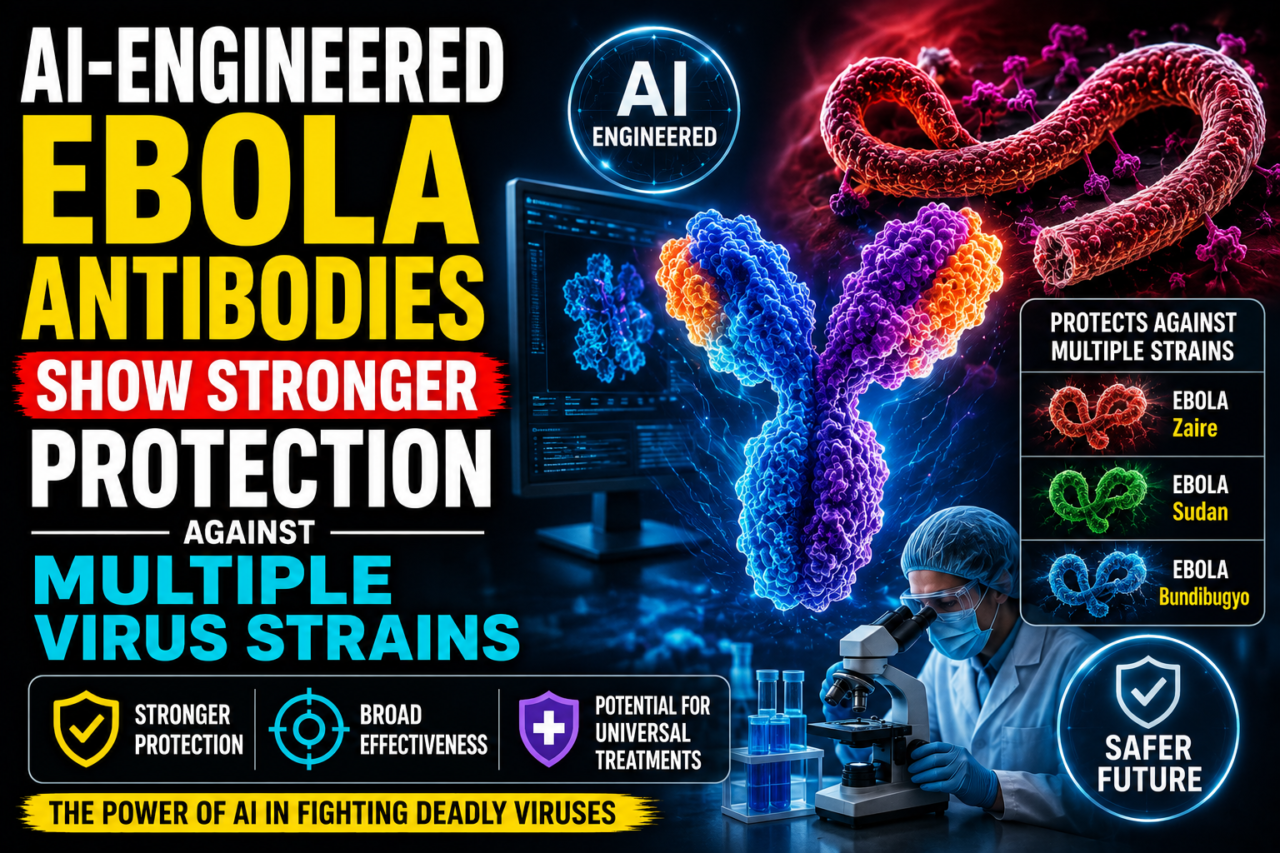

Researchers in China have developed a new artificial intelligence-powered antibody engineering system that could help create stronger and broader Ebola virus treatments capable of targeting multiple deadly Ebola strains at the same time. The breakthrough may significantly improve future preparedness against rapidly evolving viral outbreaks.
The study was led by Professor Wei Yang at the National Institute of Pathogen Biology under the Chinese Academy of Medical Sciences and Peking Union Medical College. The findings were published in the journal Research.
The Growing Challenge of Ebola Virus Variants
Ebola virus remains one of the world’s most dangerous infectious diseases, causing severe hemorrhagic fever with high mortality rates. Major outbreaks between 2013 and 2022 highlighted the urgent need for treatments that can protect against multiple Ebola species.
Several Ebola strains can infect humans, including:
- Zaire Ebola virus
- Sudan Ebola virus
- Bundibugyo Ebola virus
Most currently approved antibody therapies mainly target the Zaire strain. In addition, many treatments rely on combinations of multiple antibodies, which can increase manufacturing complexity and treatment costs.
Another major concern is viral mutation. As Ebola viruses evolve, mutations may allow them to escape immune recognition, reducing the effectiveness of existing therapies.
How AI Is Helping Scientists Engineer Better Antibodies
To address these challenges, the research team developed a new computational “predict-test-refine” pipeline that combines artificial intelligence, structural biology, and laboratory experiments.
The system works by:
- Predicting how small antibody mutations may affect viral binding
- Testing the most promising antibody designs computationally
- Refining antibody structures before laboratory validation
Using advanced structural modeling and mutational scanning tools, scientists were able to rapidly identify antibody modifications with improved viral neutralization ability.
This approach allows researchers to evaluate thousands of potential antibody changes much faster than traditional laboratory-only methods.
Stronger and Broader Ebola Antibodies
The AI-guided engineering process successfully redesigned existing Ebola antibodies to improve their activity against multiple Ebola species simultaneously.
The newly optimized antibody candidates showed:
- Stronger viral binding
- Improved neutralization potency
- Broader protection across different Ebola strains
- Potential resistance to viral escape mutations
These findings suggest that AI-assisted antibody engineering could help scientists create more durable antiviral therapies that remain effective even as viruses evolve.

Why This Discovery Is Important
The study represents a major advancement in computational immunology and antiviral drug development.
Traditional antibody discovery and optimization can take years of laboratory work. AI-driven approaches dramatically accelerate this process by narrowing down the most promising candidates before physical testing begins.
This could help researchers respond faster during future outbreaks of:
- Ebola virus
- Emerging viral pandemics
- Rapidly mutating infectious diseases
The technology may also reduce development costs and improve the speed of therapeutic design during global health emergencies.
Potential Applications Beyond Ebola
Although the study focused on Ebola virus, the computational platform could potentially be adapted for other infectious diseases.
Researchers believe similar AI-guided antibody engineering systems may help develop future treatments against:
- Influenza viruses
- Coronaviruses
- HIV
- Nipah virus
- Other emerging pathogens
The ability to rapidly engineer broad-spectrum antibodies could become an important tool in global pandemic preparedness.
Combining Artificial Intelligence and Biomedical Science
The research highlights how artificial intelligence is increasingly transforming modern biomedical research. Instead of replacing laboratory science, AI is helping scientists make faster and more accurate decisions during drug discovery and therapeutic development.
By integrating computational prediction with experimental validation, researchers can now design next-generation therapies with greater precision than ever before.
Recommended Products