


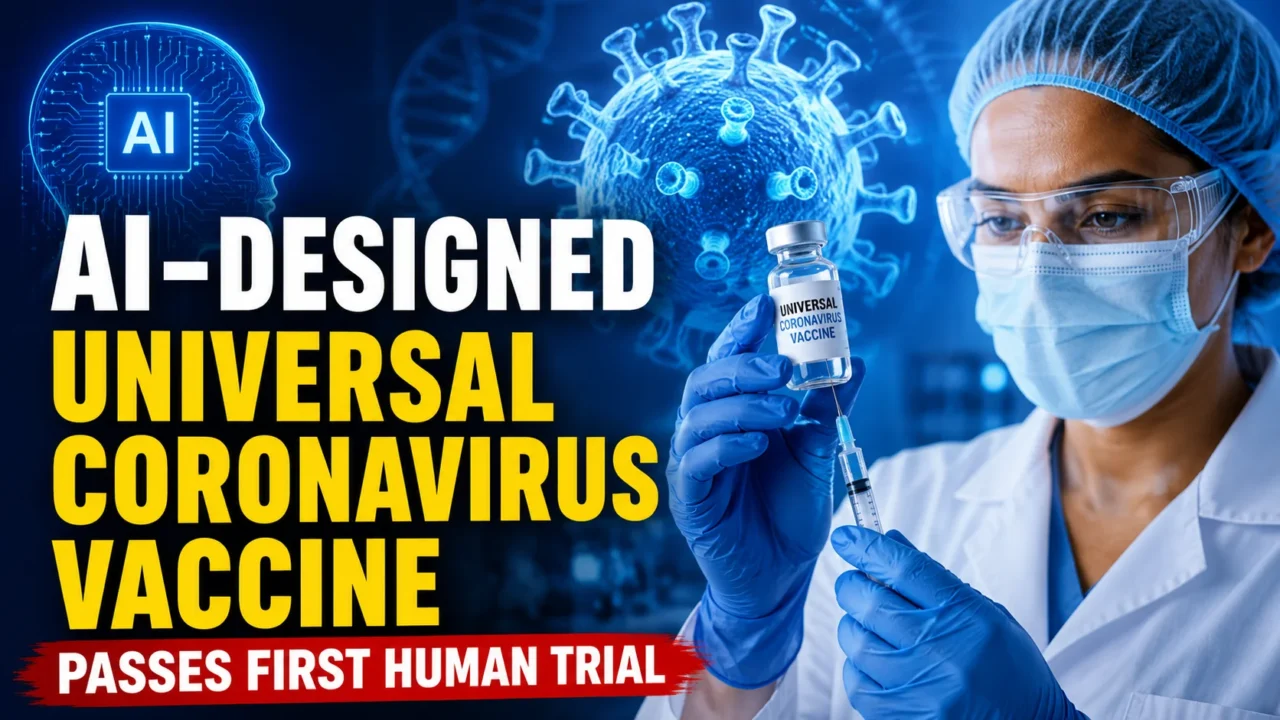

Artificial Intelligence is rapidly transforming healthcare, and a recent breakthrough has brought it into the spotlight once again. Researchers have announced that an AI-designed universal coronavirus vaccine has successfully completed its first human trial, marking a potentially significant milestone in vaccine development.
The development has attracted global attention because the vaccine’s active component was reportedly designed entirely using artificial intelligence, demonstrating how advanced computational tools can accelerate scientific discovery.

What Makes This Vaccine Unique?
Unlike traditional vaccine development, which often requires years of laboratory research and testing, this vaccine candidate was designed using AI-driven computational models. The technology analyzed vast amounts of biological data to identify potential targets capable of providing protection against multiple coronaviruses.
The goal is to create a universal coronavirus vaccine that could offer broader protection not only against current variants but also against future coronavirus threats.
First Human Trial Completed
According to reports, the first human trial involved 39 volunteers. The study primarily focused on evaluating the vaccine’s safety and initial immune response.
While the successful completion of an early-stage trial is encouraging, experts emphasize that this is only the beginning of a long clinical evaluation process. Larger trials involving hundreds or thousands of participants will be required before any conclusions can be made regarding effectiveness and long-term safety.
Needle-Free Delivery System
One of the most interesting aspects of this vaccine is its needle-free delivery mechanism. Such systems can simplify mass vaccination campaigns by reducing the need for trained healthcare personnel and improving patient acceptance.
Needle-free technologies may also help increase vaccination coverage in regions where healthcare infrastructure is limited.
The Role of Artificial Intelligence in Drug and Vaccine Development
Artificial Intelligence is becoming a powerful tool in biomedical research. It can:
- Analyze massive biological datasets quickly.
- Predict promising vaccine targets.
- Accelerate drug discovery processes.
- Reduce research costs and development timelines.
- Improve precision in molecular design.
Many pharmaceutical companies and research institutions are already integrating AI into their research pipelines to speed up innovation.
Why This Development Matters
The COVID-19 pandemic highlighted the need for faster responses to emerging infectious diseases. Traditional vaccine development often takes years, while AI-powered systems have the potential to significantly reduce discovery timelines.
If successful, AI-designed vaccines could help humanity respond more effectively to future outbreaks and pandemics.
Challenges and Caution
Despite the excitement, experts urge caution. Early-stage clinical trials are designed primarily to assess safety, not efficacy.
Several important questions remain:
- How effective is the vaccine against different coronavirus strains?
- How long does immunity last?
- What are the long-term safety outcomes?
- Can the vaccine provide protection against future coronavirus variants?
These questions can only be answered through larger and more comprehensive clinical studies.
Future Outlook
The successful completion of a first-in-human trial represents an important step forward for both vaccine science and artificial intelligence. While much more research is needed, this development showcases the growing potential of AI to transform healthcare and biomedical innovation.
As clinical testing progresses, the scientific community will closely monitor the vaccine’s performance. If future trials confirm its safety and effectiveness, AI-designed vaccines could become a major part of the next generation of disease prevention strategies.
Conclusion
The AI-designed universal coronavirus vaccine’s first human trial is a promising advancement in modern medicine. Although it is still in the early stages of development, it demonstrates how artificial intelligence can contribute to faster and potentially more effective vaccine design.
The coming years will reveal whether this innovative approach can deliver on its promise and help shape the future of global public health.
Recommended Products