



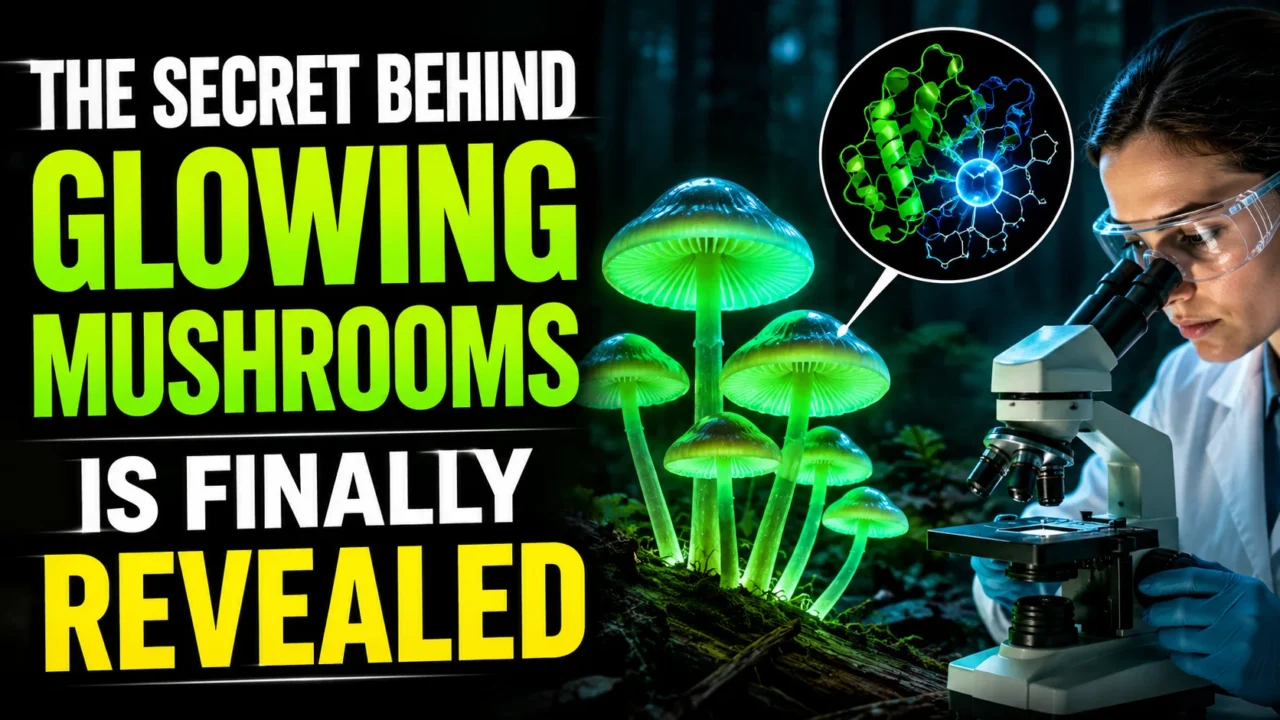

For centuries, glowing mushrooms have fascinated scientists, nature enthusiasts, and curious observers alike. Found in forests around the world, these mysterious fungi emit an eerie greenish-blue light in the darkness, creating one of nature’s most captivating spectacles. While researchers have understood parts of the bioluminescence process, one critical piece of the puzzle remained missing—until now.
Scientists have finally identified the enzyme responsible for helping bioluminescent fungi produce their natural glow, bringing us one step closer to fully understanding how these remarkable organisms light up the night.

What Are Glowing Mushrooms?
Glowing mushrooms are a type of bioluminescent fungi, organisms capable of producing and emitting light through chemical reactions occurring inside their cells.
More than 100 species of fungi are known to exhibit bioluminescence, including:
- Mycena chlorophos
- Neonothopanus gardneri
- Panellus stipticus
- Armillaria mellea
These fungi are commonly found in:
- Tropical forests
- Decaying wood
- Moist environments
- Rainforest ecosystems
Their soft green glow is most visible at night and has intrigued researchers for decades.
What Causes Mushrooms to Glow?
Bioluminescence occurs when specialized molecules undergo chemical reactions that release energy in the form of visible light.
Scientists previously knew that fungi use:
- Luciferin (light-producing molecule)
- Luciferase-related enzymes
- Oxygen
to create light.
However, a crucial component of the biochemical pathway remained unidentified.
The Missing Piece: A Newly Identified Enzyme
Researchers have now discovered a specialized enzyme known as CPH (Caffeylpyruvate Hydrolase).
This enzyme plays a critical role in the fungal bioluminescence cycle by:
- Breaking down specific compounds involved in light production
- Recycling key molecules required for continuous glowing
- Maintaining energy efficiency within fungal cells
- Supporting sustained bioluminescence
The discovery fills an important gap in scientists’ understanding of how fungal bioluminescence functions.
How Does the Enzyme Work?
The newly discovered enzyme helps convert intermediate compounds generated during the light-producing reaction.
Key Functions of CPH
1. Chemical Recycling
The enzyme breaks down caffeylpyruvic acid into reusable components.
This recycling process allows fungi to continuously generate light without wasting valuable resources.
2. Energy Conservation
Biological systems must use energy efficiently.
CPH helps recover molecules that would otherwise be lost, reducing the metabolic cost of producing light.
3. Sustaining Continuous Glow
Without efficient recycling, the glowing reaction would quickly stop.
The enzyme ensures a steady supply of materials necessary for ongoing bioluminescence.
Why Do Mushrooms Glow?
Scientists believe glowing fungi may use light for several ecological purposes.
Attracting Insects
Some insects are attracted to the glow and help disperse fungal spores.
Communication and Survival
Bioluminescence may provide evolutionary advantages by enhancing reproduction and species survival.
Defense Mechanisms
Some researchers suggest glowing fungi may deter certain predators or influence interactions with other organisms.
Importance of This Discovery
The identification of the CPH enzyme is more than just a scientific curiosity.
It could have applications in:
Biotechnology
Bioluminescent systems are already used in laboratories for:
- Medical diagnostics
- Drug discovery
- Genetic research
Understanding fungal bioluminescence may lead to improved biological tools.
Sustainable Lighting Research
Although still theoretical, scientists are exploring whether bioluminescent organisms could someday contribute to environmentally friendly lighting technologies.
Synthetic Biology
Researchers may be able to engineer glowing organisms for:
- Environmental monitoring
- Biosensors
- Agricultural applications
The Future of Bioluminescence Research
The discovery of the missing enzyme opens new avenues for research into fungal biology and natural light-producing systems.
Future studies may focus on:
- Improving understanding of fungal metabolism
- Developing novel biotechnology applications
- Engineering artificial bioluminescent systems
- Exploring ecological roles of glowing fungi
Scientists now have a more complete picture of one of nature’s most beautiful biological phenomena.
Fascinating Facts About Glowing Mushrooms
🍄 More than 100 fungal species can naturally produce light.
🍄 Most glowing fungi emit green light because it is highly visible in forest environments.
🍄 Bioluminescent fungi are found on every continent except Antarctica.
🍄 Some glowing mushrooms are bright enough to be seen from several meters away in complete darkness.
🍄 The glow is produced without generating significant heat, making it a highly efficient biological process.
Conclusion
The mystery behind glowing mushrooms has become much clearer with the discovery of the enzyme CPH, a crucial component of fungal bioluminescence. By helping recycle molecules involved in the light-producing process, this enzyme enables fungi to glow efficiently and continuously.
This breakthrough not only deepens our understanding of nature’s hidden wonders but also opens exciting possibilities in biotechnology, medicine, and sustainable innovation. As researchers continue to explore the science of bioluminescence, glowing mushrooms may illuminate far more than just the forest floor—they could help illuminate the future of scientific discovery itself.
Recommended Products