


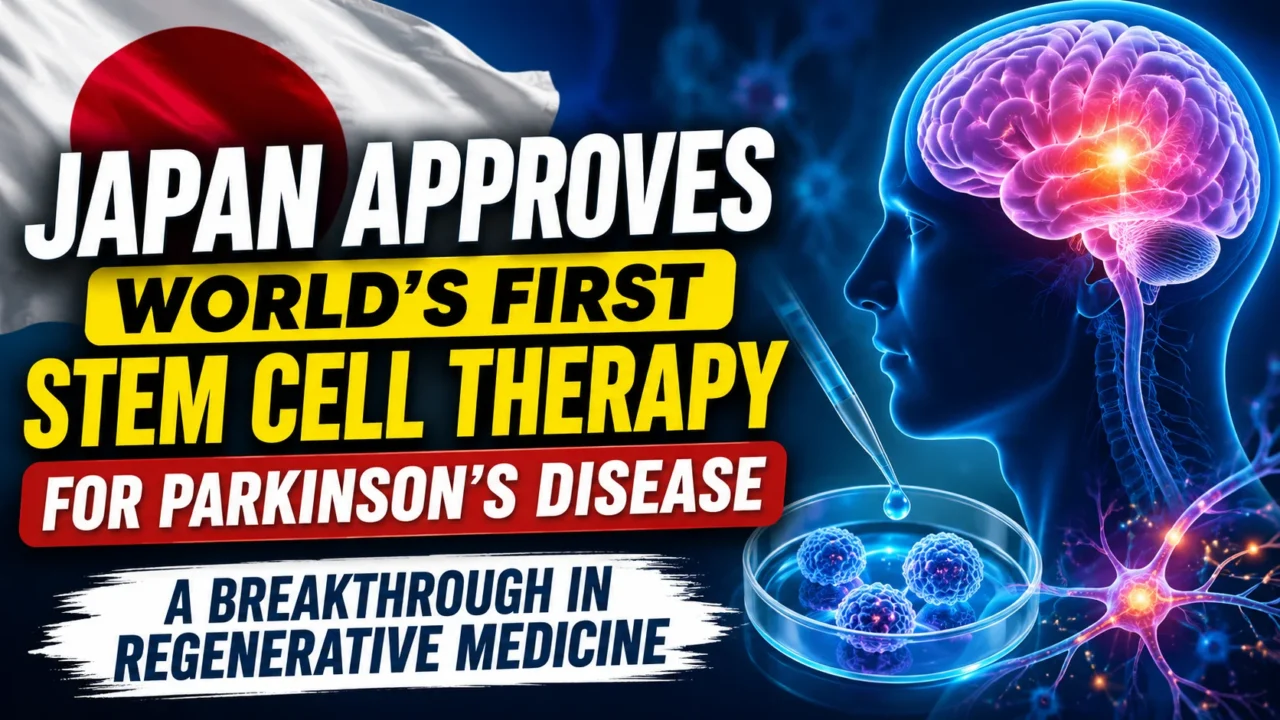

In a historic advancement for medical science, Japan has approved the world’s first stem cell therapy designed to repair brain damage caused by Parkinson’s disease. This landmark decision marks a significant step forward in regenerative medicine and offers new hope to millions of patients worldwide living with this progressive neurological disorder.
The therapy aims to do more than simply manage symptoms. Instead, it focuses on replacing the dopamine-producing neurons that are gradually lost in Parkinson’s disease, potentially addressing the root cause of the condition.

What is Parkinson’s Disease?
Parkinson’s disease is a chronic and progressive neurological disorder that primarily affects movement. It occurs when nerve cells in a region of the brain called the substantia nigra become damaged or die.
These cells normally produce dopamine, a neurotransmitter responsible for controlling movement and coordination. As dopamine levels decline, patients may experience:
- Tremors (shaking)
- Muscle stiffness
- Slowed movement (bradykinesia)
- Balance and coordination problems
- Difficulty walking
- Speech and swallowing difficulties
According to global health estimates, millions of people worldwide are affected by Parkinson’s disease, and its prevalence continues to rise with aging populations.
The Limitations of Current Treatments
Current Parkinson’s treatments primarily focus on symptom management rather than curing the disease.
Common therapies include:
Levodopa
The most widely prescribed medication that helps replenish dopamine levels.
Dopamine Agonists
Drugs that mimic the effects of dopamine in the brain.
Deep Brain Stimulation (DBS)
A surgical procedure involving implanted electrodes to help control symptoms.
While these treatments can improve quality of life, they do not stop the ongoing loss of dopamine-producing neurons.
Japan’s Revolutionary Stem Cell Therapy
The newly approved therapy uses induced pluripotent stem cells (iPSCs), a groundbreaking technology pioneered by Japanese scientist Shinya Yamanaka, who received the Nobel Prize for his work in stem cell research.
What Are iPSCs?
Induced pluripotent stem cells are adult cells that have been genetically reprogrammed into a stem-cell-like state.
These cells can develop into many different cell types, including:
- Nerve cells
- Heart cells
- Liver cells
- Dopamine-producing neurons
This flexibility makes them highly valuable for regenerative medicine.
How Does the Therapy Work?
The treatment process involves several key steps:
Step 1: Creation of Stem Cells
Researchers generate induced pluripotent stem cells under controlled laboratory conditions.
Step 2: Conversion into Neurons
The stem cells are transformed into dopamine-producing neurons.
Step 3: Brain Transplantation
These specialized neurons are carefully transplanted into the patient’s brain.
Step 4: Restoration of Dopamine Production
The transplanted cells are expected to survive, integrate into brain tissue, and produce dopamine naturally.
The ultimate goal is to restore lost neurological function rather than merely replacing dopamine through medication.
Why This Approval Is Historic
Japan’s approval represents a major milestone because it is the first regulatory approval of a stem-cell-based therapy specifically aimed at rebuilding brain tissue damaged by Parkinson’s disease.
Potential benefits include:
✅ Long-term symptom improvement
✅ Reduced dependence on medication
✅ Restoration of dopamine production
✅ Improved quality of life
✅ Advancement of regenerative medicine
Potential Impact on Future Medicine
Experts believe this breakthrough could pave the way for stem-cell therapies targeting many other neurological disorders, including:
- Alzheimer’s disease
- Huntington’s disease
- Stroke-related brain injury
- Spinal cord injuries
- Amyotrophic Lateral Sclerosis (ALS)
Success in Parkinson’s treatment may accelerate the development of regenerative therapies across multiple medical fields.
Challenges and Considerations
Despite the excitement, several challenges remain:
Long-Term Safety
Researchers must continue monitoring patients to ensure the transplanted cells remain safe over time.
Cost and Accessibility
Advanced stem cell therapies are expensive, and widespread access may take time.
Individual Patient Response
Not all patients may respond equally to treatment.
Continued Research
Further clinical studies are necessary to optimize treatment protocols and outcomes.
What This Means for Patients
For Parkinson’s patients and their families, this approval represents more than a scientific achievement—it offers hope.
Instead of relying solely on treatments that temporarily control symptoms, patients may soon have access to therapies capable of repairing damaged brain tissue and restoring lost function.
While continued research is essential, Japan’s decision signals the beginning of a new era in regenerative neurology.
Conclusion
Japan’s approval of the world’s first stem cell therapy for Parkinson’s disease is a landmark moment in modern medicine. By utilizing induced pluripotent stem cells to replace damaged dopamine-producing neurons, researchers are moving closer to treating the underlying cause of Parkinson’s rather than simply managing symptoms.
As regenerative medicine continues to evolve, this breakthrough may become a foundation for future therapies that transform the treatment of neurological diseases worldwide.
Recommended Products