



Scientists Successfully Eliminate Extra Chromosome 21 Using CRISPR Technology
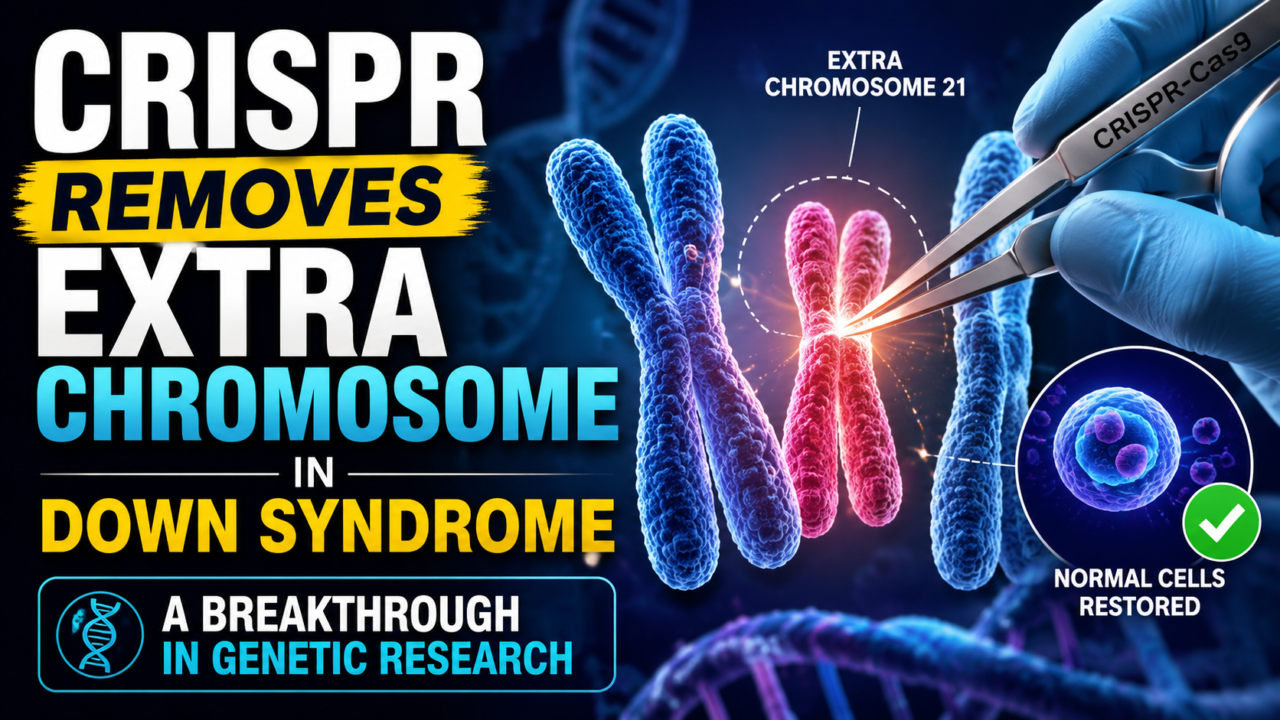
In a groundbreaking scientific development, researchers have successfully used CRISPR gene-editing technology to remove the extra chromosome responsible for Down syndrome (Trisomy 21) in human cells. This achievement represents a significant milestone in genetic medicine and opens new possibilities for future treatments of chromosomal disorders.

What is Down Syndrome?
Down syndrome, also known as Trisomy 21, is a genetic condition caused by the presence of an extra copy of chromosome 21. Instead of the usual two copies, individuals with Down syndrome have three copies of this chromosome.
Key Facts About Down Syndrome
- Affects approximately 1 in 700 births worldwide
- Causes developmental and intellectual disabilities
- Can be associated with heart defects and other health conditions
- Is currently considered a lifelong genetic condition
What Did Scientists Achieve?
Researchers developed an advanced allele-specific CRISPR-Cas9 gene-editing approach capable of selectively targeting and removing the extra chromosome 21.
The study was conducted on laboratory-grown human cells, including:
- Induced Pluripotent Stem Cells (iPSCs)
- Skin Fibroblast Cells
- Cells derived from individuals with Down syndrome
The researchers successfully eliminated the extra chromosome and restored the normal chromosomal number in many treated cells.
How Does CRISPR Work?
CRISPR-Cas9 Explained
CRISPR (Clustered Regularly Interspaced Short Palindromic Repeats) is a powerful gene-editing tool that acts like molecular scissors.
The process involves:
- Identifying a specific DNA target.
- Using the Cas9 enzyme to cut the DNA.
- Removing or modifying unwanted genetic material.
- Allowing cells to repair the DNA.
In this study, scientists specifically targeted the additional chromosome 21 while preserving the normal copies.
Why Is This Discovery Important?
This research could revolutionize how scientists approach chromosomal disorders.
Potential Benefits
✅ Better understanding of Down syndrome biology
✅ New strategies for treating genetic disorders
✅ Advancement in precision medicine
✅ Potential future therapies for chromosomal abnormalities
✅ Improved disease modeling and drug development
Current Limitations
Despite the exciting results, this breakthrough is still in the early research stage.
Scientists emphasize that:
- The experiments were performed only in laboratory-grown cells.
- The technique has not been tested in humans.
- Additional research is required to assess safety and effectiveness.
- Clinical applications may take many years to develop.
Challenges Ahead
Several challenges remain before this technology can be used in medical treatments:
Technical Challenges
- Ensuring precise chromosome removal
- Preventing unintended genetic changes
- Maintaining long-term cell stability
Ethical Considerations
- Genetic modification regulations
- Safety concerns
- Access and affordability of future treatments
Impact on Future Medicine
The successful removal of an entire extra chromosome demonstrates the growing potential of gene-editing technologies. Researchers believe this achievement could pave the way for future therapies targeting chromosomal disorders that were previously considered untreatable.
As CRISPR technology continues to advance, scientists may eventually develop safer and more effective methods for correcting genetic abnormalities at their source.
Conclusion
The successful use of CRISPR to remove the extra chromosome responsible for Down syndrome marks a remarkable achievement in genetic research. While the work is still experimental and far from clinical application, it offers hope for future breakthroughs in treating chromosomal disorders. This study highlights the incredible potential of gene-editing technology and represents an important step toward the future of precision medicine.
Recommended Products