


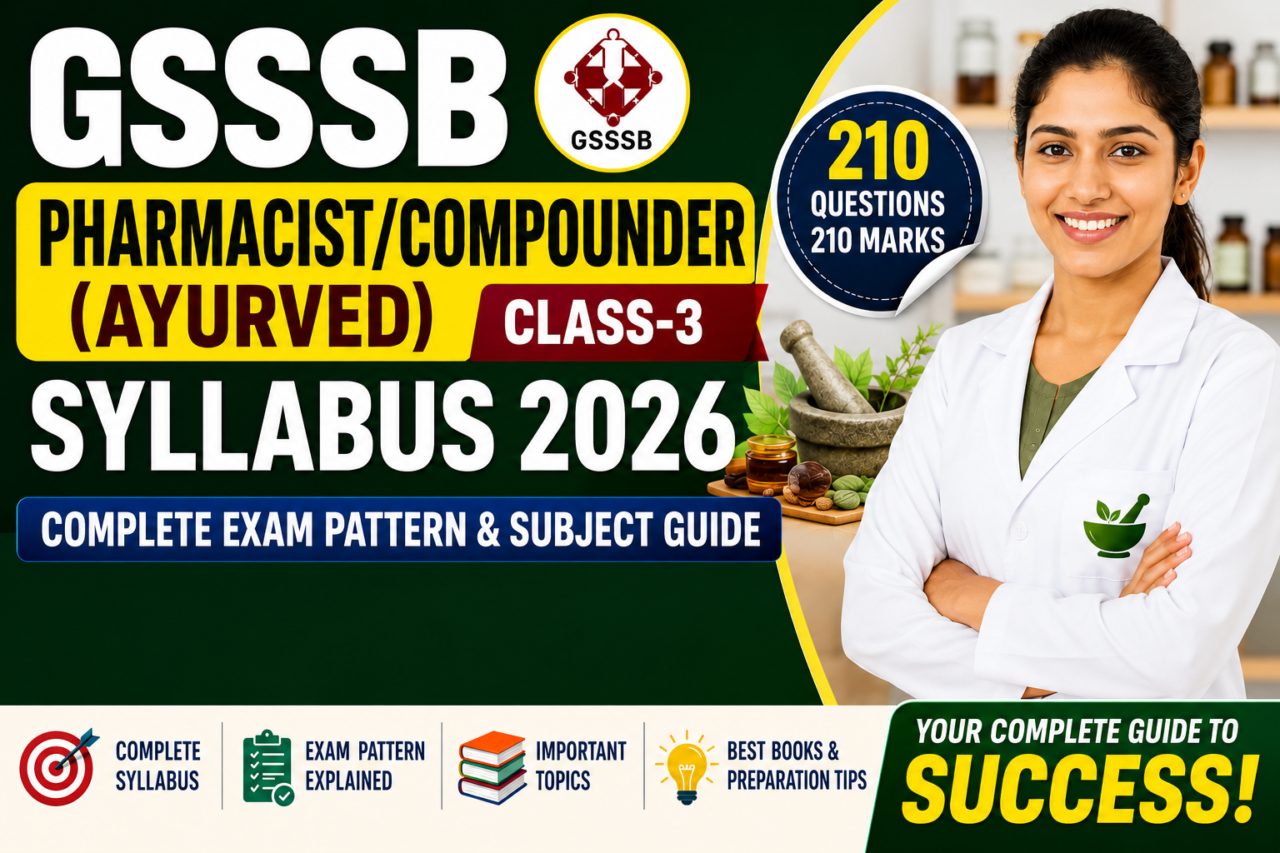

The Gujarat Gaun Seva Pasandgi Mandal (GSSSB) has officially released the detailed syllabus for the post of Pharmacist/Compounder (Ayurved), Class-3 recruitment examination 2026. Candidates preparing for this competitive exam should understand the complete syllabus, exam pattern, and important subjects to score well in the examination.
This exam includes both:
- General aptitude subjects
- Technical Ayurvedic pharmacy subjects
The examination is divided into Part-A and Part-B.
Overall Exam Pattern
| Details | Information |
|---|---|
| Total Questions | 210 |
| Total Marks | 210 |
| Exam Duration | 3 Hours |
| Exam Type | MCQ Based |
| Negative Marking | 0.25 Marks Deduction |
| Mode of Exam | CBRT / OMR |
Subjects Included
- Reasoning & Data Interpretation
- Quantitative Aptitude
- Constitution of India
- Current Affairs
- Gujarati & English Comprehension
Reasoning & Data Interpretation
Important Topics
- Problems on Ages
- Blood Relation
- Venn Diagram
- Visual Reasoning
- Arithmetic Reasoning
- Charts & Graphs
- Data Sufficiency
These questions test logical thinking and analytical ability.
Quantitative Aptitude
Important Topics
- Number System
- Percentage
- Ratio & Proportion
- Profit & Loss
- Average
- Time & Work
- Time, Speed & Distance
- Algebra
- Partnership
Students should regularly practice calculations and shortcut methods.
Constitution of India
Important topics include:
- Preamble
- Fundamental Rights
- Directive Principles
- Parliament System
- Emergency Provisions
- Constitutional Bodies
- Judicial System
Current Affairs
Questions will be asked from:
- National news
- International news
- Gujarat state current affairs
- Healthcare & government schemes
Daily newspaper reading is highly recommended.
Gujarati & English Comprehension
This section evaluates:
- Reading skills
- Interpretation
- Vocabulary understanding
- Inference ability
Paragraph-based questions may be asked.
Part-B (120 Marks)
Part-B contains technical questions related to Ayurvedic pharmacy and compounder subjects.
Important Technical Subjects
Ayurveda Paricharya
Topics include:
- Basics of Ayurveda
- Trisutra Ayurveda
- Dosha, Dhatu, Mala
- Ayurveda principles
- Ayurvedic classical texts
Swasthavritta
Topics include:
- Healthy lifestyle concepts
- Nutrition
- Sleep
- Dinacharya
- Ritucharya
- National health programmes
Rachana Sharira
Important anatomy topics:
- Digestive system
- Cardiovascular system
- Respiratory system
- Nervous system
- Sense organs
Kriya Sharira
Topics include:
- Physiology
- Dosha functions
- Dhatu concepts
- Blood circulation
- Digestion
- Prakriti
Dravyaguna
This is one of the most important subjects.
Includes Study of:
- Medicinal plants
- Ayurvedic herbs
- Drug classification
- Drug actions
- Pharmacological properties
Important herbs include:
- Ashwagandha
- Tulsi
- Guduchi
- Haritaki
- Shatavari
- Neem
- Amla
Rasashastra
Topics include:
- Ayurvedic mineral preparations
- Parada
- Bhasma preparation
- Rasayoga
- Ayurvedic formulations
Students should focus on:
- Shodhana
- Marana
- Yantras
- Puta system
Bhaishajya Kalpana
Important topics:
- Ayurvedic dosage forms
- Kwatha
- Churna
- Vati
- Avaleha
- Asava-Arishta
- Sneha Kalpana
This section is very important for practical pharmacy knowledge.
Pharmacy Management
Topics include:
- GMP Guidelines
- Drug storage
- Pharmacy setup
- SOPs
- Documentation
- Drug distribution system
- Hospital pharmacy
- Prescription handling
Computer applications in pharmacy are also included.
| Part | Subjects | No. of Questions | Marks |
|---|---|---|---|
| Part-A | Reasoning & Data Interpretation | 30 | 30 |
| Quantitative Aptitude | 30 | 30 | |
| Constitution of India | 10 | 10 | |
| Current Affairs | 10 | 10 | |
| Gujarati & English Comprehension | 10 | 10 | |
| Part-A Total | 90 Questions | 90 Marks | |
| Part-B | Technical Subjects Related to Ayurvedic Pharmacy | 120 | 120 |
| Part-B Total | 120 Questions | 120 Marks |
Recommended Study Strategy
Daily Plan
- 2 hours technical subjects
- 1 hour aptitude
- 30 minutes current affairs
- MCQ practice daily
Revision Tips
- Make short notes
- Revise formulations regularly
- Learn medicinal plant names
- Practice calculations
Career Opportunities After Selection
Selected candidates may work in:
- Ayurvedic hospitals
- Government dispensaries
- Ayurvedic pharmacies
- Healthcare centers
- Drug distribution systems
This recruitment provides stable government job opportunities for Ayurvedic pharmacy students.
Conclusion
The GSSSB Pharmacist/Compounder (Ayurved) Syllabus 2026 covers both general competitive subjects and detailed Ayurvedic pharmacy knowledge. Candidates should prepare systematically by focusing on technical subjects, MCQ practice, and regular revision.
Recommended Products