



GLP-1 drugs and addictive cravings are becoming an important area of medical research. Medicines such as semaglutide and other GLP-1 receptor agonists are widely used for diabetes and weight management, but emerging research suggests they may also influence brain pathways involved in reward, motivation and alcohol consumption.
Recent animal studies and early human clinical trials suggest that GLP-1 signalling may reduce some reward-driven behaviours, including alcohol consumption and craving. However, GLP-1 medicines are not currently established treatments for addiction, and larger clinical trials are still needed.
Quick Summary
GLP-1 receptor agonists such as semaglutide may influence brain circuits involved in reward and craving, in addition to reducing appetite. Recent research has linked GLP-1 signalling with reduced alcohol consumption and heavy-drinking days. However, evidence for addiction treatment remains early, and GLP-1 drugs are not yet approved specifically for treating addiction.
What Are GLP-1 Drugs?
GLP-1 stands for glucagon-like peptide-1, a hormone involved in blood glucose regulation, appetite and energy balance.
GLP-1 receptor agonists mimic some of the effects of naturally occurring GLP-1. They are widely used in the management of conditions such as type 2 diabetes and obesity.
Some commonly discussed GLP-1-based medicines include:

| GLP-1 Drug/Class | Common Medical Use |
|---|---|
| Semaglutide | Type 2 diabetes and weight management |
| Liraglutide | Type 2 diabetes and weight management |
| Other GLP-1 receptor agonists | Metabolic disease management |
Beyond their effects on appetite and metabolism, researchers are investigating how GLP-1 signalling affects the brain.
Why Are Scientists Studying GLP-1 Drugs and Addiction?
Addiction involves complex brain processes related to reward, motivation, learning and craving.
The brain’s reward system includes regions such as the ventral tegmental area (VTA) and nucleus accumbens, which are involved in dopamine signalling and reward-related behaviour.
Because GLP-1 drugs can influence neural pathways involved in appetite and reward, scientists are asking whether these medicines could also affect the motivation to consume alcohol or other rewarding substances.
A 2026 review in Biological Psychiatry describes GLP-1 signalling as interacting with metabolic as well as hedonic and motivational reward circuits, with emerging evidence involving drug-seeking behaviour.
The Lateral Septum May Be an Important Brain Pathway
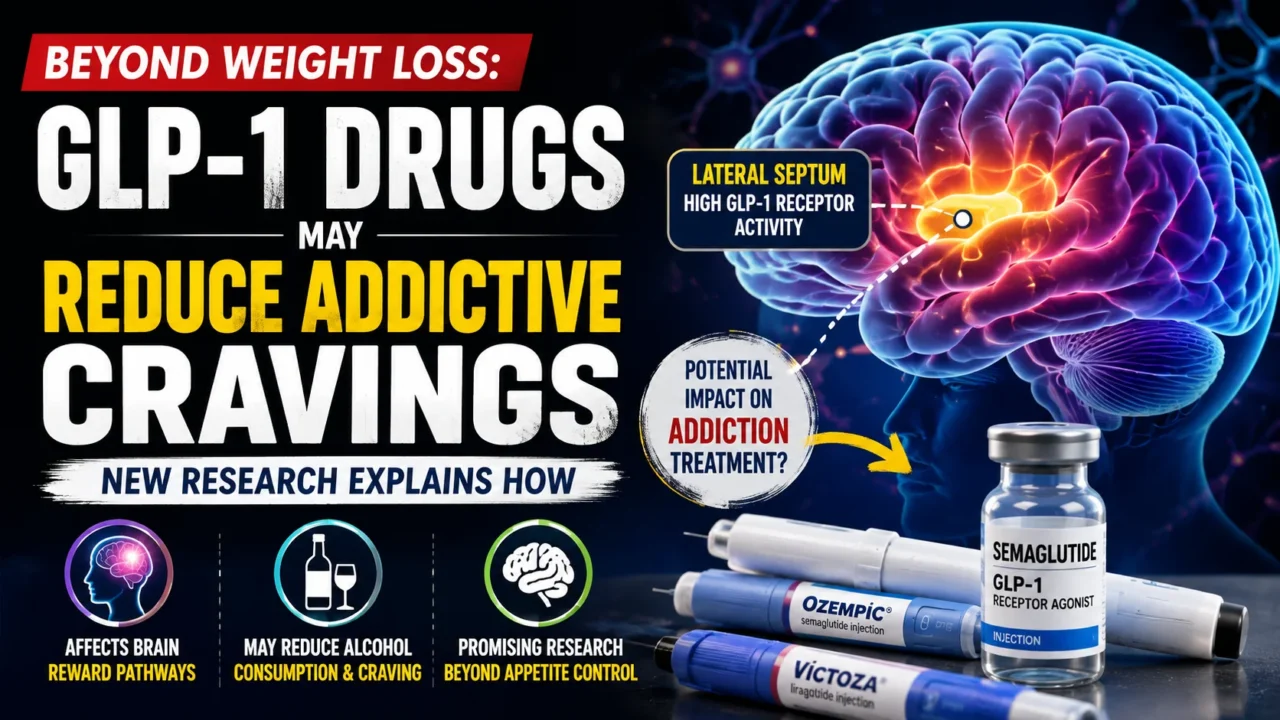
One of the most interesting areas of recent research is the lateral septum.
The lateral septum is a brain region involved in emotional regulation, motivation and reward-related behaviour. Research indicates that this region has a high level of GLP-1 receptor expression.
A 2026 Neuron report highlighted research showing that GLP-1 receptors in the lateral septum can influence alcohol-taking and alcohol-seeking behaviour in rodents.
Earlier experimental research also found that activating GLP-1 receptors in the lateral septum reduced alcohol-related reward responses and alcohol intake in rodents.
What Does This Mean?
The findings suggest that GLP-1 signalling may influence how the brain processes rewarding substances.
However, these findings were primarily obtained from animal models. They do not prove that the same mechanism will produce the same clinical effect in humans.
How Could GLP-1 Drugs Affect Craving?
Researchers are investigating several possible mechanisms.
1. Modulation of Reward Pathways
GLP-1 receptor agonists may influence neural circuits involved in reward and motivation.
Changes in dopamine signalling could alter the rewarding effects associated with certain foods or substances.
2. Effects on Hedonic Eating
Hedonic eating refers to eating driven by pleasure rather than physiological hunger.
Recent NIH-funded research found that small-molecule GLP-1 receptor agonists activated a pathway involving the central amygdala and reduced dopamine release in key reward-circuit regions in mice. This reduced pleasure-driven food consumption.
This research is particularly interesting because it suggests GLP-1 drugs can influence reward-related behaviour through neural pathways beyond traditional appetite-control circuits.
3. Changes in Alcohol-Related Behaviour
Research in animals has shown that GLP-1 receptor activation can reduce alcohol consumption and alcohol-seeking behaviour.
Human studies are now beginning to test whether these findings translate into clinical benefits.
What Does Human Research Show?
Human evidence is still developing, but several recent studies have produced encouraging results.
Semaglutide and Alcohol Use Disorder
A 2026 randomized, double-blind, placebo-controlled clinical trial studied 108 people with alcohol use disorder and obesity.
Participants were divided equally between semaglutide and placebo groups. The study found that semaglutide was associated with a greater reduction in heavy-drinking days compared with placebo.
The researchers reported an estimated treatment difference of 13.7 percentage points in the reduction of heavy-drinking days. Gastrointestinal adverse effects were generally mild to moderate and transient.
Oral Semaglutide and Alcohol Cravings
Another randomized clinical trial published in 2026 evaluated oral semaglutide in 50 adults with moderate-to-severe alcohol use disorder.
The study investigated alcohol consumption and craving outcomes and added to the growing evidence that GLP-1 receptor agonists may have potential in alcohol use disorder.
However, the small sample size and short duration mean that these findings should be interpreted cautiously.
GLP-1 Treatment Combined With Cognitive Behavioural Therapy
NIH also reported findings from a clinical trial in people with alcohol use disorder and obesity who received a GLP-1 drug alongside cognitive behavioural therapy.
The combination was associated with reduced heavy drinking, supporting further investigation of GLP-1 drugs as a possible addition to existing behavioural treatment approaches.

What Does the Evidence Currently Tell Us?
The current evidence can be summarized as follows:
| Research Area | Current Evidence |
|---|---|
| Appetite control | Strong clinical evidence |
| Weight management | Strong clinical evidence |
| Reward-related eating | Growing mechanistic evidence |
| Alcohol consumption | Emerging human evidence |
| Alcohol craving | Early human evidence |
| Other addictions | Mostly preclinical/early research |
| Approved addiction treatment | No |
This distinction is important. Research suggesting that GLP-1 drugs may influence addictive cravings does not mean that these medicines are already proven treatments for addiction.
Are GLP-1 Drugs Approved for Addiction Treatment?
No.
GLP-1 receptor agonists are not currently established or approved specifically as treatments for addiction.
The strongest emerging human evidence is currently focused on alcohol use disorder, while research into other substance-use disorders remains at an earlier stage.
Patients should not start, stop or change GLP-1 medication for addiction-related reasons without consulting a qualified healthcare professional.
Why Could This Research Be Important?
Addiction is influenced by multiple biological, psychological and environmental factors.
If GLP-1 signalling can reliably modify reward and craving pathways, it could eventually provide researchers with a new therapeutic target.
The potential significance extends beyond alcohol. Scientists are investigating whether GLP-1 pathways could eventually have relevance to other disorders involving excessive reward-driven consumption.
A recent review described GLP-1 signalling as having effects across metabolic, limbic and reward-related neural systems and highlighted its potential relevance to substance-use disorders.
What Are the Limitations of Current Research?
Despite promising findings, several important limitations remain.
Small Clinical Trials
Some of the human studies conducted so far involve relatively small numbers of participants.
Short Follow-Up
Researchers still need to determine whether reductions in drinking or craving remain effective over longer periods.
Mostly Alcohol-Focused Human Evidence
Although addiction is a broad term, much of the current clinical evidence concerns alcohol use disorder rather than other forms of substance dependence.
Animal Studies Cannot Directly Predict Human Outcomes
The lateral septum and other brain mechanisms have been investigated extensively in animal models. These findings are valuable for understanding biological mechanisms but require confirmation in humans.
Weight Loss May Complicate Interpretation
Some observational research has found reduced alcohol intake among people receiving GLP-1 receptor agonists, but the association was attenuated after accounting for weight change. This means that not every observed effect on alcohol consumption can necessarily be attributed to a direct anti-craving mechanism.
What Could Future Research Investigate?
Future studies may focus on:
- Larger randomized clinical trials
- Long-term effects on alcohol consumption
- Effects on alcohol craving and relapse
- GLP-1 effects on other substance-use disorders
- Specific brain pathways involved in craving
- Differences between injectable and oral GLP-1 therapies
- Combination treatment with behavioural therapies
- Long-term safety and tolerability
These studies will help determine whether the current findings can translate into practical addiction treatments.
GLP-1 Drugs: From Weight Loss to Brain Research
The scientific understanding of GLP-1 medicines is expanding.
Originally studied primarily for glucose regulation and metabolic health, GLP-1 receptor agonists are now being investigated for their effects on brain circuits involved in appetite, reward and motivation.
Recent research has identified multiple neural pathways through which GLP-1 signalling can affect reward-driven eating and alcohol-related behaviour.
This does not mean that GLP-1 drugs are a universal solution for addiction. Instead, the research provides a new potential direction for understanding and treating reward-related disorders.
Frequently Asked Questions
1. Can GLP-1 drugs reduce addictive cravings?
Early research suggests that GLP-1 receptor agonists may reduce some forms of craving and reward-driven consumption, particularly alcohol-related behaviour. However, more clinical evidence is required.
2. Does semaglutide help with alcohol addiction?
Recent randomized clinical trials suggest semaglutide may reduce heavy-drinking days and some alcohol-related outcomes in people with alcohol use disorder. It is not currently an established or approved treatment for alcohol addiction.
3. Which brain region may connect GLP-1 signalling with alcohol consumption?
Recent research has highlighted the lateral septum, where GLP-1 receptor signalling has been linked to alcohol-taking and alcohol-seeking behaviour in rodent models.
4. Do GLP-1 drugs affect the brain’s reward system?
Yes. Research indicates that GLP-1 signalling can influence neural circuits involved in reward and motivation. Recent studies have identified pathways involving regions such as the central amygdala and reward-circuit dopamine signalling.
5. Are GLP-1 drugs currently approved for treating addiction?
No. GLP-1 receptor agonists are currently used for metabolic conditions such as diabetes and obesity. Their potential role in addiction treatment remains under investigation.
6. Is the evidence for GLP-1 drugs and addiction based on humans or animals?
Both. A substantial amount of mechanistic research comes from animal studies, while early randomized human trials have begun investigating alcohol use disorder.
7. Could GLP-1 drugs work for addictions other than alcohol?
Possibly, but this remains uncertain. Researchers are investigating the broader role of GLP-1 signalling in substance-use disorders, but strong clinical evidence for other addictions is not yet available.
8. Should someone take a GLP-1 drug to control addiction cravings?
GLP-1 medicines should not be started or used specifically for addiction without medical guidance. Their potential role in treating addiction is still being studied.
Conclusion
Research into GLP-1 drugs and addictive cravings is opening an interesting new area of neuroscience and pharmacology.
Evidence from animal studies suggests that GLP-1 receptors in brain regions such as the lateral septum can influence alcohol-related reward and consumption. Recent human clinical trials have also reported reductions in heavy drinking and some alcohol-related outcomes with semaglutide.
However, these findings should not be interpreted as proof that GLP-1 drugs can treat all forms of addiction.
The research is still developing, and larger, longer-term clinical trials are needed. For now, the most accurate conclusion is that GLP-1 receptor signalling represents a promising research pathway for understanding and potentially treating reward-related disorders.
Key Takeaway
GLP-1 drugs may influence more than hunger. Emerging research suggests they can affect brain pathways involved in reward, motivation and alcohol consumption, but their role in addiction treatment has not yet been established.
Suggested Internal Links for GDC Classes
Add relevant internal links naturally within the article, for example:
- GLP-1 receptor agonists explained → Link to a GDC Classes pharmacology article on GLP-1 receptor agonists.
- Semaglutide mechanism of action → Link to a pharmacology drug-profile article.
- Pharmacology MCQs → Link to GDC Classes Pharmacology MCQ/Test Series page.
- GPAT Pharmacology Preparation → Link to the relevant GPAT preparation page.
- Pharmacology Notes for B.Pharm → Link to relevant study notes.
- Latest Pharmacy Research & Updates → Link to the GDC Classes pharma-news/research category.
SEO tip: Use descriptive anchor text such as “GLP-1 receptor agonists mechanism of action” instead of generic anchors such as “click here.”
Suggested External Links
For credibility, cite primary or authoritative sources where appropriate:
- NIH research on GLP-1 drugs and brain reward pathways.
- PubMed record for the semaglutide alcohol-use-disorder trial.
- PubMed record for oral semaglutide and alcohol use disorder.
- PubMed research on lateral-septum GLP-1 receptors and alcohol behaviour.
Recommended Products