


Quick Summary
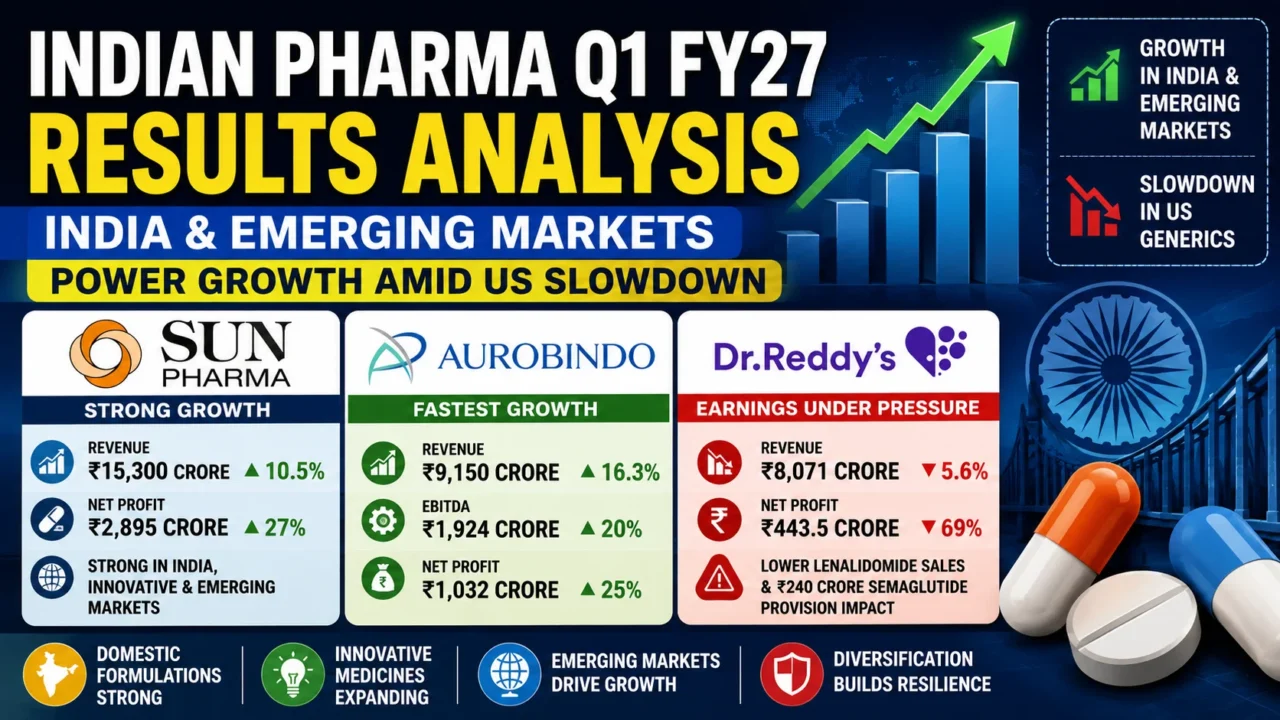
Indian pharma Q1 FY27 results show a growing contribution from domestic branded formulations, innovative medicines and emerging markets. Sun Pharma and Aurobindo Pharma reported strong growth, while Dr. Reddy’s Laboratories saw revenue and profit decline, mainly due to lower lenalidomide sales and a ₹240-crore semaglutide-related provision.
Overview: Indian Pharma Sector in Q1 FY27
The first-quarter results of major Indian pharmaceutical companies show an important shift in the sector’s growth drivers.
While the US generics market continues to face pricing pressure and competitive challenges, domestic branded formulations, innovative medicines and emerging markets are becoming increasingly important for Indian drugmakers.
The Q1 FY27 performance of Sun Pharma, Aurobindo Pharma and Dr. Reddy’s Laboratories highlights this divergence.
Sun Pharma reported strong revenue and profit growth, while Aurobindo Pharma delivered double-digit growth across key financial metrics. Dr. Reddy’s, in contrast, faced a sharp decline in reported earnings because of lower lenalidomide sales and a one-time semaglutide-related provision.

Q1 FY27 Results at a Glance
| Company | Revenue | Revenue Growth | EBITDA | Net Profit | Key Trend |
|---|---|---|---|---|---|
| Sun Pharma | ~₹15,300 crore | 10.5% | — | ₹2,895 crore | Strong India & innovative medicines growth |
| Aurobindo Pharma | ₹9,150 crore* | 16.3%* | ₹1,924 crore* | ₹1,032 crore* | Strong overall growth |
| Dr. Reddy’s | ₹8,071 crore | -5.6% | ₹1,009 crore | ₹443.5 crore | US pressure and semaglutide impact |
*Figures marked with an asterisk are based on the supplied source material and should be cross-checked against Aurobindo Pharma’s final Q1 FY27 release before publication. Aurobindo’s official investor portal provides its financial-results and earnings-release sections.
Sun Pharma Q1 FY27 Results Show Strong Growth
Sun Pharmaceutical Industries remained the largest company among the three in terms of reported quarterly revenue.
Sun Pharma’s Q1 FY27 revenue from operations rose approximately 10.5% year-on-year to ₹15,300 crore, while consolidated net profit increased 27% to ₹2,895 crore.
The company’s investor portal confirms that Q1 FY27 financial reporting is part of its current investor disclosures.
India Business Remains a Major Growth Driver
One of the key factors behind Sun Pharma’s performance was its domestic business.
According to the figures provided in the source analysis, India formulations grew 16% to ₹5,475 crore.
This highlights the growing importance of India’s branded pharmaceutical market in supporting the company’s overall performance.
Innovative Medicines Continue to Expand
Sun Pharma’s Global Innovative Medicines business also recorded strong growth, with sales reported at $351 million, representing growth of 12.8%.
Innovative medicines accounted for approximately 21.9% of total sales according to the source analysis.
The growing contribution of innovative products is strategically important because it can help pharmaceutical companies reduce dependence on traditional generic markets.
Emerging Markets Also Grow
Emerging-market sales increased by approximately 4.2% to $311 million according to the source figures.
This provides another layer of diversification beyond the US market.
US Formulations Remain Under Pressure
The US formulations business declined approximately 9.7% to $427 million according to the source analysis.
This contrast between stronger India and innovative-medicine performance and weaker US formulations illustrates the changing growth mix within the company.
Aurobindo Pharma Delivers Strong Q1 FY27 Growth
Aurobindo Pharma recorded the fastest overall growth among the three companies covered in this analysis, according to the figures provided.
Its total revenue increased 16.3% to ₹9,150 crore, while EBITDA increased 20% to ₹1,924 crore.
Net profit rose 25% to ₹1,032 crore, while EBITDA margin improved by approximately 60 basis points to 21%.
Aurobindo Pharma maintains a dedicated investor section with financial results, earnings releases and presentations.

What Drove Aurobindo Pharma’s Growth?
The company’s Q1 performance reflects the benefit of a diversified pharmaceutical business model spanning:
- Generic medicines
- Specialty products
- International markets
- APIs
- Emerging markets
The strong EBITDA growth also indicates improvement in operating performance during the quarter.
Dr. Reddy’s Q1 FY27 Results Show a Different Picture
Dr. Reddy’s Laboratories reported a significantly weaker quarter compared with Sun Pharma and Aurobindo Pharma.
Revenue declined approximately 5.6% to ₹8,071 crore, while profit attributable to shareholders fell sharply to around ₹443.5 crore.
Lower Lenalidomide Sales Hit US Revenue
One of the biggest factors affecting Dr. Reddy’s performance was the absence of significant lenalidomide sales.
The company’s previous agreement related to lenalidomide ended in January 2026, removing an important contributor to the year-ago comparison.
As a result, North America revenue fell sharply.
Semaglutide Provision Adds Further Pressure
Dr. Reddy’s also recognised a ₹240-crore provision related to semaglutide API inventory and associated costs.
This one-time provision further affected margins and profitability.
The company said the provision was related to the rejected API inventory and associated costs and did not expect a similar provision to recur.
Emerging Markets and India Cushion US Weakness
Despite Dr. Reddy’s weak reported numbers, its underlying geographic diversification remains notable.
According to the figures provided in the analysis:
- Emerging markets: +31%
- India: +17%
- Europe: +13%
This demonstrates why geographic diversification is becoming increasingly important for Indian pharmaceutical companies.
When US generic pricing or competition creates pressure, stronger performance in India and emerging markets can help support the broader business.
Why Is the US Market Under Pressure?
The US remains one of the world’s largest pharmaceutical markets and an important revenue source for Indian drugmakers.
However, generic-drug companies can face challenges such as:
- Intense price competition
- Multiple generic entrants
- Product-specific pricing pressure
- Loss of exclusivity
- Customer consolidation
- Regulatory requirements
- Supply-chain costs
- Volatility in high-value products
Therefore, companies with diversified portfolios and multiple geographic markets may be better positioned to manage individual-market volatility.
Domestic Branded Formulations Become More Important
India’s branded formulation market is becoming an increasingly important growth engine for major pharmaceutical companies.
Domestic demand can provide companies with:
- More diversified revenue
- Stronger brand presence
- Access to a growing healthcare market
- Reduced dependence on US generics
- Opportunities in innovative therapies
Sun Pharma’s strong India formulations growth in Q1 FY27 is an example of this trend.
Innovative Medicines Could Shape Future Pharma Growth
Another important trend is the increasing contribution of innovative medicines.
Traditional generic businesses can be exposed to price competition, while differentiated and innovative products may offer additional growth opportunities.
Sun Pharma’s Global Innovative Medicines business is one example of a strategy focused on expanding higher-value products. Its investor materials continue to track India, US, emerging-market and innovative businesses separately.
Q1 FY27: What the Three Companies Tell Us
The three companies present three different stories:
Sun Pharma
Strong and diversified growth
- Strong overall revenue growth
- Strong India formulations performance
- Growth in innovative medicines
- Emerging-market expansion
- US formulations weakness
Aurobindo Pharma
Fast overall growth
- Double-digit revenue growth
- Strong EBITDA expansion
- Improved operating margin
- Strong profit growth
Dr. Reddy’s Laboratories
Temporary earnings pressure
- Lower revenue
- Sharp profit decline
- Lower lenalidomide contribution
- Semaglutide-related provision
- Stronger underlying growth in several non-US markets
Key Trends in Indian Pharma Q1 FY27
| Trend | Significance |
|---|---|
| Domestic branded formulations | Important growth engine |
| Innovative medicines | Higher-value growth opportunity |
| Emerging markets | Geographic diversification |
| US generics | Continued pricing and competition pressure |
| Product diversification | Helps reduce dependence on individual markets |
| India market | Increasingly important for large pharma companies |
What Does This Mean for the Indian Pharmaceutical Industry?
The Q1 FY27 results suggest that the Indian pharmaceutical sector is becoming increasingly diversified.
The traditional model of relying heavily on US generic exports is being complemented by:
- Indian branded formulations
- Innovative medicines
- Emerging markets
- Specialty products
- New product launches
This does not mean the US market is becoming unimportant. Instead, the results show that companies are increasingly looking for multiple growth engines.
Why Is This Important for Pharmacy Students?
For B.Pharm, D.Pharm and M.Pharm students, quarterly pharma results provide useful insights into the business side of the pharmaceutical industry.
Students can understand how areas such as:
- Formulation development
- Regulatory affairs
- Generic medicines
- Innovative drugs
- Pharmacovigilance
- Quality assurance
- Manufacturing
- Sales and marketing
- International regulatory compliance
contribute to the overall pharmaceutical ecosystem.
These trends can also help pharmacy students understand which areas of the pharma industry may offer career opportunities.
Key Takeaways
- Indian pharma Q1 FY27 results show increasing diversification in growth drivers.
- Sun Pharma reported approximately 10.5% revenue growth and 27% net-profit growth in Q1 FY27.
- Sun Pharma’s India formulations and innovative medicines were important growth contributors.
- Aurobindo Pharma reported strong double-digit growth based on the figures provided in the source analysis.
- Dr. Reddy’s revenue declined approximately 5.6%, while net profit fell nearly 69%.
- Lower lenalidomide sales significantly affected Dr. Reddy’s North America business.
- A ₹240-crore semaglutide-related provision further affected Dr. Reddy’s Q1 profitability.
- India and emerging markets are becoming increasingly important growth engines.
- The US generics market continues to present pricing and competitive challenges.
- Diversification across geographies and product categories is becoming increasingly important for Indian pharma companies.
Frequently Asked Questions
1. What were the key Indian pharma Q1 FY27 results?
Sun Pharma and Aurobindo Pharma reported strong growth, while Dr. Reddy’s Laboratories experienced a decline in revenue and profitability.
2. How did Sun Pharma perform in Q1 FY27?
Sun Pharma reported revenue of approximately ₹15,300 crore, up 10.5% year-on-year, while net profit increased 27% to ₹2,895 crore.
3. Why did Dr. Reddy’s profit decline in Q1 FY27?
The decline was primarily associated with lower lenalidomide sales and a ₹240-crore provision related to semaglutide API inventory and associated costs.
4. What happened to Dr. Reddy’s North America business?
North America revenue declined sharply, with the absence of lenalidomide sales being a major factor in the year-on-year comparison.
5. Why are emerging markets important for Indian pharma companies?
Emerging markets provide geographic diversification and can help reduce dependence on a single market such as the US.
6. Why are domestic formulations important for Indian pharma?
Domestic branded formulations provide Indian companies with a significant revenue stream and reduce dependence on highly competitive international generic markets.
7. What is driving changes in the Indian pharma growth model?
The sector is increasingly being supported by domestic branded medicines, innovative therapies, emerging markets, specialty products and new launches alongside traditional generics.
8. Which Indian pharma company performed strongest among the three?
Based on the figures supplied in the original analysis, Aurobindo Pharma recorded the fastest overall revenue growth, while Sun Pharma remained the largest by revenue among the three.
Conclusion
The Indian pharma Q1 FY27 results highlight a changing growth landscape for India’s major pharmaceutical companies.
Sun Pharma demonstrated the strength of domestic formulations and innovative medicines, while Aurobindo Pharma delivered strong overall growth. Dr. Reddy’s Laboratories faced a difficult quarter because of lower lenalidomide sales and a semaglutide-related provision, although its broader geographic diversification remained a positive factor.
The broader message is clear: India, emerging markets and higher-value medicines are becoming increasingly important growth engines for Indian pharmaceutical companies as US generic-market pressures persist.
For pharma professionals and pharmacy students, these quarterly results provide a valuable view of how market diversification, product strategy and global pharmaceutical trends are shaping the future of the Indian pharma industry.
Recommended Products